

朝菌学园ZhaoDesign
朝菌学园是一家专注前沿、未来、智能设计领域的品牌。包含人机交互设计、服务设计、用户体验设计、互动媒体装置、智能产品设计等学习方向,已经帮助数百名学员取得考研、保研与留学申请的名校录取offer
930篇原创内容
Official Account
,
01 摘要
Abstract
本文为关于运动用可穿戴系统的人机交互作品的文献回顾。我们选择了一个由57篇论文组成的语料库,并通过文献综述的基础理论方法对其进行分析。我们在这些论文中发现了五个主题:不同的研究视角、运动和运动者的类型、可穿戴设备在运动中的作用、它们的可穿戴性以及不同类型的反馈。这些主题可以为我们提供未来研究的机会点:对不同形式因素和反馈类型的调查;对不同运动者和协作任务的考虑;推动运动领域边界的需要;对运动演变的探索;不同设备的相互联系;以及方法论的严谨性的提高。
This paper presents a literature review of human–computer interaction works on wearable systems for sports. Weselected a corpus of 57 papers and analyzed them through thegrounded theory for literature review approach. We identified fivethemes across the papers: the different research perspectives, thetype of sports and sportspeople, the roles of wearables in sports,their wearability, and the different types of feedback. These themeshelped us in delineating opportunities for future research: the investigation of different form factors and types of feedback; the consideration of different sportspeople and collaborative tasks; the needof pushing the boundaries of the sports domain; the explorationof the evolution of sports; the interconnection of different devices;and the increase of methodological rigor.
02 索引词
Index Terms
运动员,健身,运动,系统性文献再观察,可穿戴设备,可穿戴技术
Athletes, fitness, sports, systematic literature review, wearable devices, wearable technologies
03 简介
Abstract
运动为互动技术提供了有趣的机会[1],用于运动的可穿戴设备的市场再运动手表(如Suunto、Garmin、Polar)、运动服装(如Nike)、IT(如Apple)和新兴的可穿戴产品(如Jawbone)制造商和公司的推动下正蓬勃发展着。这类设备的日益普及,一方面是传感器逐渐小型化的结构,以及随之而来的可穿戴性的改善。可穿戴性指的是可以穿在人体上并适应其形状的人工制品的能力[2]。另一方面是由于人们生活和行为上身体传感器网络研究的进步。这使运动员能够在骑马[7]、羽毛球[8]、篮球[9]、划船[10]、游泳[11]等各种运动中持续监测各种参数。
随着体育可穿戴设备被越来越多的用户使用,学术研究已经开始关注这些技术的“人的方面”,了解它们对运动员表现的影响,并开发更有效的互动方式。特别是,人机交互(HCI)界对研究体育领域的穿戴设备表现出越来越大的兴趣[12]:运动员有特 殊的需求,必须深入了解这些需求,以便创造出能够整合到他们的实践中的技术。考虑到越来越多的关于运动可穿戴设备的人机交互研究,我们认为对这个再搜索领域进行文献回顾是及时的,因为回顾对于加强一个研究领域至关重要[13]。在这样做的过程中,我们的目标是绘制已经调查过的主题和迄今为止已经采用的研究方法,重点是交互的人的方面。此外,我们还想开始划定人机交互界未来可以开展的研究方向。
按照人机交互领域的类似工作[14],我们采用了文献回顾的基础理论(GTLR)方法[15],在这个方法中,回顾成为一个搜索、选择和分析研究的严格过程。我们的分析确定了贯穿所选论文的五个相关主题。第一个主题涉及研究视角,它可以由一个特定的技术机会、设计意图或了解可穿戴设备如何被整合到现场实践中的需要所驱动。第二个主题与运动和运动员的类型有关,强调了个人运动的主导地位,以及对“普通”运动员的关注。第三个主题探讨了可穿戴设备在体育中扮演的角色,即促成、改善或增强体育体验,其中每个角色都可能影响这种体验的身体、认知或社会层面。第四个主题是关于可穿戴性,强调目前的研究主要是利用手腕上的技术。最后一个主题是关于给用户的反馈类型:在大多数情况下,实时反馈是给运动员或教练的。对这些主题的分析可能会建议未来的研究方向,通过深化并同时拓宽体育可穿戴设备的研究重点。
我们审查的大多数论文都是从人机交互的角度提出的初步研究,因为涉及的在此领域的用户数量,人机交互的研究是有限的,而且对技术的关注多于对人类需求的关注。鉴于这些前提,我们为这个领域的人机交互研究的发展划定了六个方向。
总之,这篇综述有助于HCI领域的可穿戴运动设备的研究,从第一次出现到 2018 年,并根据所发现的差距确定未来可能的研究方向。本文件安排如下:第二节概述了所用的方法。第三节介绍了分析期间确定的主题,第四节讨论了研究结果,并提出了今后要开展的研究方向。
SPORTS provides interesting opportunities for interactivetechnologies [1]. The market of wearable devices for sportsis currently booming, driven by sport watches (e.g., Suunto,Garmin, Polar), sports apparel (e.g., Nike), IT (e.g., Apple), andemergent wearable products (e.g., Jawbone) manufacturers andcompanies. The increasing diffusion of these kinds of devices,on the one hand, is the result of the progressive miniaturizationof sensors and the consequent improvement of their wearability,a term that refers to the ability of an artifact to be worn on thehuman body and to adapt to its shape [2]. On the other hand, itis due to the advancements in research on body sensor networks[3] and human activity recognition using wearable sensors [4]–[6], which allowed for the collection of accurate information on people’s activities and behaviors. This enabled athletes tocontinuously monitor a variety of parameters in sports as diverseas horse riding [7], badminton [8], basketball [9], rowing [10],and swimming [11].
As wearables for sports are being used by a growing user base,academic research has started focusing on the “human aspects”of such technologies, in order to understand their impacts onathletes’ performances and develop more effective ways of interaction. In particular, the human–computer interaction (HCI)community has showed an increasing interest in studying wearables in the sports domain [12]: athletes have idiosyncratic needsthat have to be understood in depth in order to create technologiescapable of being integrated into their situated practices. Considering the increasing number of HCI studies on wearables forsports, we deem timely to conduct a literature review of this research domain, as reviews are critical to strengthening a field ofstudy [13]. In doing so, we aim to map the topics that have beeninvestigated and the research methods that have been adoptedso far, focusing on the human side of interaction. Moreover, wewant to start delineating what future strands of research couldbe undertaken by the HCI community.
Following similar works in the HCI field [14], we adoptedthe grounded theory for literature review (GTLR) method [15],in which reviewing becomes a rigorous process of searching,selecting, and analyzing studies. Our analysis identifies five relevant themes across the selected papers. The first theme concerns the research perspective, which can be driven by a specifictechnological opportunity, by a design intent, or by the need tounderstand how a wearable device can be integrated into situated practices. The second theme relates to the type of sportsand sportspeople, highlighting the predominance of individualsports, as well as the focus on a “generic” kind of athlete. Thethird theme explores the roles that wearables play in sport, thatis enabling, improving, or augmenting the sports experience,whereby each role may affect either the physical, cognitive, orsocial dimension of such experience. The fourth theme addresseswearability, highlighting that current research mostly leverageswrist-worn technologies. The last theme concerns the type offeedback given to the user: in the majority of cases, a real-timefeedback is given to athletes or coaches. The analysis of thesethemes may suggest future directions for research, by deepeningand at the same time widening the research focus on wearablesfor sports: most of the papers we reviewed present preliminarystudies from a HCI perspective, as the number of users involved is limited, and attention is paid more to technology than to human needs. Given these premises, we delineated six directionsfor evolving HCI research in this area.
In sum, this review contributes to the HCI field by surfacinga tentative map of HCI studies on wearables for sports, fromtheir first appearance to 2018, and by identifying possible futuredirections of research based on the gaps identified. This paper isorganized as follows: Section II outlines the methodology used.Section III presents the themes identified during the analysis,while Section IV discusses the findings and proposes lines ofresearch to be developed in the future.
04 方法论
Methodology
为了分析关于运动可穿戴设备的人机交互文献,我们采用了“基础理论文献回顾”方法[15]。这种方法植根于基础理论[16],这是一种在社会科学中发展起来的方法,旨在通过数据收集和分析的归纳过程来建立理论。基础理论与其他方法的不同之处在于它是一种诱导性的,而不是一种假设性的演绎性的立场。基于基础理论的分析包括三个反复的主要阶段。1)收集和编码数据;2)发展、检查和整合理论类别;3)分析和比较概念,归纳构建理论[17]。因此,基于理论的文献综述将被分析的文章内容作为经验材料进行分析,可以通过综述来构建理论。作为原始的基础理论方法,这种回顾方法基于不同的分析阶段,以归纳和迭代的方式进行[15]:1)定义:选择包括/排除论文的标准,确定研究领域,确定适当的来源,并决定具体的搜索词;2)搜索:在确定的来源中收集符合标准的论文;3)选择:通过手动检查论文来完善样本。4)分析:采用开放式、轴向和选择性编码技术;以及5)展示:结构化、展示和讨论分析的内容。
In order to analyze the HCI literature on wearables for sports,we employed the Grounded Theory Literature Review [15]. Thismethod is rooted in grounded theory [16], an approach developed in social sciences that aims to build theories through aninductive process of data gathering and analysis. What distinguishes grounded theory from other approaches is an inductive, rather than a hypothetical-deductive stance. An analysisbased on grounded theory involves three iterative main stages:1) collecting and coding data; 2) developing, checking, and integrating theoretical categories; and 3) analyzing and comparingconcepts to inductively construct a theory [17]. Accordingly,grounded theory literature review uses the content of the articles under analysis as empirical material to be analyzed in orderto build theory through review. As the original grounded theory approach, this review method is based on different stages ofanalysis to be applied inductively and iteratively [15]: 1) Define:choosing the criteria for including/excluding the papers, identifying the fields of research, determining the appropriate sources,and deciding the specific search terms; 2) Search: collecting thepapers that fit in the criteria across the identified sources; 3)Select: refining the sample by manually checking the papers;4) Analyze: adopting open, axial, and selective coding techniques; and 5) Present: structuring, presenting, and discussingthe content of the analysis.
通过确定的来源进行搜索
Search Through the Identified Sources
我们确定了本综述的重点,将其限制在对运动用可穿戴设备的人机交互重新搜索上。这样一来,我们排除了那些专门关注人类活动识别问题的研究,以及那些调查用于监测健康的可穿戴设备。一方面,人类活动识别的工作通常集中在所提出的算法上,而不是人与人之间的互动,而且他们提供的数据可视化并不是有意的,主要是为了满足终端用户(如运动员、教练员)的需求而设计的。相反,我们的重点是研究有目的地针对这些终端用户的预发界面。另一方面,用于监测健康的可穿戴设备与用于运动的可穿戴设备所处理的问题和目标是不同的:前者涉及病人对治疗的依从性或从伤害中的恢复等问题,后者则是为了在锻炼和比赛中提供支持,或提高运动员的表现。虽然在健康领域也有应用,但在体育领域的应用并不多。在与体育密切相关的领域,如身体康复和健康行为改变, 我们倾向于在这个阶段将重点放在一个较窄的领域。这将导致更明确的目标和更好地限定分析所产生的主题。此外,我们排除了可穿戴设备以外的任何体育技术,例如,涉及环境智能或有形互动的解决方案。
本评论中的论文是在2018年6月收集的。我们选择Scopus和计算机协会数字图书馆(ACM DL)作为来源,因为它们是人机交互会议论文集和期刊 论文的主要储存库。我们在这两个资料库中使用以下术语和连接器进行查询。[("sport "或 "fit- ness "或 "workout "或"training"或"athlete")和("we∗ar")]。至于Scopus,我们将搜索范围限制在属于以下研究领域的文章:工程、计算机科学、社会科学、心理学、多学科和未定义。此外,我们将搜索范围限制在只用英语撰写的文章、出版中的文章和会议论文。至于ACMDL,我们没有应用任何限制,因为它已经专注于计算机科学出版物。这些查询检索到了3519个条目:Scopus中28 25个,ACMDL中694个。我们将结果导出到一个表格中,重新排列了带有出版物细节的栏目,以使其统一,并删除了重复的内容。最终,我们最初的暂定语料库有3186篇论文。
We defined the focus of this review by limiting it to HCI research on wearable devices for sports. In doing so, we excludedthose studies exclusively focusing on human activity recognition issues, as well as those investigating wearables for monitoring health. On the one hand, human activity recognition workstypically focus on the algorithms proposed, rather than on thehuman aspects of interaction, and the data visualizations theyoffer are not intentionally and primarily designed for being interacted by end users (e.g., athletes, coaches) in order to satisfytheir situated needs. Conversely, our focus was on studies presenting interfaces purposefully addressed to such end-users. Onthe other hand, wearables for monitoring health deal with different issues and goals with reference to wearables for sports:while the former concern topics like the patient’s adherence to atreatment or her recovery from an injury, the latter are addressedto give support during workouts and races, or to increase the athlete’s performance. Although there are applications in the health omain that are tightly related to the sports context, such as physical rehabilitation and health behavior change, we preferred tofocus on a narrower area at this stage. This would lead to clearerobjectives and better circumscribed themes resulting from theanalysis. Moreover, we excluded any sports technology beyondwearable devices, e.g., solutions involving ambient intelligenceor tangible interaction.
The papers in this review were collected in June 2018. Wechose Scopus and the Association for Computing MachineryDigital Library (ACM DL) as sources as they are the mainrepositories for HCI conference proceedings and journal articles. We conducted a search in both repositories by using thefollowing terms and connectors for the query: [(“sport” or “fitness” or “workout” or “training” or “athlete”) and (“wear∗”)].As for Scopus, we limited our search to the articles belongingto the following research fields: engineering, computer science,social sciences, psychology, multidisciplinary, and undefined.Furthermore, we limited our search to articles, articles in press,and conference papers, written in English only. As for ACMDL, we did not apply any restriction because it already focuseson computer science publications. These queries retrieved 3519entries: 2825 in Scopus and 694 in ACM DL. We exported theresults in a table, rearranged the columns with the publicationsdetails in order to make them uniform, and deleted the duplicates. Eventually, our initial tentative corpus had 3186 papers.
选择标准
Selection Criteria
该语料库通过检查每篇论文是否符合以下标准而得到完善。
1)论文必须涉及一项运动,从严格意义上讲,就是为了自身利益而进行的有意和具体的体育活动。用于健身的可穿戴设备也包括在这个定义中。然而,我们排除了所有那些具体旨在促进健康目标(如减肥)的可穿戴设备,以及那些明确为在执行其他任务时进行的体育活动而设计的设备,如在上班或购物时测量步数的计步器。
2)这些论文必须展示一个互动的人工制品,也就是说一个提供界面的设备。其目的是为了与体育领域的终端用户(如运动员、教练员和观众)进行互动。根据这一标准,我们排除了所有与人类活动识别有关的作品,因为这一研究领域的重点是设备的感应能力,而不是它们的“人的方面”;即使这些作品可以提供数据的可视化,但它们不是专门为体育领域的终端用户设计。
3)这些论文必须提出一项与终端用户有关的研究。这一标准是为了确保审查与人机交互领域有关。
语料库被分为四个部分,每个部分由本文的一位作者负责。每位作者通过阅读标题、关键词和摘要来评估她/他所分配的论文,从而舍弃那些不符合上述标准的论文。第一 次选择产生了一个112篇论文的语料库。从3186篇到112篇论文的大幅减少是由于大多数论文研究了活动识别技术而不是交互式人工制品。在这次选择之后,我们仔细阅读了剩下的论文并进行了讨论。这种彻底的阅读识别了那些不完全满足三个选择标准的论文,因此这些论文被丢弃了。此外,当语料库中出现多篇由同一作者撰写的关于同一项目的论文时,我们选择最完整的一篇进行分析,而舍弃其他的。最终,我们的语料库包含了57篇论文。然而,在被丢弃的论文中,有四篇被保留在一个单独的文件夹中,因为他们被认为是对理解此主题是有所帮助的[18]-[21]。这些论文至少符合两个选择标准。
The corpus has been refined by checking the appropriatenessof each paper to the following criteria.
- The papers had to address a sport, in the strict sense of anintentional and specific physical activity conducted for itsown sake. Wearables for fitness were included in this definition. However, we excluded all those wearables specifically aimed at promoting health goals (e.g., losing weight),as well as those explicitly designed for physical activitythat could be conducted while performing other tasks, e.g.,pedometers measuring the steps taken while going to workor shopping.
- The papers had to present an interactive artifact, that is,a device providing an interface purposefully designed forbeing interacted with end users in the sports domain (e.g.,athletes, coaches, and audience). With this criterion, weexcluded all the works pertaining to human activity recognition, as this research field focuses on the devices’ sensing capabilities, rather than on their “human aspects”; eventhough such works may provide data visualizations, theseare not specifically designed for end users in the sportsdomain.
- The papers had to present a study with end users. Thiscriterion was included to ensure that the review pertainedto the field of HCI.
The corpus was divided into four parts, and each part was assigned to one of the authors of this paper. Each author evaluatedher/his assigned papers by reading the title, the keywords, and theabstract, thus discarding those not corresponding to the abovecriteria. This first selection produced a corpus of 112 papers. The great diminution from 3186 to 112 papers was due to thefact that the majority of them investigated activity recognitiontechniques rather than interactive artifacts. After this selection,the remaining papers have been carefully read by all the authorsand discussed. This thorough reading allowed for the identification of those papers that did not fully satisfy the three selectioncriteria, which were thus discarded. Moreover, whenever thecorpus presented more than one paper by the same authors andon the same project, we selected the most complete one for ouranalysis while discarding the others. Eventually, our corpus includes 57 papers. However, among the discarded papers, fourwere retained in a separate folder because they were consideredinspirational and useful for understanding the topic [18]–[21].These comply with at least two selection criteria.
分析和介绍
Analyze and Present
分析是以归纳为导向的:一旦确定了语料库,作者们就 阅读论文以确定反复出现的主题。作为第一步,开放性编 码,每位作者都为每篇论文单独指定一个或多个概念标签。至于第二步,轴向编码,概念被归类为连贯的概念类别。同样,这也是由单人单独进行的。然后,我们一起讨论所定义的类别,并对其进行协调。最后,在一个连贯的解释方案中,这些概念类别被一一连接起来。分析中出现了五个主要的主题:研究视角和方法论方法、运动和 运动员的类型、可穿戴设备在运动中的作用、可穿戴性和反馈的类型。
The analysis was inductively oriented: once the corpus wasdefined, the authors read the papers to identify recurrent themes.As a first step, the open coding, each author separately assignedone or more conceptual labels to each paper. As for the secondstep, the axial coding, the concepts were grouped into coherent conceptual categories. Again, this was made by each author separately. Then, the authors discussed together the definedcategories and reconciled them. Finally, the conceptual categories were connected one to the other in a coherent explanatoryscheme. Five main themes emerged from the analysis: researchperspectives and methodological approaches, types of sports andsportspeople, roles of wearable devices in sports, wearability,and type of feedback.
05 研究结果
Findings
研究视角和方法论途径
Research Perspectives and Methodological Approaches
在我们的语料库中,我们认识到了三种不同的研究视角:技术驱动、设计驱动和接受度研究视角。技术驱动的观点包括在特定的体育背景下介绍和讨论新设备(通常是原型)。采用这种观点的论文集中在一个特定的技术解决方案的潜力上:设计理念通常是以要求的方式提出的,其发展的动机通常来自文献。这些研究提出了用户围绕着可用性方面的评价,尽管只是初步的。我们确定了31篇属于这种观点的论文[22]-[52]。
设计驱动的观点包括十篇论文[53]-[62]。这种观点侧重于设计方面,并且经常采用一种建构主义的立场,让潜在的用户参与到验证所提出的设计理念中来。两篇论文使用了通过设计进行研究的方法[56], [60],而一篇论文使用了设计研讨会活动[59]。一篇论文 使用了与潜在用户的访谈[54],一篇采用了观察和半结构化访谈[55],还有一篇采用了对可穿戴设备在线评论的内容分析[57]。还有一些论文通过调查问卷或在线调查让用户参与其中[53],[58],[61]。其中一些论文让用户参与进来,以获得在设计过程中使用的见解,并对设计的原型进行评估[53], [56], [58],[59], [61], [62]。
接受研究的角度包括16篇论文。这个观点需要进行(相对)大型的用户研究,调查特定可穿戴设备的可接受性和采用情况[63]-[78]。有七篇论文使用了深入的相互交流[64]、[66]、[68]、[71]、[72]、[75]、[78],有四篇使用了在线交流的方式。调查[63]、[67]、[73]、[77],还有一篇使用问卷调查[76]。两篇论文采用了多种方法的组合:在线调查和访谈[69],或者日志和在线调查[65]。有一篇论文采用了对Ama- zon.com上客户评论的情感分析[70]。有一篇文章也采用了自动民族志的方法,作为准备进行背景分析的试验性方法[74]。在所有的案例中,这些研究都集中在商业产品上。
一个值得深化的相关方面涉及到了在这三个角度所采用的研究方法。这些研究可以分为用户需求征询研究和评估研究,前者是为了发现开发原型的需求或定义创造新设备的机会,后者是为了评估新的或商业的解决方案。表一概述了这些研究是如何分布在这三个角度的(有些作品提出了一个以上的研究,因此属于多个类别)。
对于用户需求的激发,大多采用了问卷调查、访谈和观察(包括基于个人的和在线的)。一些使用问卷调查的研究重新收集了大量的参与者,例如Gradl等人[67],他们涉及227名运动员;Stewart等人[53],他们从轮滑运动员那 里收集了323个答案;以及Havlucu等人[69],他们招募了1 567名土耳其网球联合会的成员。然而,其中大多数涉及到更有限的样本,例如Aggravi等人[22],涉及一名滑雪教练和七名盲人滑雪者;或者Zhao等人[23],招募了五名参与者。为确定用户需求而进行的访谈通常涉及少量的用户(少于20人)。例如,Carrington等人[64]采访了五名轮椅运动员和三名治疗师,而Pan等人[54]采访了七名举重运动员。相反,调查商业设备的使用情况的访谈涉及更多的参与者(20人或更多)。Rapp和Tirabeni[75]采访了20名精 英和业余运动员,以了解可穿戴设备如何融入他们的体育活动;Fritz等人[66]招募了30名商业活动追踪器的用户, 以收集关于如何对可穿戴设备进行长期使用的见解;Gui 等人[68]采访了 31 位 We Run 用户,调查了先前存在的社交网络对分享习惯的影响。[71]采访了 29 人关于他们做运动的动机。相反,观察和情境访谈的使用程度要低得多。Mencarini等[55]观察了6次室内攀岩课,采访了17名受训者和登山向导,而Patel和O'Kane[74]观察11名参与者在健身房锻炼。
至于评估,所采用的方法可以分为实验性的实验室研究和实地研究,两者都使用各种技术来收集措施和洞察力实验性实验室研究是在“受控环境”下进行的,通常选择定量检测技术或混合方法。例如,B ogers等人[56]采用半结构化访谈、问卷调查和日志数据分析来评估球衣,以测量占有率,并使用光条给予反馈。值得注意的是,这些实验很少采用纵向设计、控制组或前/后测试的干预措施。不过,也有一些例外。例如,Bice 等人[63]设计了一个为期8周的前/后测试干预实验,以评估可穿戴设备对身体活动动机的影响;Strohrmann等人[44]采用了一个控制组,以评估连接到智能手机应用程序的I MU如何改善跑步技术;Zhao等人[45]设计了一个控制组,以评估可穿戴设备对身体活动的影响。[24]使用了一个主体间设计,有36名参与者提供了前/后调查问卷。
相反,实地研究旨在评估"野外"的可穿戴设备,让用户在日常运动和健身实践中自由使用它们。例如,Fedosov等人[25]监测了一个为期一周的冬季研讨会的参与者,以研究一个用于分享滑雪场地图内容的可穿戴增强现实(AR)系统的感知的有用性和可用性。Mau-riello等人[26]使用观察、访谈和问卷调查来评估一个旨在支持集体跑步的可穿戴电子织物显示器。剩余的一些作品专门使用调查问卷或半结构化的访谈来询问用户的意见。例如,Kreitzberg等人[72]采访了25位参与者,探讨人们如何以及与谁交流健身追踪器的信息。Kräuter等人[27]采用问卷调查的方式来评估用户对可穿戴自行车原型的感受。
We recognized three different research perspectives in ourcorpus: the technology-driven, the design-driven, and the acceptance study perspective. The technology-driven perspectiveconsists in the presentation and discussion of novel devices (usually prototypes) in a specific sports context. Papers adopting thisperspective focus on the potentialities of a specific technologicalsolution: the design idea is often presented in terms of requirements and the motivation for its development is commonly takenfrom the literature. These studies present user evaluations, albeitonly preliminary, revolving around usability aspects. We identified 31 papers belonging to this perspective [22]–[52].
The design-driven perspective includes ten papers [53]–[62].This perspective focuses on design aspects and often employs aconstructivist stance, involving potential users in validating theproposed design idea. Two papers use a research-through-designapproach [56], [60], while one employs design workshop activities [59]. One paper uses interviews with potential users [54],one adopts observation and semistructured interviews [55], andone employs content analysis of online reviews of wearable devices [57]. Others engage users through questionnaires or onlinesurveys [53], [58], [61]. Some of these papers involve users forboth gaining insights to be used in the design process, and assessing the designed prototype [53], [56], [58], [59], [61], [62].
The acceptance study perspective includes 16 papers. Thisperspective entails the conduction of (relatively) large user studies, investigating the acceptability and the adoption of specificwearable devices [63]–[78]. Seven works use in-depth interviews [64], [66], [68], [71], [72], [75], [78], four use onlinesurveys [63], [67], [73], [77], and one uses questionnaires [76].Two papers adopt a combination of methods: online surveysand interviews [69], or logs and online survey [65]. One paperemploys sentiment analysis of customers’ comments on Amazon.com [70]. Auto-ethnography is also employed by one work,as a pilot approach to prepare for a contextual analysis [74]. Inall the cases, the studies are focused on commercial products.
A relevant aspect that is worth to be deepened relates to theresearch methods employed across the three perspectives. Thesecan be divided into user needs elicitation studies, addressed todiscover requirements to develop prototypes or define opportunities for creating novel devices, and evaluation studies, aimedat assessing novel or commercial solutions. Table I outlines howthe studies are distributed among the three perspectives (someworks present more than one study thus belonging to multiplecategories).
As for the user needs elicitation, questionnaires (both paper and online based), interviews, and observation have beenmostly employed. Some of the studies using questionnaires recruited a large number of participants, such as Gradl et al. [67],who involved 227 athletes, Stewart et al. [53], who collected323 answers from roller derby skaters, and Havlucu et al. [69],who enrolled 1567 members of the Turkish Tennis Federation.However, the majority of them involved more limited samples,such as Aggravi et al. [22], who involved one skiing instructorand seven blind skiers, or Zhao et al. [23] who recruited fiveparticipants. Interviews conducted to identify user requirementscommonly involved a small number of users (less than 20): Forexample, Carrington et al. [64] interviewed five wheelchair athletes and three therapists, while Pan et al. [54] interviewed sevenweightlifters. Conversely, interviews investigating the situateduse of commercial devices involved a higher number of participants (20 or more): Rapp and Tirabeni [75] interviewed 20elite and amateur athletes to discover how wearables integrateinto their sports activities; Fritz et al. [66] recruited 30 users ofcommercial activity trackers to gather insights on how to design wearables that can be used over long terms; Gui et al. [68]interviewed 31 WeRun users to investigate the influence of preexisting social network in sharing habits; and Jaharrai et al. [71]interviewed 29 people about their motivation to do sports. Observation and contextual interviews, instead, are used to a muchlesser extent. Mencarini et al. [55] observed 6 indoor climbing lessons and interviewed 17 trainees and mountain guides,whereas Patel and O’Kane [74] observed 11 participants whileexercising at the gym.
As for the evaluation, the methods employed can be dividedinto experimental lab studies and field studies, both using a variety of techniques to gather measures and insights.
Experimental lab studies were conducted in “controlled situations” often opting for quantitative inspection techniques ormixed methods. Bogers et al. [56], for instance, employedsemistructured interviews, questionnaires, and log data analysis to evaluate jerseys measuring ball possession and givingfeedback using light stripes. It is worth noticing that experiments rarely employed longitudinal designs, control groups orpre/post-test interventions. There are, though, some exceptions:For example, Bice et al. [63] designed an 8-week, pre-/post-testintervention experiment to assess the effects of wearables onphysical activity motivation; Strohrmann et al. [44] employeda control group to evaluate how an IMU connected to a smartphone application may improve running technique; Zhao et al.[24] used a between-subject design with 36 participants providing pre/postquestionnaires.
Field studies, instead, were aimed at assessing wearables “inthe wild” leaving users free to use them during their everydaysports and fitness practices. Fedosov et al. [25], for instance,monitored participants in a weeklong winter seminar to studythe perceived usefulness and usability of a wearable augmentedreality (AR) system for sharing content on ski resort maps. Mauriello et al. [26] used observation, interviews, and questionnairesto evaluate a wearable e-textile display aimed at supportinggroup running. A residual number of works exclusively askedfor users’ opinions using either questionnaires or semistructuredinterviews. Kreitzberg et al. [72], for instance, interviewed 25participants to explore how and with whom people communicatefitness tracker messages. Kräuter et al. [27] employed a questionnaire to assess users’ feelings toward a wearable prototypefor cycling.
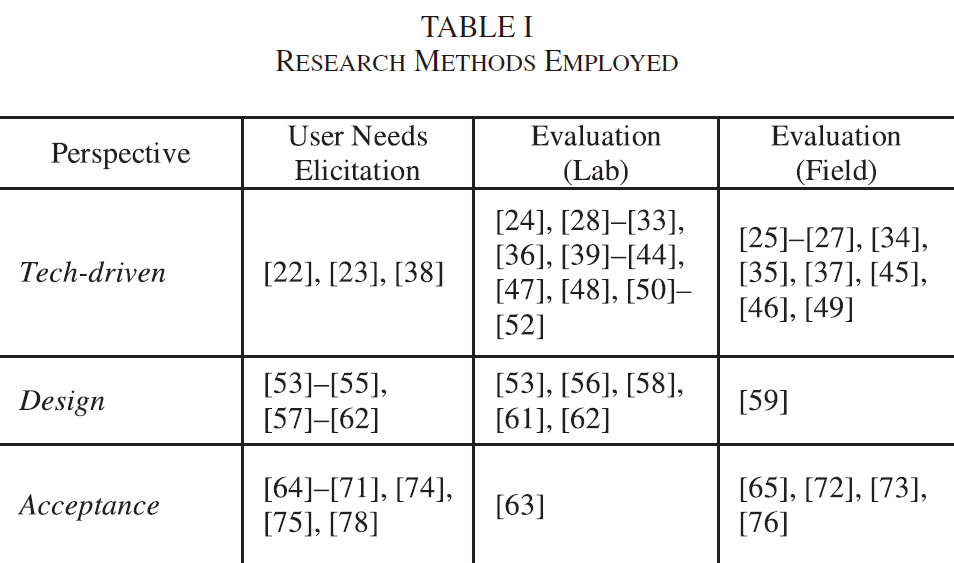
表1:采用的研究方法
运动和运动员的类型
Types of Sports and Sportspeople
在我们的语料库中,所涉及的运动和运动员的类型有很大的不同,尽管存在着规律性。有九篇论文没有关注某项具体的运动,而是以一种非常普遍的方式考虑体育[24]、[ 28]、[29]、[57]、[67]、[73]、[75]-[77]。七篇论文提到了健身[23]、[63]、[66]、[70]-[72]、[74]。有六篇论文指出了广泛的运动类别,如下肢运动[30]、耐力运动[78]、战略运动[31]、野外运动[32]、奥林匹克运动[58]或轮椅运动[64]。其余的涉及各种不同的运动:8篇是关于滑雪/滑雪板的,7篇是关于跑步的,还有4 篇论文侧重于攀岩。自行车、网球、游泳和武术等运动只分别在两篇论文中进行了调查。最后,其他涉及的运动( 每项都只在一篇论文中提到)有跳水、轮滑、划船、羽毛球和举重。我们的语料库中只有三种团队运动:篮球[56]、足球[33] 和冰球[59]。没有论文考虑到汽车或摩托车比赛等汽车运动。语料库中涉及的体育项目概况见图1。
就目标用户而言,大多数论文(57篇中的27篇)关注的是普通的运动者(例如,没有具体说明他们的专业水平, 如初学者或精英,或提及普通从业者)。有两篇论文涉及残疾运动员,但没有具体说明他们的专业水平[22],[34]。五篇论文考虑了精英运动员[35]、[36]、[59]、[60]、[69]和两篇受损精英运动员[37]、[64]。三篇论文同时考虑了 精英和业余运动员[38]、[75]、[78],还有三篇论文只考虑了业余运动员[39]-[41]。11篇论文对初学者进行了研究,如[42]-[44]、[55]、[61]。值得注意的是,在涉及初学者的论文中,有三篇是关于攀岩的(在总共四篇涉及攀岩的论文中)。这可能是由于一些运动(如攀岩)需要比其他运动(如跑步)更高的技术专长才能进行,因此需要研究能够支持新手运动员的技术。有四篇论文没有直接调查运动员,而是调查体育赛事的目标受众[29]、[33]、[58]、[65]。
其他体育行为人,如教练、队友、裁判、治疗师和社会网络受众,也在我们的语料库中被提及(57篇论文中的19篇),突出了体育的社会维度。卫生专业人员出现了两次[6 4],[59]。教练在八篇论文中被考虑[22]、[32]、[34]、[36]、[45]、[46]、[55]、[60],运动伙伴和队友被调查了五次[25]-[27]、[31]、[56],而裁判只在[35]被提及。最后,社会网络受众在三个作品中被考虑[68],[72],[77]。
The types of sports and sportspeople addressed in our corpusvary considerably, even though regularities are present. Ninepapers do not focus on a specific sport but rather consider sportsin a very generic way [24], [28], [29], [57], [67], [73], [75]–[77].Seven papers refer to fitness [23], [63], [66], [70]–[72], [74]. Sixpapers point to broad categories of sports such as lower limbsports [30], endurance sports [78], strategic sports [31], fieldsports [32], Olympic sports [58], or wheelchair sports [64]. Theremaining ones address a wide range of different sports: eight areon skiing/snowboarding, seven are on running, and four papersfocus on climbing. Sports such as cycling, tennis, swimming,and martial arts are only investigated in two papers each. Finally,other sports addressed (each one mentioned in one paper only)are diving, roller derby, rowing, badminton, and weightlifting.Only three team sports are present in our corpus: basketball [56],football [33], and hockey [59]. No paper considers motor sportssuch as car or motorcycle racing. See Fig. 1 for an overview ofthe sports addressed in the corpus.
For what concerns the targeted users, most papers (27 outof 57) focus on generic sportspeople (e.g., without specifyingtheir level of expertise, such as beginner or elite, or referringto a generic practitioner). Two papers address disabled sportspeople, without specifying their level of expertise [22], [34].Five papers consider elite athletes [35], [36], [59], [60], [69]and two impaired elite athletes [37], [64]. Three papers consider both elite and amateur sportspeople [38], [75], [78], andthree amateur sportspeople only [39]–[41]. Beginners are investigated in 11 papers, e.g., [42]–[44], [55], [61]. It is worthnoticing that among the papers addressing beginners, three arefocused on climbing (out of a total of four papers addressingclimbing). Probably, this is due to the fact that some sports (e.g.,climbing) need a higher technical expertise to be practiced thanother sports (e.g., running), thus requiring research on technology capable of supporting novice athletes. Four papers do notinvestigate sportspeople directly, but target audience of sportsevents [29], [33], [58], [65].
Other sports actors, such as coaches, teammates, judges, therapists, and social network audience, are also mentioned in ourcorpus (19 papers out of 57), highlighting the social dimensionof sports. Health professionals occur twice [64], [59]. Coachesare considered in eight papers [22], [32], [34], [36], [45], [46],[55], [60], sports partners, and teammates are investigated fivetimes [25]–[27], [31], [56], whereas judges are mentioned onlyin [35]. Finally, social network audience is considered in threeworks [68], [72], [77].
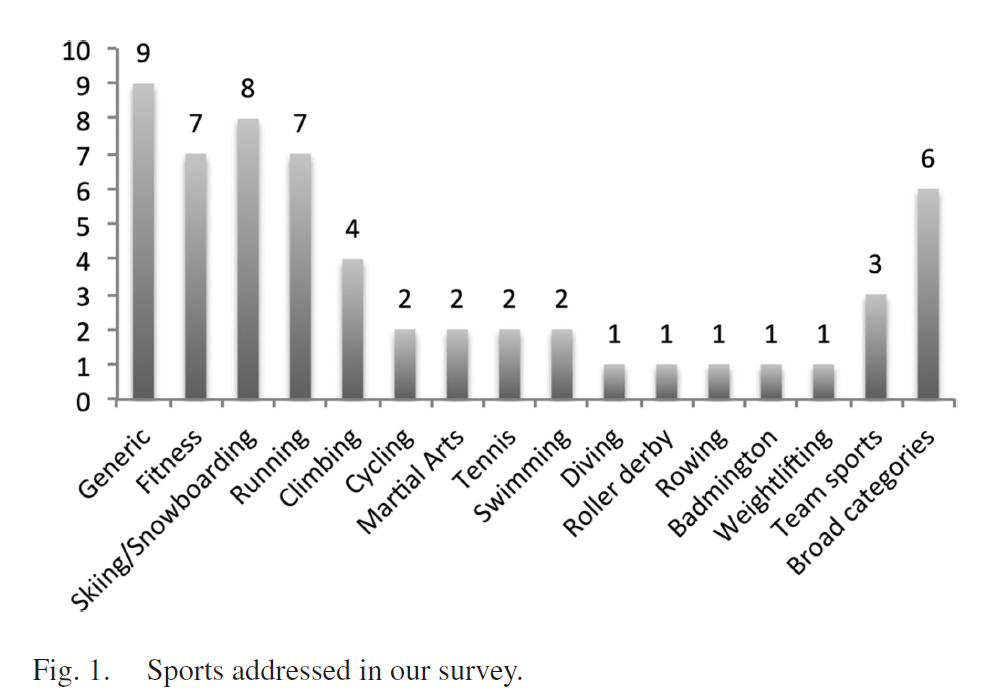
图1:我们调查中涉及到的体育项目
可穿戴设备在体育中的作用
Role of Wearable Devices in Sports
我们确定了可穿戴设备在体育实践中可能发挥的三种非排他性作用,即启用、改进和增强一个或多个与体育有关的方面。使能是指可穿戴设备允许用户做一些没有技术就不可能做的事情;改进是指可穿戴设备旨在支持用户以更好的方式做一些事情;增强是指以不同于没有技术时的方式做一些事情。
为了分析技术给予的支持种类,我们区分了体育实践的三个方面,即身体、认知-情感和社会方面。
1)体能:它涉及到具体运动技术的表现和运动技能;前者通常是有经验的运动员所关心的问题,而后者则主要涉及到初学者。在体育运动中,一个好的技术意味着如何很好地完成一项技能,而技能是一种实现预定结果的能力,具有最大的确定性,而且往往以最小的时间、精力或两者的支出来实现[70],例如在攀登中正确使用脚。
2)认知-情感:它包括情绪、流量、心理控制和其他心理因素,如动机,即促进做某事或实现某事的愿望或意愿。动机在体育中很重要。它可以被定义为一个人努力的方向(即运动员被吸引的情况、实践等)和强度(即他有多努力),其中时间维度是相关的,即这种努力的持续或持久程度[79]。
3)社会性:它包括了社会关系和包容性的广泛维度;它指的是允许人们为了快乐而相互见面的活动。它还涉及人际和组织交流,包括语言和非语言交流[80]。
正如表二所总结的那样,我们的语料库中出现的主要作用是改善一个特定的体育方面(30篇),而少数论文的目的是促成(15篇)或增加(9篇)一项体育。值得注意的是,一些论文可以被归入多个类别,因为它们涉及到体育的多个方面:然而,为了清楚起见,我们只考虑主要的作用,即论文中讨论得比较多的作用。有三篇论文没有参照可穿戴设备的作用进行分类[57]、[70]、[76]。此外,我们无法找出任何技术是为了实现认知-情感方面的例子。
至于扶持作用,有15篇论文要么支持初学者获得运动技能,要么允许有缺陷的人练习一项运动。Franke和Lukowi cz[61]为划船运动员提供了一个系统,可以在不需要教练直接监督的情况下训练和监测他们的技术。Feeken等人[43]设计了一个可穿戴系统,以促进初级攀登者的技术技能发展。Chen等人[42]开发了一个虚拟教练,帮助马拉松初学者根据他们的心率来调整他们的速度,以便他们的身体能够及时做出反应,保持所需的训练强度。有三篇论文专注于实现社会体验[58]、[65]、[33]。他们介绍了使远程受众的热情可见的工具,以使公众在体育赛事期间参与其中。
在我们的语料库中,改善是最常讨论的,出现在30篇论文中。总共有14篇论文关注于改善体育的物理方面。例如,Ladha等人[39]提出了一个可以复制专家评估的性能分析系统,从而代表了向攀岩的自动教练系统迈出的 第一步。Hassan等人[47]、Seuter等人[28]和Strohrmann等人[44]提出了基于不同类型反馈的系统,以提高跑步训练的表现。Chi等人[35]旨在改善裁判的表现评估,帮助评估武术中的搏击比赛。Rapp和Tirabeni[75]探讨了可穿戴设备如何影响运动员的表现,发现它们的效果可能会因运动员的经验水平而改变。共有11篇论文关注体育认知情感方面的改善。例如,Kidman等人[36]旨在改善运动员对短期和长期疲劳的自我认识,以便有意识地控制任务的执行。Ja rrahi等人[71]研究了可穿戴设备对激励人们进行体育锻炼的影响。Havlucu等人[60],[69]强调了流动在网球运动员的运动表现中的重要性,并提出了有助于保持流动的概念。五篇论文关注与社会体验有关的方面。例如,Kraeuter等人[27]提出了一个使用手势识别和一系列缝在自行车手衬衫背面的发光二极管(L ED)的系统,以帮助他们在道路上进行交流,从而改善人际沟通。Gui等人[68]和Stragier等人[77]研究了分享体育活动信息对社交网络的影响。
增强作用是我们的语料库中讨论较少的作用。这一组包 括九篇在体育活动中引入互动元素的作品,以便改变体育 本身的性质(例如其规则和目标)。有三篇论文专注于增强社会体验。Tomitsch等人[29]使用无线可穿戴运动传感器来增强观众的现场参与,改变他们的干预机会。Weilenmann等人[46]和Kono等人[31]提出了可穿戴系统, 用于增强集体运动者的社会体验。只有Niforatos等人[50] 讨论了运动的物理方面的增强,他们开发了一个增强滑雪者周边视野的系统,使他们能够感知到是否有人正在接近 他们的背部。有五篇论文介绍了旨在增强认知-
情感方面的设备。例如,Colley等人[49]研究了当滑雪者在真正的斜坡上时,在头戴式显示器(HMD)上呈现另 一种虚拟现实(VR)视图的效果,创造了一种混合的虚拟/现实体验,而Gradl等人[67]探讨了运动员对VR和AR系统的接受程度。
We identified three nonexclusive roles that wearables mayplay in the sports practice, namely, enabling, improving, andaugmenting one or more sport-related aspects. Enabling meansthat wearables allow users to do something that would be impossible to do without technology; improving means that wearablesare meant to support the user in doing something in a better way;augmenting relates to do something in a different way than howit was done without technology.
In order to analyze the kind of support given by technology,we distinguished three aspects of the sports practice, namely thephysical, the cognitive-emotional, and the social aspects.
- Physical: It relates to performance and motor skills acquisition for specific sports techniques; while the formeris generally a concern for experienced athletes, the latterpertains mainly to beginners. In sports, a good techniquemeans how well a skill is performed, whereby a skill is anachieved ability to bring about predetermined results, witha maximum of certainty and often with the minimum ofoutlay time, energy, or both [70], for example, the correctuse of feet in climbing.
- Cognitive-emotional: It comprises emotions, flow, mentalcontrol, and other psychological factors such as motivation, i.e., the promotion of the desire or willingness to door achieve something. Motivation is important in sport: Itcan be defined as the direction (i.e., the situations, practices, etc., to which an athlete is attracted) and intensity(i.e., how hard she tries) of one’s effort, whereby the temporal dimension is relevant, i.e., how sustained or lastingthat effort is [79].
- Social: It encompasses the broad dimension of social relations and inclusiveness; it refers to activities that allowpeople to meet each other for pleasure. It also concerns interpersonal and organizational communication, both verbal and nonverbal [80].
As summarized in Table II, the main role emerging from ourcorpus is to improve a specific sports aspect (30 papers), whilefew papers aim to enable (15) or augment (9) a sport. It is worthnoticing that some papers could be classified into multiple categories as they address more than one aspect of sports: however,for the sake of clarity, we considered only the main role, i.e.,the role that is more extensively discussed in the paper. Threepapers were not classified with reference to the role of wearable[57], [70], [76]. Moreover, we could not identify any example inwhich technology was meant to enable the cognitive–emotionalaspect.
As for the enabling role, 15 papers either support the acquisition of motor skills by beginners or allow impaired individuals topractice a sport. Franke and Lukowicz [61] provide rowing beginners with a system that allows to both train and monitor theirtechnique without requiring the direct supervision of an instructor. Feeken et al. [43] design a wearable system that facilitatesthe development of technical skills of beginner climbers. Chenet al. [42] develop a virtual coach that helps marathon beginners adjust their speed based on their heart rate so that their body canreact in time to maintain the required training intensity. Threepapers focus on enabling the social experience [58], [65], [33]:They present tools for making the enthusiasm of remote audience visible in order to enable the public’s participation duringsports events.
The improving role is the most frequently discussed role inour corpus, being present in 30 papers. A total of 14 papers focuson improving the physical aspect of sports. For example, Ladhaet al. [39] propose a performance analysis system that replicatesexpert assessments, thus representing a first step toward an automatic coaching system for climbing. Hassan et al. [47], Seuteret al. [28], and Strohrmann et al. [44] propose systems based ondifferent types of feedback to improve the performance in runtraining. Chi et al. [35] aim to better the judges’ performance assessment, giving help in evaluating sparring matches in martialarts. Rapp and Tirabeni [75] explore how wearables impact onthe athlete’s performance, finding that their effect may changedepending on her level of experience. A total of 11 papers focus on the improvement of the cognitive–emotional aspects ofsports. Kidman et al. [36], for instance, aim to ameliorate theathletes’ self-awareness of both short- and long-term fatigue inorder to control task execution consciously. Jarrahi et al. [71]investigate the impact that wearables have in motivating peopleto do physical activity. Havlucu et al. [60], [69] highlight theimportance of flow in the sports performance of tennis playersand propose concepts that help to maintain it. Five papers focus on aspects related to the social experience: For example,Kraeuter et al. [27] propose a system using gesture recognitionand a series of light emitting diodes (LEDs) sewed on the backof cyclists’ shirt in order to help them communicate when theyare on the road, thus improving interpersonal communication.Gui et al. [68] and Stragier et al. [77] investigate the impact ofsharing information about sports activity on social networks.
The augmenting role is the less discussed role in our corpus.This group includes nine works introducing interactive elementsinto the sports activity so that the nature of the sport itself ismodified (e.g., in its rules and objectives). Three papers focuson augmenting the social experience. Tomitsch et al. [29] usewireless wearable motion sensors to augment spectator participation in loco, changing their opportunities for intervening.Weilenmann et al. [46] and Kono et al. [31] present wearablesystems for augmenting the social experience of groups of collocated sportspeople. The augmentation of the physical aspects ofsports is addressed only by Niforatos et al. [50], who developeda system for augmenting the skiers’ peripheral view, allowingthem to perceive whether somebody is getting to their back. Fivepapers present devices that aim to augment cognitive–emotionalaspects: For example, Colley et al. [49] investigate the effectsof presenting on a head-mounted display (HMD) an alternativevirtual reality (VR) view while the skier is on a real slope, creating a blended virtual/real experience, whereas Gradl et al. [67]explore the acceptance of VR and AR systems among athletes.
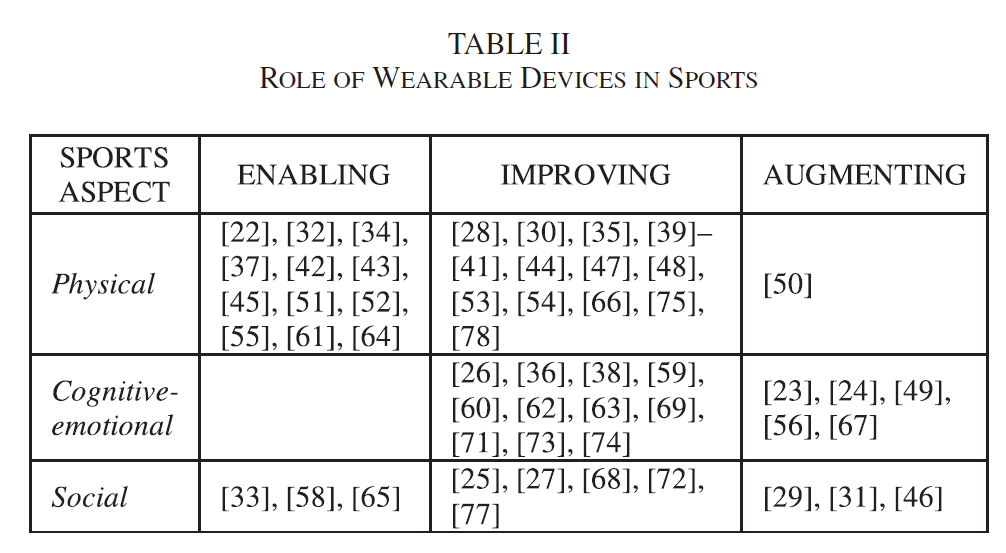
表2:可穿戴设备在体育运动中的作用
可穿戴性
Wearability
所谓可穿戴性,是指一件工艺品穿在人体上的能力[2]。值得注意的是,一个好的可穿戴性不仅是身体舒适的问题,也是社会和心理舒适的问题[81],这样才能有效地传递信息,并可用于互动[82]。
在我们的语料库中,很少有文章(57篇中的8篇)直接 涉及可穿戴性的主题[48], [55], [57], [59]-[62],[64]。这些都是探索性的论文,提出的调查可能为新的可穿戴设备的设计提供信息。尽管没有明确提到 "可穿戴性"一词,但这些作者试图找到放置设备的最佳身体位置,以确保舒适性、感应的准确性和反馈的可感知性。例如,Bäch-lin等人[48]和Kosmalla等人[62]分别试图发现游泳和攀岩中的最佳外形因素、身体位置或反馈方式。
大多数被选中的论文(57篇中的29篇)介绍了新的可穿戴原型,或者将多用途的商业穿戴设备调整到运动领域(例如护目镜),但没有讨论其可穿戴性。然而,通过分析建议的设备,他们为他们的设计选择提供了隐含的动机。最常见的形式和位置是放在手腕上的带子或手表(21篇)。这很方便,因为它利用了手表和手镯的传统位置,这在文 化上已经被认可和接受。此外,把设备放在手腕上,可以很容易地看到反馈,并有利于收集物理和生理数据,如心脏信号和身体运动。语料库中探讨的其他身体位置是头部[25]、[31]、[38]、[45]。[49],[67],颈部[58],胸部[26],[32],[36],[42],[56]。手臂[34]、[44]、[65]、腿[30]、[37]、脚[43]、[47]以及全身多个位置(9)。这最后一组包括由感知和发送反馈的不同设备组成的可穿戴系统[27]、[28]、[52]、[53]、[65],以及可穿戴的全身运动的系统[35]、[40]、[41]、[54]。语料库中涉及的身体位置概览见图2。
通过分析那些超越“手表隐喻”的论文,我们发现,关于赋予人工制品的形状以及将其放置在身体上的位置的决定,是基于两个原因做出的。1)设备的作用(例如,增加体验,改善与队友的交流等);2)将设备嵌入已经在运动实践中使用的人工制品(例如,衣服或装备)中的可能性,或者创造一个新“物体”的需要。同样明显的是,旨在增强运动体验的研究通常 依赖于HMD,使用AR或VR。在滑雪和单板滑雪等运动中,护目镜已经是运动员装备的一部分, HMD 有被研究过[25],[31],[49],[50]。而在体育运动中,增强体验需要额外的人工制品[38],[45],[67]。
相比之下,旨在支持运动员在训练或学习期间的表现的研究,根据运动中涉及的身体部位(以确保更精确的运动检测)以及反馈的目标(以获得更好的反馈感知能力)来定义可穿戴设备的形状和位置。为了确保最佳感应,它们可以放在运动员的脚上[41]、[43]、[44]、腿上[28]、[30]、胸部[42]或手腕上[39],具体取决于每项运动要求的运动类型。为了确保反馈的可感知性,可穿戴设备通常被放置在运动员的手臂[44]、[65]、耳朵[37]或腰部[36]。当反馈针对参 与体育活动的其他运动员(即队友或对手)时,它通常被嵌入到运动员的服装中,并显示在胸部,以便更加明显[26], [27],[56];相反,当它针对外部角色,如裁判和观众时,信息由放置在运动员身上的传感器捕获并显示在屏幕[29],[35],[58]。
The term wearability refers to the ability of an artifact to beworn on the human body [2]. It is worth noticing that a good wearability is not only a matter of physical comfort, but also ofsocial and psychological comfort [81], in order to be effectivein conveying information and accessible for interaction [82].
Few articles (8 out of 57) in our corpus directly address thetopic of wearability [48], [55], [57], [59]–[62], [64]. These areexploratory papers presenting investigations that may inform thedesign of new wearable devices. Even though the term “wearability” is not explicitly mentioned, these authors attempt to findthe best body location to place the device in order to ensure comfort, accuracy of sensing, and perceptibility of feedback. Bächlin et al. [48] and Kosmalla et al. [62], for instance, attemptto discover the best form factors, body locations, or feedbackmodalities in swimming and climbing, respectively.
The majority of the selected papers (29 out of 57) present newwearable prototypes or adapt multipurpose commercial wearables to the sports domain (e.g., goggles) without discussingtheir wearability. Yet, by analyzing the proposed devices, theyoffer implicit motivations for their design choices. The mostcommon form and location are a band or a watch to be placedon the wrist (21 papers). This is convenient because it exploitsthe conventional location of watches and bracelets, which are already culturally recognized and accepted. Furthermore, placingthe device on the wrist allows feedback to be visualized easily,and facilitates the collection of both physical and physiologicaldata, e.g., heart signal and body movements. Other body locations explored in the corpus are the head [25], [31], [38], [45],[49], [67], the neck [58], the thorax [26], [32], [36], [42], [56], thearms [34], [44], [65], the legs [30], [37], the feet [43], [47], andmultiple locations all over the body (9). This last group includeswearable systems composed of different devices for sensing andsending feedback [27], [28], [52], [53], [65], as well as wearablesystems for full-body sports [35], [40], [41], [54]. See Fig. 2 foran overview of the body locations addressed in the corpus.
By analyzing the papers that have moved beyond the “watchmetaphor,” it emerges that the decisions on the shape to be givento the artifact, as well as on the position of the body where toplace it, are made on the basis of two reasons: 1) the role of thedevice (e.g., augmenting the experience, improving the communication with teammates, etc.); 2) the possibility of embeddingthe device in an artifact already used during the sports practice(e.g., clothes or gear), or the need to create a new “object.” It isalso apparent that the studies aiming to augment the sports experience typically rely on HMDs, using AR or VR. HMDs have been studied both in sports where goggles are already part ofthe athlete’s equipment, such as skiing and snowboarding [25],[31], [49], [50], and in sports where the enhancement of theexperience would require an additional artifact [38], [45], [67].
By contrast, research aimed at supporting the athlete’s performance during training or learning defines the wearable’s shapeand location on the basis of the body parts involved in the sport(for ensuring a more precise movement detection), as well asthe target of the feedback (for a better feedback perceptibility).To ensure optimal sensing, they can be placed on the athlete’sfeet [41], [43], [44], legs [28], [30], chest [42], or wrist [39], depending on the types of movements required by each sport. Toensure the perceptibility of the feedback, wearables are typicallypositioned on the athlete’s arms [44], [65], ears [37], or waist[36]. When the feedback targets other athletes involved in thesports activity (i.e., teammates or opponents), it is commonlyembedded in the athlete’s apparel and displayed on the thoraxto be more visible [26], [27], [56]; instead, when it is addressedto external actors, such as judges and audience, the informationis captured by sensors placed on the athlete and is displayed onscreens [29], [35], [58].
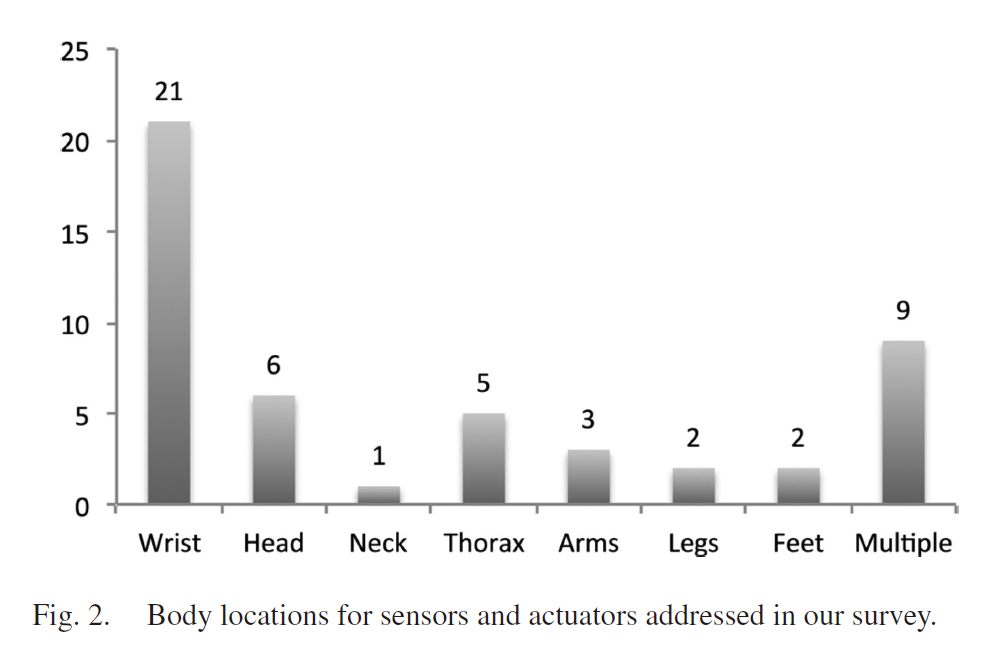
图2:我们调查中涉及的传感器和执行器的身体位置。
反馈的类型
Type of Feedback
最后一个主题是关于提供的反馈类型。运动员要么依靠明确的指标,如追求的目标的实现,要么依靠反馈反应, 这些反馈可以是内在的或增强的[83],以评估他们的表现。内在的反馈(也称为内在的)是来自运动员对自己的运动和空间位置的感知的信息(即本体感觉),而增强的反馈(或外在的)是来自外部代理的信息[83],如教练或基于视频的运动分析[84]。
增强的反馈是学习和改进的基础,因为它可以帮助运动 员对他们的内部感觉进行分类,并更好地理解他们的表现所依据的机制:这就是可穿戴设备可以提供的反馈。增强的反馈(从现在开始只称为“反馈”)可以根据传递的时间进行分类。如果是在执行动作时(即实时)提供,则被定义为同时提供,如果是在动作结束后提供,则被定义为终端提供[85]。关于使用同步反馈还是终端反馈的决定取决于运动所要求的任务种类以及反馈所要表达的内容。事实上,当反馈指的是动作的质量时,它既可以表达对表现的了解,也可以表达对结果的了解,当它指的是达到的目标/水平时[85]。我们确定了37篇介绍可穿戴设备提供并发反馈的论文,8篇介绍可穿戴设备提供终端反馈的论文[23]、[24]、[33]、[39]、[59]、[68]、[71]、[77],以及6篇讨论可穿戴系统提供两者(混合反馈)的论文[63]、[66]、[72]-[74]、[78]。六篇论文没有直接讨论反馈的主题[45]、[57]、[64]、[69]、[70]、[75]、[76]。
另一个区别可以根据用于传递反馈的方式(见图 3)。在所有类型的交付(即并发、终端和混合)中,最常用的方式是视觉方式,在屏幕上提示信息(23 个可穿戴系统)、LED 灯(11 个)或HMDs(4)。
特别是,采用终端反馈和混合反馈的设备只依赖于视觉模式。终端反馈是通过移动应用程序[23]、[24]、[33]、[59]、[68]或网站[39]、[71]、[77]提供。同样,混合反馈通常以运动员进展“摘要”的形式在可穿戴显示器上实时提示,然后通过使用移动应用程序或网站的更详细的表述在大屏幕上进行可视化[63], [72]-[74]。正如Fritz等人[66]所讨论的,后者的可视化也允许在社交网络上分享成绩。同步反馈主要通过三种方式进行,即视觉、听觉和触觉,取决于其目标和目的。当反馈是针对运动者的,并且正在进行的活动依赖于其视觉注意力时,触摸(使用振动或肌肉电刺激)和听觉(通过语音提示,如嘟嘟声或口头指示)是首选,例如,[22]、[30]、[37]、[40]、[ 42]、[53]、[55]。[60],[61]在其中一些情况下[22]、[41]、[42]、[55]、[61],触觉或听觉信息使教练能够发出前馈而不是反馈,也就是说,在动作之前而不是在动作之后发出做什么的指令。在同时向不同的利益相关者传达多个反馈信息的情况下,视觉通道专门用于观众[65]、教练[36]、队友[26]、[27]、[56] 或裁判[35],而运动员则通过触觉和/或听觉刺激被告知。当运动员的改进取决于视觉反馈本身时,例如,当反馈反映了她的表现时[28],或者当反馈旨在提高她的表现时[25]、[31]、[38]、[45]、[49]、[67],视觉反馈被用来直接通知运动员。关于反馈方式的选择也取决于所从事的运动种类:比较三种不同方式的探索性研究发现,视觉反馈对游泳运动员的效果更好[48],而声音和振动对攀岩运动员的效果更好[62]。
The last theme concerns the type of feedback provided. Athletes rely either on explicit indicators, such as the achievementof the pursued goal, or on feedback responses, which can be inherent or augmented [83], in order to assess their performance.Inherent feedback (also called intrinsic) is the information originating from the athlete’s perception of her own movements andposition in space (i.e., proprioception), while augmented feedback (or extrinsic) is the information coming from an externalagent [83], such as the coach or video-based motion analysis[84].
Augmented feedback is fundamental for learning and improving because it helps athletes categorize their internal sensationsand better understand the mechanisms underlying their performance: this is the kind of feedback that wearables can provide.Augmented feedback (from now on called just “feedback”) canbe categorized according to the timing of delivery. It is definedas concurrent if delivered while executing the movement (i.e.,in real time), and terminal if it is given once the movement isconcluded [85]. The decision about whether using concurrent orterminal feedback depends on the kind of task required by thesport as well as on the content that the feedback aims to express.Indeed, feedback can express either knowledge of performance,when it refers to the quality of movements, or knowledge of results, when it refers to the goal/level achieved [85]. We identified37 papers that present wearables providing concurrent feedback,eight papers presenting wearables giving terminal feedback [23],[24], [33], [39], [59], [68], [71], [77], and six papers that discusswearable systems providing both (mixed feedback) [63], [66],[72]–[74], [78]. Six papers do not directly address the topic offeedback [45], [57], [64], [69], [70], [75], [76].
Another distinction can be made according to the modalityused to convey the feedback (see Fig. 3). The most used modalityacross all the types of delivery (i.e., concurrent, terminal, and mixed) is the visual one, with information prompted on screens(23 wearable systems), LEDs (11), or HMDs (4).
In particular, the devices adopting terminal and mixed feedback rely on visual modality only. Terminal feedback is providedthrough mobile apps [23], [24], [33], [59], [68] or websites [39],[71], [77]. Likewise, mixed feedback is usually prompted in realtime on the wearable display in the form of a “summary” of theathlete’s progress, and then visualized on larger screens throughmore detailed representations using mobile apps or websites[63], [72]–[74]. The latter visualization allows also for sharingperformance results on social networks, as discussed by Fritzet al. [66].
Concurrent feedback is delivered through three main modalities, visual, auditory, and haptic, depending on its target andpurpose. Touch, using vibrations or electrical muscle stimulation, and hearing, through audible cues (e.g., beep or tone) orverbal instructions, are preferred when the feedback is directedat the sportsperson and the activity she is performing relies onher visual attention, e.g., [22], [30], [37], [40], [42], [53], [55],[60], [61]. In some of these cases [22], [41], [42], [55], [61], thehaptic or auditory information enables the coach to send a feedforward rather than a feedback, i.e., an instruction about what todo preceding the action rather than following it. In case of multiple feedbacks conveyed to different stakeholders at the sametime, the visual channel is dedicated to the audience [65], thecoach [36], the teammates [26], [27], [56], or the judges [35],while the athletes are informed through haptic and/or audio stimuli. Visual feedback is used to inform directly the sportspersonwhen her improvements depend on the visual feedback itself,e.g., when the feedback mirrors her performance [28], or whenit is aimed at augmenting her performance [25], [31], [38], [45],[49], [67]. The choice about feedback modality also depends onthe kind of sport practiced: explorative studies that comparedthe three different modalities found that visual feedback wouldwork better for swimmers [48], whereas sound and vibrationwould work better for climbers [62].
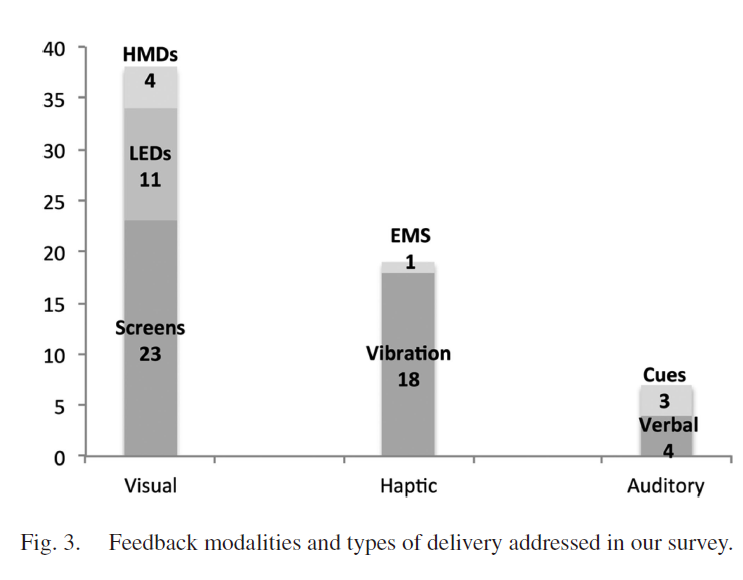
图3:我们调查中涉及的反馈方式和传递类型
06 讨论
Disscussion
上述分析描述了此领域的人机交互仍然处于早期阶段,驱动更多的是由技术进步,而不是“人类的目标和需求”,传统的方向人机交互研究。在下文中,我们将讨论这一领域可能的研究路线图的六个方向。
The analysis presented above depicts an area of HCI that is stillin its early stages, being driven more by technological advancements than by “human goals and needs,” which traditionally orient HCI research. In the following, we discuss six directionsfor a possible roadmap of research in this area.
探索不同形式的因素和反馈类型
Explore Different Form Factors and Types of Feedback
我们分析的大多数可穿戴设备都被设计成戴在手腕上, 形状类似于手表和手镯。手表的形式很方便,因为它利用了一种广泛的、跨文化的惯例,即为了获得某种信息而将“工艺品”戴在那里。然而,人机交互研究可以通过研究新的形式因素和身体位置来推动可穿戴设备的产品设计。通过对运动类型的彻底分析,即在某种运动实践中涉及的动作,以及其中使用的装备和服装,可穿戴设备可能履行的角色,以及它的功能(传感、发送反馈或两者),将有可能设想出新的形式因素和交互模式。总的来说,人机交互研究的目标应该是绘制体育可穿戴设备设计中所涉及的维度(运动类型、角色和功能)。
分析还表明,目前的可穿戴设备所提供的反馈大多是并发的[78]。尽管这在一些情况下和许多运动中是有意义的,但终端反馈肯定是值得探索的。同时反馈和终端反馈的整合,以及我们如何根据运动员的情况和目标来区分它们的使用,也应该被研究。这将为研究反馈的表达能力提供新的机会,包括实时反馈(即有多少信息可以实时传递, 以及运动员在表演时可以感知和理解)和事后反馈(当有时间反思刚刚经历的经历时)。
The majority of wearable devices we analyzed are designedto be worn on the wrist and are similar in shape to watches andbracelets. The watch form is convenient because it leverages awidespread and cross-cultural convention about where to wearan “artifact” in order to have access to some kind of information. Yet, HCI research could push the wearables’ product designforward by investigating new form factors and body locations.Through a thorough analysis of the sports type, i.e., the movements involved in a certain sports practice, as well as the gearand the apparel used in it, the role that the wearable may fulfill,and itsfunction (sensing, sending feedback, or both), it would bepossible to envision new form factors and interaction modalities.By and large, HCI research should aim to map the dimensionsinvolved in the design of wearables for sports (sports type, role,and function).
The analysis also makes apparent that the feedback deliveredby current wearables is mostly concurrent [78]. Although thismakes sense in several situations and for many sports, terminalfeedback is definitely worth to be explored. The integration ofconcurrent and terminal feedback, and how we can differentiatetheir use depending on the athlete’s situations and goals, shouldbe investigated as well. This would open new opportunities forstudying the expressive abilities of feedback both in real time(i.e., how much information is possible to deliver in real time, aswell as is perceivable and understandable by sportspeople whileengaged in their performances) and after the experience (whenthere is time for reflection on the experience just lived).
超越“一般”的“个人”运动员
Move Beyond “Generic” “Individual” Athletes
目前,人机交互研究似乎集中在个人运动和一般的运动员身上(也就是说,没有具体说明他们的经验水平、能力或训练频率)。大多数穿戴式设备都是为个人运动者/运动员设计的(我们的语料库中只有三种团队运动)。同样地,评估通常涉及运动员个人,而不是团体/团队。事实 上,很少有例子考虑到体育的社会层面。例如,Chi等人[ 35]专注于成对的武术运动员,研究压电式力传感器,以检测何时对竞争对手的身体产生了重大影响;Kräuter等人[27]招募了一个定期聚会的自行车运动员群体,以评估一个增强群体交流的原型;Mauriello等人[26]对一小队篮球运动员的轻型球衣进行评估。尽管如此,仍有许多可能性来扩大参与与设备互动的 "单位"。
一方面,关注团队运动可能会带来全新的设计问题和机会,例如改善运动员之间以及与教练的交流。另一方面, 考虑到可穿戴设备层的协作行为,特别是多用户任务/活动的应用,可能为可穿戴设备的体育研究设定新的方向。例如,可穿戴设备可以成为团队运动中战略定义的集体支持。运动员可以通过使用这些设备一起合作,以便实时调整他们正在进行的表现和完善他们的目标。同样,可穿戴设备可以“调解”运动员和教练之间的关系,帮助他们共同确定训练,或开发一种“共享知识”,这可能有利于运动员对自己身体的理解。总而言之,体育领域的各种合作活动都可以通过可穿戴设备来支持,使多个用户在同一任务上共同工作。
另一个研究方向是考虑参与与设备互动的运动者的类型。很少有研究专注于精英运动员或初学者,而更倾向于针对“普通”运动员。技术可能以不同的方式支持运动员的专业知识和体育知识。事实上,Rapp和Tirabeni[75]强调,不同经验水平的运动员有不同的信息需求,并从事不同的运动实践。这一点应该在未来的研究中进一步探讨。同样地,很少有论文专注于为残疾运动员设计。此外,他们考虑了身体上的损伤,而忽略了认知上的损伤。在体育中使用可穿戴技术的一个研究机会是使认知障碍者能够识别和管理与 某些体育活动相关的情绪或认知状态,例如,通过支持他 们的记忆功能,集中他们的注意力,或减少他们的情绪困扰(如自闭症患者)。
At present, HCI research seems to focus on individual sportsand on generic sportspeople (that is, without specifying theirlevel of experience, ability, or frequency in training). Most wearable devices are designed for individual sportspeople/athletes(only three team sports are present in our corpus). Likewise,evaluations usually involved athletes as individuals and not asa group/team. Indeed, there are few examples considering thesocial dimension of sports. For example, Chi et al. [35] focus onpairs of martial arts athletes, studying piezoelectric force sensors that detect when a significant impact has been delivered toa competitor’s body; Kräuter et al. [27] recruit a regularly meeting group of cyclists to evaluate a prototype that enhances groupcommunication; and Mauriello et al. [26] evaluate light jerseyswith a small team of basketball players. Still, there are manypossibilities to widen the “unit” engaged in the interaction withthe device.
On the one hand, focusing on team sports may open completely new design questions and opportunities, e.g., for improving the communication among the athletes and with thecoaches. On the other hand, considering collaborative behavior at the wearable device layer, with particular reference tomultiuser task/activity applications, may set new directions forwearables for sports research. For instance, wearables may become a collective support for strategy definition in team sports. whereby athletes may cooperate together by using the devicesin order to tune their ongoing performance and refine their goalsin real time. Likewise, the wearable may “mediate” the relationship between the athlete and the coach, helping them collectivelydefine the workouts, or develop a “shared knowledge” that maybenefit the athlete’s understanding of her own body. In sum, thereare a variety of collaborative activities in the sports domain thatcould be supported by wearables by enabling multiple users towork together on the same task.
A further research direction is to consider the type of sportspeople involved in the interaction with the device. Few studiesfocus on elite sportspeople or beginners, rather preferring totarget “average” athletes. Technology may support athletes indifferent ways along the spectrum of their expertise and sportsknowledge. Actually, Rapp and Tirabeni [75] highlighted thatathletes at different levels of experience have different information needs and engage in different sports practices. This shouldbe further explored in future studies. Similarly, few papers focus on designing for disabled athletes. Moreover, they considerphysical impairments, while ignoring cognitive ones. A researchopportunity for using wearable technology in sports could be toenable cognitively impaired individuals to recognize and manage emotions or cognitive states relevant to certain sports activities, e.g., by supporting their memory functioning, focusing theirattention, or reducing their emotional distress (e.g., in autisticindividuals).
挑战极限
Push the Boundaries
关于可穿戴设备在体育中可能发挥的作用,我们的审查发现了当前文献中的两个主要空白(见表二):似乎没有关于可穿戴设备在体育中的认知和情感方面的研究,也没有关于其用于增强身体技能的研究([50]除外)。相反,很明显,我们分析的大多数作品都制作和研究了可穿戴设备,以实现或改善运动的物理方面。这可能是由于在许多流行的运动中,如自行车和跑步,实现对表现的测量相对容易,因为它取决于可以毫不费力地由嵌入设备的传感器收集的变量(如速度)。然而,运动体验不能被简化为单纯的身体努力和表现,因为它包含了一个认知/情感维度,这更难衡量,但也很有趣。
认知和情感方面在体育实践中很重要,可以支持动机和 承诺[86],也可以防止倦怠[87]和促进应对策略[88]。除了少数例外(如[62]和[75]),与表现有关的认知方面在我们的语料库中没有得到太多的关注。因此,通过对心理、情感和行为变量(如自我效能和动机)的探索,可以为研究和设计提供有趣的可能性。例如,适当的可视化可以支持运动员反思他们自己的期望和压力水平,并为教练员提供工具来促进运动员的积极性,同时保护他们的安全。通过考虑运动员的生活经验、监测和整合到正在进行的表现的反思实践中,Hirose等人[19]提出了一个系统,潜水时记录一个人的第三人称视角,提供一种"增强的眼睛",如果实时使用,可以增加运动体验。
增强运动员的身体能力是人机交互的另一个有趣的研究方向。由于可穿戴设备与人体有严格的联系,技术可以通过赋予运动员更多的力量、速度或处理疲劳的能力,以及通过扩大他们能够进行的各种运动来增强他们的能力。对这一主题的研究不足,可能是由于内在的假设,即身体及其发展必须重新“不受”体育领域外部因素的影响:体育中的身体必须通过训练和牺牲来改善,因此任何外部援助都可能违反这一假设,属于“欺骗”范畴。尽管增强可能会朝着增强的想法发展(见,例如[89]),被认为与体育价值观相矛盾(见,例如,[55]),并且在概念上接近于使用兴奋剂,但当应用于可及性问题时,它也可以打开有趣的视角。例如,电动自行车已经被证明可以扩大自行车的可及性(例如,[90]):对增强“人”的技术的积极态度可以为该领域的进一步调查铺平道路。
从这个角度来看,许多与可穿戴设备和运动有关的研究问题还没有被人机交互研究者解决。例如,可穿戴设备是 否过度地“量化”了运动体验,将一些物理性的东西变成了可以合理检查的数字数据?可穿戴设备如何以及在何种程度上对运动员产生心理影响?可穿戴设备是否改变了体育领域的组织实践,重新配置了角色,并修改了规则?
Regarding the roles that wearables could play in sports, ourreview identified two main gaps in the current literature (seeTable II): it seems that there is no research on wearables enablingthe cognitive and emotional aspects of sport, as well as on theiruse for augmenting physical skills (with the exception of [50]). Itis apparent, instead, that the majority of works we analyzed haveproduced and investigated wearables for enabling or improvingphysical aspects of sports. This may be due to the relative easeof implementing measurement of performance in many popularsports, like cycling and running, as it depends on variables thatcan be effortlessly collected by the sensors embedded in thedevice (e.g., speed). Nevertheless, the sports experience cannotbe reduced to the mere physical effort and performance as itentails a cognitive/emotional dimension that is harder to measurebut interesting to explore.
Cognitive and emotional aspects are important in the sportspractice to support motivation and commitment [86] as well as toprevent burnout [87] and facilitate coping strategies [88]. Withfew exceptions (i.e., [62] and [75]), cognitive aspects related toperformance have not received much attention in our corpus. Interesting possibilities for research and design can thus be openedby the exploration of psychological, emotional, and behavioralvariables, such as self-efficacy and motivation. For example,appropriate visualizations may support athletes in reflecting ontheir own expectations and level of stress, as well as providecoaches with tools to foster athletes’ motivation while preserving their safety. By considering the athlete’s lived-experience,its monitoring, and integration into reflective practices on theongoing performance, Hirose et al. [19] proposed a system that records one’s third-person view while diving, providing a sortof “enhanced eye” that augments the sports experience if usedin real time.
Augmenting the athlete’s physical abilities is another interesting line of research for HCI. As wearables are strictly connectedto the human body, technology might empower athletes by giving them more strength, speed, or ability to deal with fatigue,as well as by expanding the kinds of movements they are ableto enact. The lack of research on this topic may be due to theintrinsic assumption that the body and its development must remain “untouched” by agents external to the sports domain: thebody in sport must be improved through training and sacrifices,whereby any external aid could appear to violate this assumption,falling within the “cheating” category. Although augmentationmay evolve toward the idea of enhancement (see, e.g., [89]),be perceived in contradiction to sports values (see, e.g., [55]),and conceptually close to doping, it could also open interestingperspectives when applied to accessibility issues. For example,e-bikes have been proven to widen the accessibility of biking(e.g., [90]): a positive attitude toward technology for augmenting “the human” can pave the way for further investigations inthis domain.
In this perspective, many research questions related to wearables and sport have not yet been addressed by HCI researchers.For example, are wearable excessively “quantifying” the sportsexperience turning something physical into digital data that canbe rationally examined? How, and to what extent, do wearablesproduce psychological effects on athletes? Are wearables changing the organizational practices in the sports domain, reconfiguring roles, and modifying rules?
探索体育的演变
Explore the Evolution of Sports
令人惊讶的是,目前还缺乏关于技术如何改变体育领域本身的颠覆性想法,即赋予新型运动以生命,或为运动员创 造新的机会。尽管科幻小说中描述了未来的社会,团队和个人运动由于新的使能技术而得到发展(例如,在电影《滚球》和《未来体育》中),但目前还没有关于可穿戴技术如何改变运动规则的研究。实际上,一个有趣的例子是由Hayakawa等人[18]代表的沿着这一研究方向的研究。尽管它没有被纳入我们的语料库,因为它缺乏适当的用户研究,但它讨论了一种新的运动类型——“空中运动”,即可穿戴的HMD将来自飞行无人机装置的相机视图与用户的自愿运动结合起来。据称,这创造了一种新的运动体验,在这种体验中,运动员通过潜入无人机, 在有效利用四肢的同时,体验双目立体飞行的感觉,从而享受跨越她的身体限制,如高度和重力。在这方面,像ACM主办的“超人运动”研讨会[91]这样的倡议可能会带来有趣的见解。
Surprisingly, there is currently a lack of disruptive ideas abouthow technology could change the sports domain itself, by givinglife to new kinds of sports, or creating novel opportunities forathletes. Despite the sci-fi imaginary depicting future societieswhere team and individual sports are evolved thanks to novelenabling technologies (for example, in movies like “Rollerball”and “Futuresport”), there is no research on how wearable technology may change the rules of a sport. Actually, an interestingexample that goes along this line of research is represented byHayakawa et al.[18]. Even though it has not been included in ourcorpus as it lacks a proper user study, it discusses a new sportsgenre, the “Aerial Sports,” whereby a wearable HMD integratesa camera view from a flight drone unit with the user’s voluntary motion. This supposedly creates a new sports experience inwhich the athlete enjoys crossing her physical limitations, suchas height and gravity, by diving into the drone and experiencingthe binocular stereoscopic sensation of flying while using herlimbs effectively. In this respect, interesting insights may comefrom initiatives like the symposium on “superhuman sports” [91]organized under the auspices of ACM.
不同系统的互连
Interconnect Different Systems
在我们的语料库中缺少关于不同标准和通信技术之间互操作性的技术讨论。这并不奇怪,因为人机交互作品很少处理直接的技术问题。然而,更令人惊讶的是,在应用层面上 完全没有关于整合设备的可能性的见解,这使得设计者能 够设计出利用同质或跨领域的多个平台的可穿戴系统,以及用户在独特的用户体验中交换不同服务的数据。实际上,我们分析的可穿戴设备被认为是独立的系统,因此它们与更广泛的生态系统的整合没有被考虑在内。
相反,通过云计算和/或边缘基础设施,可穿戴设备与 物联网(IoT)的整合带来了许多机会。Aloi等人[92]高度评价了互操作性是如何实现不同数据源的整合,有利于在最佳设备上分配数据,实现异构设备之间的互动,并赋予普适性动态服务以生命。这些机会也可能与体育领域有关, 需要进一步研究。例如,互操作性可以允许设计用于汽车运动的可穿戴技术(目前在我们的语料库中没有),这些技术可以与其他技术设备(如汽车或摩托车)协调。此外,它可以增加可穿戴设备所考虑的数据种类,这些数据现在是孤立的,仅限于所从事的运动,通过将它们与来自其他物联网设备(如医疗可穿戴设备)的信息联系起来,将 监测的参数扩展到运动员生活的多个方面。此外,互操作 性可能会增加创建动态可视化的机会,在现有的最佳屏幕上显示同步和终端反馈(也利用嵌入"环境 "的资源)。
Technical discussion about interoperability among differentstandards and communication technologies is missing in ourcorpus. This comes as no surprise as HCI works rarely tackle technical issues directly. However, much more surprising is thecomplete absence of insights on the possibility of integrating devices at the application level, allowing designers to design wearable systems exploiting multiple platforms in homogeneous orcross domains, as well as users to exchange data across differentservices within a unique user experience. Actually, the wearableswe analyzed are thought as stand-alone systems, whereby theirintegration into a wider ecosystem is not taken into account.
There are instead many opportunities coming from the integration of wearables with Internet of Things (IoT) via cloudcomputing and/or edge infrastructures. Aloi et al. [92] highlight how interoperability could allow the integration of different data sources, favor the distribution of data on the best deviceavailable, enable the interaction between heterogeneous devices,and give life to pervasive dynamic services. These opportunitiescould be relevant for the sports domain as well and need furtherresearch. For instance, interoperability could allow to designwearable technologies for motor sports (which are currently absent in our corpus) which may coordinate with other technological instruments (such as a car or a motorbike). Further, it mayincrease the kind of data considered by the wearable, which arenow siloed and circumscribed to the sport practiced, by connecting them with information coming from other IoT devices(e.g., medical wearables), extending the parameters monitored tomultiple aspects of the athlete’s life. Moreover, interoperabilitymay increase the opportunities for creating dynamic visualizations displaying concurrent and terminal feedback on the bestscreen available (also leveraging the resources embedded in the“environment”).
提高方法的严谨性
Improve Methodological Rigor
通过观察所有三个确定的研究角度所采用的方法,大多数的用户研究都缺乏深入性和严谨性,并不能完全提供关于可穿戴设备的“人”的影响的深入见解。
总的来说,大多数定性研究对所采用的方法描述得很差,而且令人惊讶的是,对结果的叙述并不完整。例如,专注于需求收集的研究往往缺乏适当的观察和人种学研究。我们的语料库中没有“完整的”人种学研究,这意味着长时间的观察和/或参与体育活动,这表明目前人机交互界对于可穿戴设备如何或可以融入体育实践的观察数据有限。同样,目前也需要进行野外评估研究。Schlögl等人[21]强调,为了全面了解与可穿戴技术互动所带来的挑战,仍有许多关键问题需要通过现实生活中的用户研究来解决。一些声称“在现场”的研究在生态环境中部署他们的系统,但不是在完全“自然”的情况下。例如,他们引入了由重新搜索者创建的人工任务[25],或者在解释研究环境和所涉及的样本时缺乏严谨性。此外,评价主要是在短期内通过有限的试验或在有限的天数内进行的。当然,接受研究是复杂的事实,扩展使用可能很难评估与研究原型。的确,“接受研究”类别的所有论文都在调查商用可穿戴设备的影响。
定量研究似乎也引起了同样的关注:其中大多数是探索性的,涉及的参与者数量有限,在研究设计和统计有效性方面的结果相当薄弱。我们在审查的论文中没有发现随机对照试验,而问卷调查在统计方面的阐述很少,对所用方法的描述也很差。对心理和行为变量的长期影响以及可穿戴设备使用的最终副作用也没有被考虑。
有鉴于此,我们认为该领域需要更多的实验性研究来报告效果大小,采用纵向德标和涉及控制组,以及比较不同的设计,并参考可穿戴设备的形状、佩戴性、功能和可视化。至于定性研究,研究人员应关注可穿戴设备在运动实践中的使用情况,旨在了解它们的体验性影响,以及它们 “如何”和“为什么”支持或不支持运动员的定位目标。正如Rapp和Tirabeni所指出的,关于可穿戴设备和运动的人机交互研究缺乏关于可穿戴设备是如何从属“生活”的报告[75],以及它们是如何被运动员为他们自己的目的占有的,甚至是违背设计者的意图的。在未来的几年里,应该进行背景访谈(如[75]中的报告)、日记和民族志,探索可穿戴设备如何影响运动员的体验,以及背景因素和运动员的特质如何影响可穿戴设备的可接受性和有效性。
By looking at the methods employed across all the three identified research perspectives, most of the user studies lack thoroughness, rigor, and are not fully capable of providing in-depthinsights on the “human” impact of wearables.
By and large, most of the qualitative studies examined showvery poor description of the methods employed and surprisinglypresent an incomplete recounting of the results. For example,the studies focused on requirement gathering often lack appropriate observational and ethnographic research. “Full” ethnographies implying a long period of observation and/or participation into sports activities are absent in our corpus, signalingthat at present the HCI community has limited observationaldata on how wearables are, or can be, integrated into the sportspractices. Likewise, in-the-wild evaluation studies are currentlyneeded. Schlögl et al. [21] highlight that there is still a number of key problems requiring real-life user studies to be solvedin order to gain a holistic understanding of the challenges thatarise from interacting with wearable technology. Some of thestudies claiming to be “in the field” deployed their systems inan ecological setting, but not in completely “natural” situations:For example, they introduced artificial tasks created by the researcher [25] or lacked rigor in explaining the study setting andthe sample involved. Further, evaluations have been mainly conducted in the short term through a limited number of trials orduring a limited number of days. Of course, acceptance studies are complicated by the fact that extended use might be difficultto assess with research prototypes. Indeed, all the papers in the“acceptance study” category investigate the impact of commercial wearables.
The quantitative studies seem to raise the same concerns: mostof them were explorative and involved a limited number of participants, with rather weak outcomes in terms of research designand statistical validity. We did not find randomized control trialsamong the examined papers, while questionnaires present littlestatistical elaboration and poor description of the used methods.Long-term impacts on psychological and behavioral variablesand eventual side effects of wearable use are not considered aswell.
Given this, we believe that the field needs more experimental studies reporting effect size, employing longitudinal designs and involving control groups, as well as comparing different designs, with reference to the wearables’ shape, wearability, functionalities, and visualizations. As for the qualitativeresearch, researchers should focus on how wearables are usedin sports practices, aiming to understand their experiential effects, the “how” and “why” they support or not the athletes’situated goals. As Rapp and Tirabeni noted, HCI research onwearable and sports lacks reports on how wearables are subjectively “lived” [75], and how they are appropriated by athletesfor their own situated purposes, even against the designer’s intentions. Contextual interviews (like those reported in [75]), diaries, and ethnographies exploring how wearable devices affectthe athlete’s experience, as well as how contextual factors andathletes’ idiosyncrasies may influence wearables’ acceptabilityand efficacy, should be conducted in the next years.
07 结论和未来工作
Abstract
在本文中,我们按照基础理论文献综述方法[15]进行了文献综述。我们分析了1999年至2018年在科学会议和期刊上发表的57篇论文,目的是了解当前人机交互研究如何处理体育领域的可穿戴技术。我们的分析表明,该领域的人机交互研究在许多方面还处于起步阶段。尽管据称它对交互的“人的方面”感兴趣,但这里的人机交互仍然是由设计的技术方面驱动的,而忽略了技术对用户体验的影响。
我们确定了推动运动可穿戴设备的人机交互研究的六个方向:1)虽然目前的研究被腕表的隐喻和提供同步反馈所支配,但将运动可穿戴设备的设计所涉及的维度(角色
、功能和运动类型)与可提供的反馈类型联系起来的时机可能已经成熟。2)我们认为,研究应该超越针对“普通”“个人”运动员提出的方法,针对不同的运动员,探索合作任务;3)技术研究还应该考虑体育体验的认知、情感和社会 方面的复杂组合;4)另一个有趣的研究方向是探索技术产品如何通过实现激进的新实践来改变体育体验;5)同样,相互联系的研究也是如此。6)最后,在分析用户需求和评估所开发的技术产品时,都需要更严格的方法论。
未来的工作还有很多机会。虽然在这个阶段我们倾向于将我们的语料库限定在体育领域,以便更好地指出其关键问题和机会,但人机交互将受益于扩大本评论的覆盖面,使之包括其他不同但相关的领域。例如,即使是为不同的目标、背景和实践(即健康)而设计的,用于身体康复的可穿戴设备也与体育活动紧密相关。例如,Singh等人[93]开发了一个可穿戴系统,可以感知和声音,支持身体康复和疼痛管理。而Vasconcelos等人[94]提出了三个由可穿戴设备控制的运动诊断游戏,可用于多种康复场景。这些和其他这方面的工作可以引入新的主题,并对可穿戴设备在进行身体活动时如何使用提供一个补充性的视角。
In this paper, we presented a literature review following thegrounded theory literature review approach [15]. We analyzed57 papers published in scientific conferences and journals from1999 to 2018 with the aim of understanding how current HCIresearch tackles wearable technology in the sports domain. Ouranalysis shows that HCI research in this field is, in many respects, in its infancy: Despite its allegedly interest in the “human aspects” of interaction, here HCI is still driven by technicalaspects of design, while overlooking the impact of technologyon the user experience.
We identified six directions for moving the HCI research onwearables for sports forward: 1) While current research is dominated by the metaphor of the wrist watch and by deliveringconcurrent feedback, times might be ripe to map the dimensionsinvolved in the design of wearable for sports (role, function,and sports type) to the types of feedback that can be provided;2) we believe that research should move beyond proposing devices addressed to “average” “individual” athletes by targetingdifferent sportspeople and exploring collaborative tasks; 3) future research should also consider the complex constellation ofcognitive, emotional, and social aspects of the sports experience; 4) another intriguing line of research could be to explorehow technological artifacts may change the sports experienceby enabling radical new practices; 5) likewise, interconnecting wearable devices to the wider IoT ecosystem may enable newservices and interaction modalities; and 6) finally, more rigorous methodological approaches are needed both for the analysisof the users’ needs and for the evaluation of the technologicalartifacts developed.
There are many opportunities for future work. While at thisstage we preferred to circumscribe our corpus to the sports domain for better pointing out its key issues and opportunities,HCI would benefit from widening the coverage of this review toother distinct, but related areas in the future. For instance, eventhough designed for different goals, contexts, and practices (i.e.,health), wearable devices for physical rehabilitation are tightlyrelated to sports activities. Singh et al. [93], for example, developed a wearable system that senses and sonifies movementssupporting physical rehabilitation and pain management. WhileVasconcelos et al. [94] proposed three exercise-agnostic gamescontrolled by a wearable device, which can be used for a multitude of rehabilitation scenarios. These and other works in thisvein could introduce new themes and give a supplementary perspective on how wearables are used while doing physical activity
ABOUT US
参考文章:
Designing Wearable Systems for Sports:A Review of Trends and Opportunitiesin Human–Computer Interaction
作者:
Eleonora Mencarini
Amon Rapp
Lia Tirabeni
Massimo Zancanaro
译者:糖醋排菇
为尊重版权和译者
转载请联系我们