
01 摘要
Abstract
我们提出了一种名为 InSituWear 的体表成型机器人制造方法,该方法将低温热塑性聚己内酯 (PCL) 直接熔融拉伸到人体上,从而制造个性化可穿戴设备。PCL 加热至塑化状态后,被拉伸成微丝(最小直径约为 0.03 毫米),并由机器人进行三维拉伸;冷却后,微丝粘附并保持形状。由于 PCL 在 50 ℃ 左右即可成型且冷却迅速,我们的工艺无需三维数据采集、数字建模和组装,即可在皮肤安全温度下实现即时贴合人体的穿戴。我们提出了一种可调设计系统,通过改变微丝直径、缠绕密度和编织图案来局部控制刚度和柔顺性,从而提高舒适度,优于片状热塑性材料。技术实验表征了制造参数(速度、温度、成分和路径策略)如何影响性能。最后,我们展示了个性化的人体包裹式可穿戴设备(例如袖套、手套),并展望了更大规模的应用(例如家具、建筑表面),这些应用展现了更佳的贴合度、零浪费制造工艺和智能行为。这些原型为人机交互领域中具身化、形态生成和自适应机器人制造提供了一个框架。
We present InSituWear, a form-finding, on-body robotic fabricationmethod that melt-draws low-temperature thermoplastic polycapro-lactone (PCL) directly onto the human body to create personalizedwearables. Heated to a plasticized state, PCL is stretched into micro-filaments (minimum diameter ≈ 0.03 mm) and robotically drawn in3D; upon cooling, the filaments adhere and retain shape. Because PCL conforms around 50 ◦C and cools rapidly, our process elimi-nates 3D capture, digital modeling, and assembly, enabling immedi-ate, body-conforming wear at skin-safe temperatures. We presenta tunable design system that varies filament diameter, wrappingdensity, and weaving pattern to locally control stiffness and com-pliance, improving comfort relative to sheet-based thermoplastics.Technical experimentation characterizes how fabrication param-eters (speed, temperature, composition, and path strategy) affectperformance. Finally, we demonstrate personalized body-wrappedwearables (e.g., sleeve, glove) and speculate on larger-scale applica-tions (e.g., furniture, architectural surfaces) that showcase enhancedfit, waste-free fabrication, and intelligent behavior. These proto-types outline a framework for embodied, form-finding, adaptiverobotic fabrication in HCI.
02 CCS概念
CCS Concepts
• 以人为中心的计算 → 交互设计系统和工具;人机交互 (HCI);交互设备;
• 计算机系统组织 → 机器人技术。
• Human-centered computing → Systems and tools for interactiondesign; Human computer interaction (HCI); Interaction devices;
• Computer systems organization → Robotics.
03 关键词
Keywords
人体制造、皮肤制造、个人制造、可穿戴设备、机器人制造
On-Body Fabrication, On-Skin Fabrication, Personal Fabrication,Wearable Devices, Robotic Fabrication
04 介绍
INTRODUCTION
如果可穿戴设备不是在遥远的工厂制造,而是直接绘制在我们的身体上会怎样?如果制造过程不再是加法或减法,而是在体内成型会怎样?如果机器人能够编织出定制的智能纺织品,且不产生任何浪费会怎样?如果设计不再需要静态的3D模型,而是允许机器围绕身体动态制造,通过运动、材料和交互来塑造形态,又会怎样?
如今,大多数可穿戴技术和纺织品都是通过大规模生产工艺生产的,这些工艺将预先设定的形态强加于被动材料之上。加法和减法虽然功能强大,但依赖于标准化的生产流程,这会产生大量的材料浪费,需要复杂的组装,并且限制了个性化。纺织业尤其面临着产能过剩和减少浪费的严峻挑战,同时还要努力满足对适应性强、贴合人体曲线产品的需求。在医疗矫形器、康复、沉浸式系统和时尚等领域,人体特定结构可以提升舒适度和精准度,但大多数制造方法仍然难以达到这种响应水平。
现代数字制造技术(例如CAD建模、3D打印、CNC加工)通常需要在制造开始前在软件中定义最终几何形状。这种预先设定的形状随后被施加到物理材料上,从而扩大了数字表示与材料行为之间的差距[20]。因此,材料通常被视为被动基材,而不是其自身弹性、多孔性或热响应特性能够影响制造结果的主动组件[4, 5, 9]。在纺织领域,这种疏忽限制了适应性强、人体特定型制造的可能性。
相比之下,建筑领域以过程为导向的制造方法,例如弗雷·奥托的膜形态生成方法,展示了形态如何从材料特性和外力而非详细的几何建模中涌现。这些方法为可穿戴设备制造提供了实际优势:更好地适应复杂曲率、减少对详细几何建模的依赖以及固有的适应性结果。
基于此,我们提出了InSituWear,一种基于人体形态生成的制造方法,它利用机器人将低温热塑性聚己内酯(PCL)熔融拉伸到人体上。我们的贡献有四点:
1. 一种无需三维捕捉、数字建模或组装的制造方法(InSituWear),可实现即时贴合人体的穿戴。利用低温PCL微丝的弹性和粘附性,该材料能够贴合并直接包裹人体曲面。
2. 定制的计算流程,已在两个工业机器人平台(xArm6和UR20)上进行了演示。与受限于固定打印床尺寸和平面层叠的传统数字制造不同,我们的系统支持空间中的自由三维运动,使机器人能够直接在人体周围进行制造。
3. 一项技术探索,旨在表征制造参数(挤出速度、温度、包裹密度和机器人工具路径)如何影响结构和美学性能。
4.演示性应用展示了原位制造技术在无废料、个性化、贴合人体的可穿戴设备(例如手套、自适应袖套)方面的潜力,以及将该方法扩展到家具和建筑元素的探索性研究。通过将制造过程重新构想为一个交互式的、贴身的过程,InSituWear 弥合了设计、人体、材料行为和制造之间的鸿沟,从而为人机交互和设计研究做出了贡献。制造和穿着融为一体,为纺织品制造开辟了可持续、适应性和具身化的未来之路。
What if wearables were not manufactured in distant factories, butdrawn directly onto our bodies? What if fabrication were no longeradditive or subtractive, but formed in-situ? What if robots couldweave custom-fit, intelligent textiles without waste? And what ifdesign no longer required static 3D models, but instead allowedmachines to fabricate dynamically around the body, shaping formthrough movement, material, and interaction?
Today, most wearable technologies and textiles are producedthrough mass-manufacturing processes that impose predefinedform onto passive materials. Additive and subtractive approaches,while powerful, rely on standardized production pipelines that gen-erate significant material waste, require complex assembly, andlimit personalization. The textile industry in particular facescritical challenges of overproduction and cutting waste, while strug-gling to meet demand for adaptable, body-conforming products.Across domains such as medical orthoses, rehabilitation, immersivesystems, and fashion, body-specific structures can enhance comfortand precision, yet most fabrication methods still struggle to achieve this level of responsiveness.
Contemporary digital fabrication practices (e.g., CAD modeling,3D printing, CNC machining) typically require defining a final ge-ometry in software before fabrication begins. This predeterminedform is later imposed on physical materials, widening the gap be-tween digital representation and material behavior. As a result,materials are often treated as passive substrates rather than activecomponents whose own elastic, porous, or thermally responsivequalities can shape fabrication outcomes [4, 5, 9]. In textiles, thisoversight constrains opportunities for adaptive, body-specific fabri-cation.
By contrast, process-driven fabrication approaches in architec-ture, such as Frei Otto’s membrane form-finding, show how formcan emerge from material properties and external forces rather thandetailed geometric modeling. These approaches offer practi-cal advantages for wearable fabrication: improved accommodationof complex curvature, reduced dependence on detailed geometricmodeling, and inherently adaptive outcomes.
Motivated by this context, we introduce InSituWear, a form-finding, on-body fabrication method that robotically melt-drawslow-temperature thermoplastic polycaprolactone (PCL) directlyonto the human body.
Our contributions are fourfold:
1. A fabrication method (InSituWear) that eliminates the needfor 3D capture, digital modeling, or assembly, enabling immediate,body-conforming wear. By exploiting the elasticity and adhesion oflow-temperature PCL microfilaments, the material conforms andwraps directly around body curvature.
2. A bespoke computational pipeline, demonstrated in twoindustrial robotic platforms (xArm6 and UR20). Unlike conventionaldigital fabrication constrained by fixed print-bed dimensions andplanar layering, our system supports freeform, three-dimensionalmovement in space, allowing the robot to fabricate directly aroundthe body.
3. A technical exploration that characterizes how fabricationparameters (extrusion speed, temperature, wrapping density, androbotic tool path) affect structural and aesthetic performance.
4. Demonstrative applications that illustrate the potential ofin-situ fabrication for waste-free, personalized, body-conformingwearables (e.g., gloves, adaptive sleeves), along with speculativeexplorations that extend the approach to furniture and architecturalelements.By reimagining fabrication as an interactive, on-body process,InSituWear contributes to HCI and design research by collapsing thegap between design, body, material behavior, and fabrication. Mak-ing and wearing merge into a single act, opening pathways towardsustainable, adaptive, and embodied futures of textile fabrication.
05 相关工作
Related Work
可穿戴制造领域的前期工作已推动了数字纺织印花、功能纤维开发和原位构建方法的发展。
然而,在这些领域,仍然存在一些持续的挑战,包括对人体适应性有限、材料浪费、多步骤工作流程以及缺乏集成智能。
2.1 数字纺织制造
增材制造技术已能够制造出具有可调力学性能的织物状结构,用于服装和鞋类。打印的网格、晶格和混合方法展示了从设计到生产的直接流程,但制造仍然受到打印床几何形状和非人体操作工艺的限制。耐克Flyprint [46] 和阿迪达斯的4D晶格程序 [6] 等商业探索展示了编码几何的潜力,而学术研究则展示了尼龙和PLA的打印网格 [24]、用于复合材料的纺织品直接打印 [40]、用于驱动的微柱 [30] 以及刺绣-打印混合技术,例如PunchPrint [8]。这些技术共同拓展了设计语言,但仍需进行后组装才能贴合人体。
除了基于网格和混合复合材料之外,一些制造系统可以生产无需组装的纺织结构。诸如打印泰迪熊 [18]、3D打印织物 [31]、桌面静电纺丝 [39] 和DefeXtiles [12] 等基于纤维和长丝的工艺,无需缝纫或连接步骤,即可在增材制造平台上直接生成柔性薄片或类似纺织品的表面。这些技术使得无缝纺织品的制造取得了显著进步,但由于它们仍然与人体分离,因此不能直接贴合人体曲线。
为了实现更适应曲面的制造工艺,研究人员探索了算法成型和多轴沉积方法。基于编译器的机器编织系统[25]能够根据高级几何描述,直接在V型床机器上生成无缝的三维纺织品,包括管状、分支状和复杂壳体。Narayanan等人[28]进一步引入了将曲面几何体映射到编织指令的算法,从而制造出能够近似非平面表面的织物。Oxman等人[7]利用多轴3D打印技术将柔性PHA沉积到现有的曲面基材上,从而制造出更具有机感的3D打印鞋类。虽然这些方法能够制造出符合数字表面模型的部件,但直接在人体上进行制造可以显著减少3D捕捉、建模和制造规划方面的问题,这预示着一种前景广阔的新型交互+制造范式。
2.2 智能功能纺织品
人机交互(HCI)领域通过将传感和驱动功能嵌入织物中,扩展了纺织品的应用范围。 Rhapso公司推出了用于稳健互连的导电纤维[3];SenSequins公司开发了用于可寻址传感的导电亮片[23];水凝胶-纺织复合材料生产出水响应型致动器[38];快速熨烫界面技术实现了印刷电子器件在织物上的快速转移[22];FibeRobo公司开发了可集成到织物中的可编程纤维[13]。这些方法展示了多种交互功能,但通常是在纺织品制造完成后添加智能,而不是在材料形成过程中集成智能。
2.3 用于人体穿戴的热塑性塑料
低温热塑性塑料(LTTP),特别是聚己内酯(PCL),因其生物相容性和在安全低温下可重塑的特性而被广泛用于矫形器制造。LTTP在约55–74℃软化,该温度足以进行成型,但又足够低,可直接接触皮肤,冷却后硬化以恢复刚性[1, 44]。在人机交互(HCI)领域,LTTP已被应用于智能矫形器和可穿戴交互设备中,例如通过热成型实现个性化贴合[44]或利用形状记忆技术制作可调节的医疗支撑[47]。虽然体表成型可以提高贴合性和制造效率,但基于片材的工艺依赖于相对较大较厚的材料,这限制了局部柔韧性和透气性。探索具有更小结构单元的PCL可以调节局部厚度,从而实现可控的顺应性和气流,提高长期舒适性和功能性。
2.4 原位制造
原位制造方法直接在需要使用材料的地方进行制造,无需模具和组装。喷涂纺织品领域的最新进展也探索了通过溶剂型纤维悬浮液将材料直接沉积到人体上的方法,这些悬浮液在接触空气后会固化成非织造织物[26]。在建筑领域,Popescu 展示了带有肋条和通道的针织膜,用于制造轻质、高效的壳体[2, 16, 33, 35, 36];GramazioKohler 的网状模具通过机器人编织将增强材料和模板结合在一起[17, 43];ICD/ITKE 的无芯长丝缠绕技术生产出大跨度纤维复合材料结构[21, 27, 32, 41]。
在人体尺度上,ExoSkin 可以直接在皮肤上打印模型[15],而 SkinMarks 则将贴合式电子元件放置在解剖标志点上,以实现精确的输入和输出[45]。其他相关的材料驱动方法,例如 Fabrican 的喷涂纺织系统,可将液态纤维悬浮液直接沉积在人体上,使其固化成无纺布,从而实现快速、无模具的服装成型[26]。手持式浇铸方法进一步将原位制造扩展到人体表面,但速度仍然较慢,规模较小,且自动化程度有限[34]。这些例子表明,形态生成和原位制造方法如何减少浪费并提高合身度,凸显了将机器人制造直接应用于人体的巨大潜力。
2.5 差距和挑战
虽然之前的研究在数字纺织品制造、智能纤维、人体热塑性材料以及原位构建和纺织品制造方面取得了重大进展,但仍存在一些挑战:
• 预设形状。增材制造和纺织印花方法依赖于标准图案或CAD定义的几何形状,限制了其对人体独特轮廓的适应性。
• 材料浪费和效率低下。裁剪、组装和后处理会产生大量浪费。仅面料边角料就约占输入材料的15% [14, 37],而废弃服装每年产生的纺织废料超过9200万吨 [14]。
• 多步骤工作流程。大多数系统需要扫描、数字建模或后组装才能实现可穿戴形状,这减慢了生产速度,并将设计与制造脱节。
• 智能集成有限。虽然导电和响应性纤维已经存在,但很少有制造方法能在生产过程中直接嵌入这些纤维,而是在纺织品成型后再进行连接。
为了弥补这些不足,我们看到了一个契机,即开发出能够同时实现形状生成、零浪费、一步成型和安全制造,并将智能直接嵌入纤维中的工艺。在接下来的章节中,我们将介绍 InSituWear,这是我们为应对这些挑战而设计的,用于将 PCL 长丝通过机器人熔融拉伸直接应用于人体的方法。
Prior work in wearable fabrication has advanced digital textileprinting, functional fiber development, and in-situ constructionmethods. Yet, across these domains, persistent challenges remain,including limited adaptability to the body, material waste, multi-step workflows, and the lack of integrated intelligence.
2.1 Digital Textile Fabrication
Additive manufacturing has enabled fabric-like structures with tun-able mechanics for apparel and footwear. Printed meshes, lattices,and hybrid approaches demonstrate direct design-to-productionpipelines, but fabrication remains constrained by print-bed geome-try and off-body processes. Commercial explorations such as NikeFlyprint [46] and Adidas’s 4D lattice program [6] illustrate thepotential of encoded geometry, while academic work has demon-strated printed meshes in nylon and PLA [24], direct printing ontextiles for composites [40], micro-pillars for actuation [30], andembroidery-print hybrids such as PunchPrint [8]. Collectively, thesebroaden the design vocabulary but still require post-assembly toconform to the human body.
Beyond mesh-based and hybrid composites, several fabricationsystems produce assembly-free textile structures. Fiber- and filament-based processes such as Printing Teddy Bears [18], 3D Printed Fabric[31], Desktop Electrospinning [39], and DefeXtiles [12] generateflexible sheets or textile-like surfaces directly on additive manufac-turing platforms without sewing or joining steps. These techniquesenable notable progress in seamless textile fabrication, yet remainoff-body and therefore do not conform directly to human curvature.
To move toward fabrication that better accommodates curvedsurfaces, researchers have explored algorithmic shaping and multi-axis deposition methods. Compiler-based machine knitting systems[25] generate seamless three-dimensional textile forms, includingtubes, branches, and complex shells, directly on V-bed machinesfrom high-level geometric descriptions. Narayanan et al [28] fur-ther introduced algorithms for mapping curved geometries intoknitting instructions, enabling fabrics that approximate nonplanarsurfaces. Oxman et al [7] used multi-axis 3D printing to depositflexible PHA onto existing curved substrates, resulting in moreorganic 3D-printed footwear. While these methods produce partsthat conform to digital surface models, direct on-body fabricationcould substantially reduce issues around 3D capture, modeling, andmanufacturing planning, suggesting a promising new interaction-plus-fabrication paradigm.
2.2 Smart and Functional Textiles
The HCI community has expanded textile vocabularies by embed-ding sensing and actuation into fabrics. Rhapso introduces conduc-tive fibers for robust interconnects [3]; SenSequins develop conduc-tive sequins for addressable sensing [23]; Hydrogel-Textile Com-posites produce water-responsive actuators [38]; Rapid Iron-OnInterfaces enable fast transfer of printed electronics onto cloth [22];and FibeRobo develops programmable fibers that integrate intoweaving [13]. These approaches demonstrate diverse interactivefunctions, yet typically add intelligence after textile fabricationrather than integrating it during material formation.
2.3 Thermoplastics for On-Body Fabrication
Low-Temperature Thermoplastics (LTTPs), particularly polycapro-lactone (PCL), are widely used for orthosis fabrication due to theirbiocompatibility and their ability to be reshaped at safe, low tem-peratures. LTTPs soften at approximately 55–74◦C, warm enoughto permit forming, yet low enough for direct skin contact, and thenharden to recover rigidity upon cooling [1 , 44]. In the HCI com-munity, LTTPs have been incorporated into smart orthoses andwearable interactive devices, for instance through heat moldingto achieve individualized fit [44] or leveraging shape-memory foradjustable medical supports [47]. While on-body forming improvesconformability and manufacturing efficiency, sheet-based processesrely on relatively large and thick stock, which limits local flexibilityand breathability. Exploring PCL with smaller structural units couldtune local thickness to achieve controllable compliance and airflow,improving long-term comfort and functionality.
2.4 InSitu Fabrication
In-situ approaches fabricate materials directly where they will beused, eliminating molds and assemblies. Recent developments insprayable textiles have similarly explored direct material depositiononto the body through solvent-based fiber suspensions that solidifyinto nonwoven fabrics upon contact with air [26]. In architecture,Popescu has demonstrated knitted membranes with ribs and chan-nels for lightweight, efficient shells [2, 16 , 33, 35 , 36]; GramazioKohler’s Mesh Mould merges reinforcement and formwork viarobotic weaving [17 , 43]; and ICD/ITKE’s coreless filament wind-ing produces long-span fiber-composite structures [21 , 27 , 32 , 41].
At the body scale, ExoSkin prints artifacts directly on skin [15],and SkinMarks places conformal electronics on anatomical land-marks for precise input and output [45]. Related material-drivenapproaches such as Fabrican’s spray-on textile system deposit a liq-uid fiber suspension that solidifies into a nonwoven fabric directlyon the body, enabling rapid, mold-free garment formation [26].Handheld casting methods further extend in-situ fabrication tobody surfaces but remain slow, small-scale, and limited in automa-tion [34]. These examples illustrate how form-finding and in-situmethods can reduce waste and improve fit, highlighting the poten-tial of bringing robotic fabrication directly onto the body.
2.5 Gaps and Challenges
While prior research has made significant advances in digital textilefabrication, smart fibers, thermoplastics for the body, and in-situconstruction and textile fabrication, several challenges remain:
• Pre-prescribed form. Additive and textile-printing meth-ods rely on standard patterns or CAD-defined geometries,limiting adaptability to the unique contours of the body.
• Material waste and inefficiency. Cutting, assembly, andpost-processing generate significant waste. Fabric cutoffsalone account for roughly 15% of input material [14 , 37],and discarded garments contribute to over 92 million tonsof textile waste annually[14].
• Multi-step workflows. Most systems require scanning, dig-ital modeling, or post-assembly to achieve wearable form,slowing production and separating design from making.
• Limited integration of intelligence. While conductiveand responsive fibers exist, few fabrication methods embedthem directly during production, instead attaching themafter the textile is formed
To address these gaps, we see an opportunity for fabrication pro-cesses that are simultaneously form-finding, waste-free, one-step,and safe, while embedding intelligence directly into fibers. In thefollowing section, we introduce InSituWear, our approach to roboticmelt-drawing of PCL filaments directly onto the body, designed tomeet these challenges.
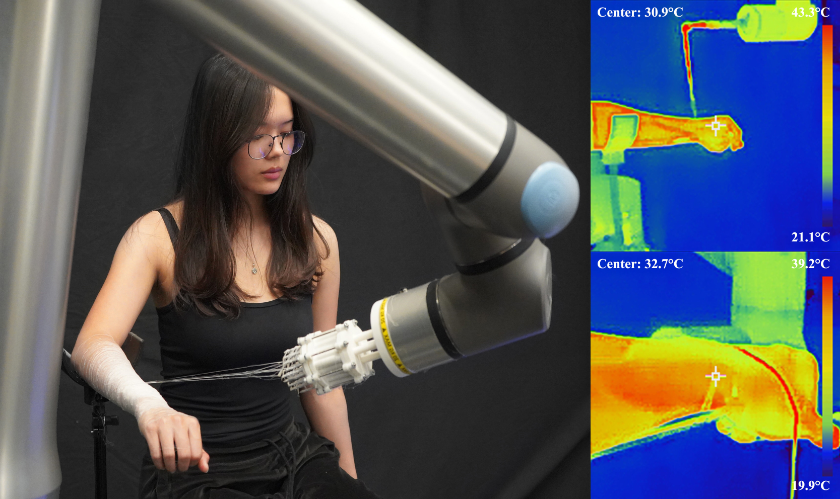
图 2:机械臂张力缠绕热塑性聚己内酯 (PCL) 丝在人体上(左)和皮肤安全 PCL 沉积的热成像(右)。
06 InSituWear 方法
The InSituWear Method
InSituWear 是一种机器人制造方法,它通过熔融拉伸聚己内酯 (PCL) 长丝,直接在人体上生产定制贴合的纺织品,如图 2 所示。与逐层沉积材料的增材制造或从本体中去除材料的减材制造工艺不同,InSituWear 采用拉伸缠绕法。PCL 在针尖处加热至塑化状态(约 55–60℃),被拉伸成连续的丝状,并拉伸缠绕在现有几何形状上,无论是物体、框架还是人体部位。由于长丝横截面很小,其温度在拉伸过程中迅速下降,并在接触皮肤时达到皮肤安全温度(低于约 40℃)。长丝在缠绕过程中保持柔韧性,并在完全冷却后固化成稳定的结构,精确贴合局部轮廓。
该工艺有四个独特之处。首先,InSituWear 采用“形态生成”技术:它不采用预设图案,而是利用 PCL 长丝的拉伸特性来增强结构强度,使纺织结构通过直接在人体上缠绕和交叉而自然形成。其次,它实现了零浪费:无需裁剪、修剪或产生边角料,解决了传统纺织工作流程效率低下的问题。第三,它实现“一步到位”和“即时”操作:无需扫描、数字建模和后组装,设计、合身和制造融为一体,只需一次操作即可完成。第四,它从一开始就具备智能性:热致变色颜料和活性成分可在缠绕过程中嵌入,使可穿戴设备从制造之初就具备交互功能。
InSituWear 方法由三个相互依存的组件构成:机器人平台、计算流程和末端执行器。虽然机器人本身可以是任何兼容的工业机械臂(例如 xArm6 或 UR20),但我们贡献了其他两个要素:用于规划和执行熔融拉伸机器人制造的计算流程,以及一组用于拉伸和缠绕 PCL 纤维的可互换末端执行器。
InSituWear is a robotic fabrication method that produces custom-fittextiles directly onto the human body by melt-drawing polycapro-lactone (PCL) filaments, as illustrated by Figure 2. Unlike additivemanufacturing, which deposits material layer by layer, or subtrac-tive processes, which remove material from bulk, InSituWear em-ploys a pull-and-wrap approach. Heated to a plasticized state atthe needle tip (∼55–60◦C), PCL is drawn into continuous strandsand tension-wrapped around an existing geometry, whether anobject, frame, or body part. Due to the small cross-section of thefilament, its temperature drops rapidly during extension, reachingskin-safe levels (below ∼40◦C) by the time it makes contact. Thefilaments remain flexible during wrapping and then solidify intostable structures as they fully cool, conforming precisely to localcontours.
This process is distinct in four ways. First, it is form-found:instead of imposing pre-prescribed patterns, InSituWear drawsstrength from the tensile behavior of PCL filaments, allowing tex-tile structure to emerge through wrapping and crossing directly onthe human body. Second, it is waste-free: no cutting, trimming, oroffcuts are produced, addressing the inefficiencies of conventionaltextile workflows. Third, it is one-step and on-the-fly: by removingthe need for scanning, digital modeling, and post-assembly, design,fit, and fabrication converge into a single embodied act. Fourth, itis intelligent from the outset: thermochromic pigments and activecomponents can be embedded during wrapping, enabling wearablesto become interactive systems from the moment they are made.
The InSituWear method is composed of three interdependentcomponents: a robotic platform, a computational pipeline, and anend effector. While the robot itself can be any compatible industrialarm (e.g., xArm6 or UR20), we contribute the other two elements:a computational pipeline for planning and executing melt-drawnrobotic fabrication, and a set of interchangeable end effectors forpulling and wrapping PCL fibers.
3.1 计算流程
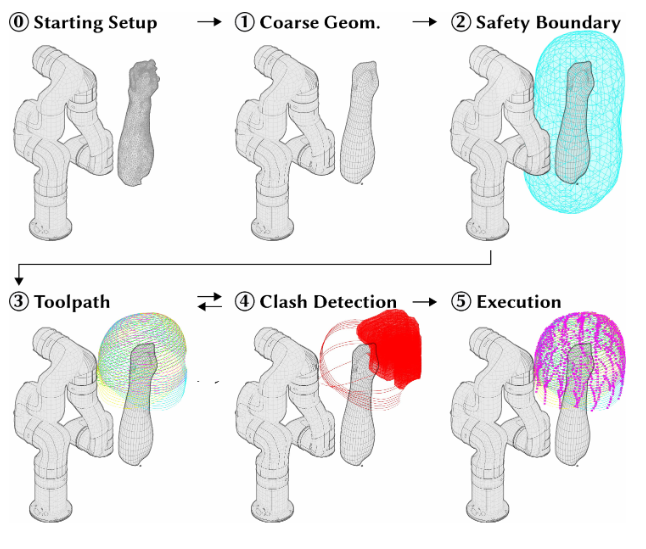
InSituWear 计算流程将设计意图转化为可执行的机器人工具路径规划,用于张力包裹 PCL 的制造,从而确保在人脸接触环境中的安全性和可重复性。每个应用都从一个简化的场景开始,该场景包括制造区域、人体、支撑物、座椅和材料板,这些元素被捕获为规划的基本几何体。如图 3 所示,该流程包含五个阶段:
(1)粗略几何体:一个简化的边界形状(例如,前臂的圆柱体)定义了制造区域。精细的细节无需考虑,因为纤维会通过张力进行自我调整。
(2) 安全边界定义:在粗略几何形状周围引入安全裕度,创建机器人不得越过的禁区(在当前开发的场景中为 20-40 厘米)。
(3) 工具路径生成:给定几何形状和安全边界,系统生成用于丝材沉积的工具路径。这些路径定义了丝材方向、缠绕密度和顺序,并调整刚度、孔隙率和舒适度。
(4) 碰撞检测:除了安全边界之外,还执行碰撞检测,以防止机器人、穿戴者或附近物体之间发生碰撞。
(5) 机器人执行:经过验证的工具路径被转换为机器人特定的命令。执行过程与末端执行器加热循环同步,以确保纤维拉伸的一致性。
3.2 末端执行器套件
InSituWear 方法的关键组件是其末端执行器套件,该套件通过一系列可互换的头部实现 PCL 纤维的机器人熔融拉伸,这些头部可根据不同的制造需求进行定制:多针头用于快速覆盖较大区域(例如前臂),单针头用于更精细、更精确的图案化(例如手套)。该套件的开发经历了系统的原型制作,测试了接触点、间距、加热方法、材料等(图 4)。
3.1 Computational Pipeline
The InSituWear computational pipeline translates design intentinto executable robotic tool path planning for tension-wrappedPCL fabrication, ensuring safety and repeatability in human-facingcontexts. Each application begins with a simplified scene, includ-ing the fabrication volume, human body, resting supports, seating,and material plate, captured as basic geometry for planning. Thepipeline, illustrated in Figure 3, consists of five stages:
(1) Coarse Geometry: A simplified bounding shape (e.g., acylinder for a forearm) defines the fabrication volume. Finedetail is unnecessary, as fibers self-adjust through tension.
(2) Safety Boundary Definition: Safety margins are intro-duced around the coarse geometry, creating exclusion zonesthe robot may not cross (20-40cm on current developedscenes).
(3) Toolpath Generation: Given geometry and safety bound-aries, the system generates toolpaths for filament deposition.These paths define strand orientation, wrapping density, andsequencing, adjusting stiffness, porosity, and comfort.
(4) Clash Detection: In addition to safety boundaries, clashdetection is performed to prevent collisions between therobot, the wearer, or nearby objects.
(5) Robotic Execution: Validated toolpaths are translated intorobot-specific commands. Execution is synchronized withend-effector heating cycles to ensure consistent filamentdraw.
3.2 End Effector Suite
A key component of the InSituWear method is its end effector suite,which enables robotic melt-drawing of PCL fibers through a set ofinterchangeable heads tailored to different fabrication needs: multi-needle heads for faster coverage on larger areas (e.g., forearm) andsingle-needle heads for finer, more precise patterning (e.g., gloves).The suite was developed through systematic prototyping, testingcontact points, spacing, heating methods, materiality, and more(Figure 4)
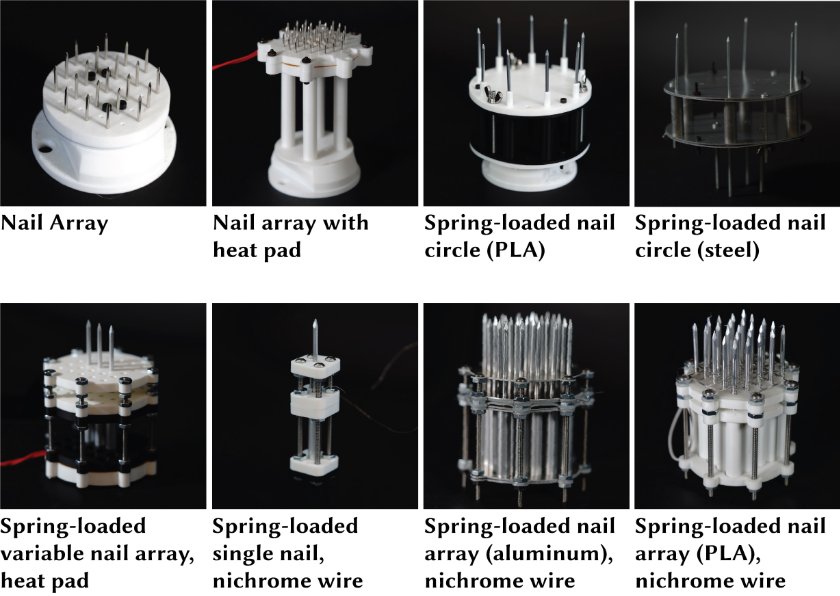
Figure 4: Design development of the multi-needle end effec-tor, exploring nail layout, heating units, and spring loads.
初步评估了3D打印和纤维纺丝中常用的熔融挤出(“滴胶”)策略。挤出法可以精确控制直径,但需要稳定的压力、稳定的流量和固定的喷嘴,因此不适用于本项目探索的多种针头布局的快速迭代。相比之下,浸涂和舀取熔融拉丝法所需的硬件更简单,可以适应不同的几何形状,并允许快速测试多针和单针配置,这些功能对我们的原型制作和制造流程至关重要。
早期的熔融拉丝原型使用带有固定钢钉和外部加热装置的PLA本体,将纤维的来源限制在熔融托盘中,导致丝材质量不稳定(图4a)。随后,加热垫版本增加了内置加热功能,但精度不足,并且与弹簧加载机构不兼容(图4b-d)。因此,每根针头上都直接集成了加热的镍铬丝,从而实现了局部且灵敏的温度控制(图 4e)。可调节电压能够可靠地将针尖温度提升至 PCL 熔点(约 60 ℃)以上,确保了丝材的稳定拉拔。为了适应表面差异,每根针头都安装在压缩弹簧上(图 4f-i)。这种弹簧加载的回缩系统允许在轻微压力下进行垂直位移,从而实现对不均匀 PCL 表面的自校正(图 5)。
这一过程促成了两种互补配置的开发。单针头(图 6)可实现精确控制的线实验和精细图案化。多针阵列头(图 7)则优先考虑效率,能够同时在多个接触点上拉动纤维。这两种配置共同构成了 InSituWear 末端执行器套件:一套可伸缩的加热工具包,支持各种应用中的精细实验和快速纺织品原型制作。
Preliminarily, we evaluated melt–extrude (“drool”) strategiescommonly used in 3D printing and fiber spinning. Extrusion can of-fer precise diameter control but requires regulated pressure, stableflow, and fixed nozzles, making it impractical for rapidly iterat-ing across the many needle layouts explored in this project. Melt-drawing via dipping and scooping, by contrast, required simplerhardware, accommodated varied geometries, and allowed fast test-ing of multi-needle and single-needle configurations, capabilitiesessential to our prototyping and fabrication workflow.
Early melt-draing prototypes used PLA bodies with fixed steelnails and external heating, restricting fiber origin to a molten trayand yielding inconsistent filaments (Figure 4a). Then, heat-pad ver-sions added onboard heating but lacked precision and were incom-patible with spring-loaded mechanisms (Figure 4b-d). Therefore,heated nichrome wire was integrated directly onto each needle,providing localized and responsive temperature control (Figure 4e).Adjustable voltage reliably raised each tip above PCL’s ∼60 ◦C melt-ing point, enabling consistent filament pulling. To accommodatesurface variability, each needle was mounted on a compressionspring (Figure 4f-i). This spring-loaded retraction system allowedvertical displacement under light pressure, enabling self-correctionacross uneven PCL shapes (Figure 5).
This process led to the development of two complementary con-figurations. The single-needle head (Figure 6) provides precisionfor controlled line experiments and detailed patterning. The multi-needle array head (Figure 7) prioritizes efficiency, enabling simulta-neous fiber pulling across multiple contact points. Together, theseconfigurations define the InSituWear end effector suite: a retractable,heated toolkit supporting both fine-grained experimentation andrapid textile prototyping across diverse applications.
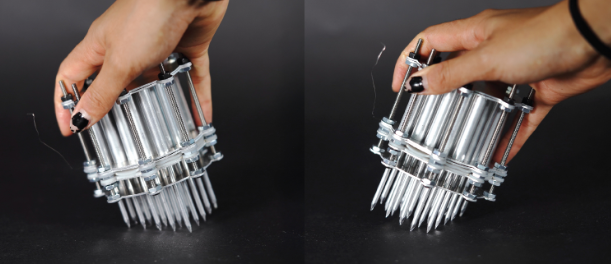
图 5:弹簧加载回缩系统使加热针能够在纤维拉拔过程中适应表面变化。
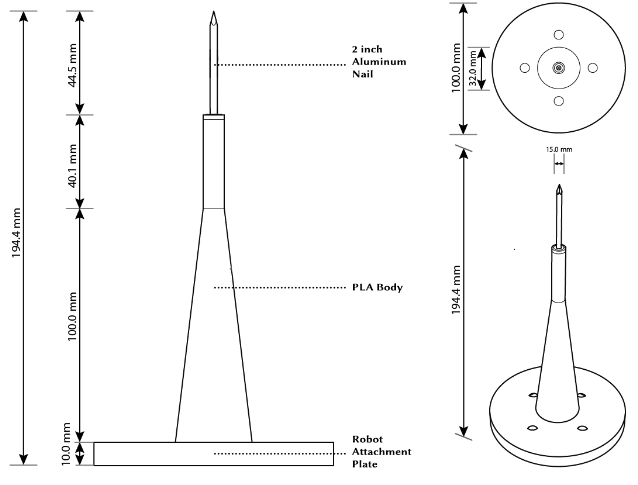
图 6:InSituWear 末端执行器套件:单针头,用于精确的纤维放置和可控的图案化。
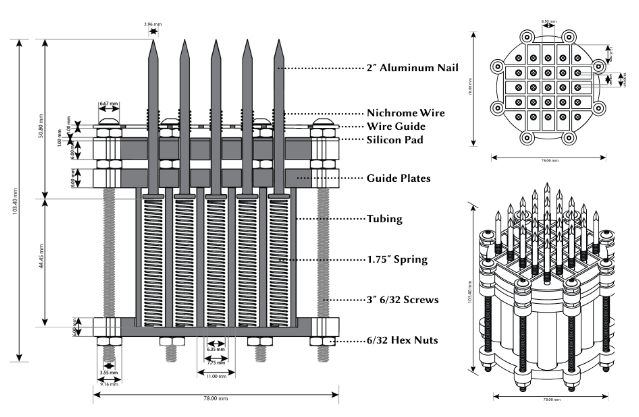
图 7:InSituWear 末端执行器套件:多针头,带有弹簧加载的加热尖端,用于大面积纤维牵引。
07 材料工程与测试
Material Engineering and Testing
这一过程促成了两种互补配置的开发。单针头(图 6)可实现精确控制的线实验和精细图案化。多针阵列头(图 7)则优先考虑效率,能够同时在多个接触点上拉动纤维。这两种配置共同构成了 InSituWear 末端执行器套件:一套可伸缩的加热工具包,支持各种应用中的精细实验和快速纺织品原型制作。
4.1 探索性材料目录 我们选择材料时主要考虑的是人体制造的要求:低热风险、生物相容性、快速固化以及与熔融拉伸工艺的兼容性。聚己内酯 (PCL) 被选为主要结构材料,因为它是一种低温热塑性塑料,在约 55-60℃ 时软化,可在数秒内冷却至皮肤安全温度,并且由于其生物相容性而被广泛应用于矫形器领域 [1]。其快速的冷却速率和粘稠的塑化相使其特别适合张力缠绕,使连续的微丝在拉伸过程中能够粘附,并在冷却后稳定下来。
为了在一步制造工艺中实现功能性和表现性,我们探索了两类添加剂:热致变色粉末和光致变色粉末。这些粉末可以与熔融的 PCL 均匀混合而不会发生化学降解,从而实现熔融拉伸,同时赋予材料对加热器或紫外线的视觉响应。从工艺角度来看,粉末比液体染料或其他添加剂更适合PCL熔融拉伸工艺,因为液体染料或其他添加剂容易燃烧、分离或干扰纤维形成。从交互角度来看,这些变色添加剂为将传感或显示功能直接嵌入纺织品结构中提供了基础,从而支持在制造过程中集成智能的更广泛目标。
基于这些材料选择,我们创建了一个用于实验的PCL-粉末复合材料目录。将热致变色粉末和光致变色(紫外光激活)粉末与PCL颗粒按质量分数0%、2.5%、5%和7.5%进行控制混合(表1)。将每种混合物加热至100℃以熔化PCL,并搅拌至均匀,得到稳定的样品,适用于后续的熔融拉伸和纤维拉伸试验。
Before developing fiber structures and full on-body fabrication,we examined how different material mixtures behave during melt-drawing. This section characterizes the thermoplastics and addi-tives used in InSituWear, revealing how composition and processingparameters shape filament formation. These material studies estab-lish the foundation for controllable fiber production in subsequentexperiments.
4.1 Exploratory Material Catalog
Our material choices were guided by the requirements of on-bodyfabrication: low thermal risk, biocompatibility, rapid solidification,and compatibility with melt-drawing processes. Polycaprolactone(PCL) was selected as the primary structural material because itis a low-temperature thermoplastic that softens at approximately55−60◦C , cools to skin-safe temperatures within seconds, and iswidely used in orthotic applications due to its biocompatibility [1].Its fast cooling rate and tacky, plasticized phase make it particularlywell-suited for tension-wrapping, allowing continuous microfila-ments to adhere as they are drawn and to stabilize once cooled.
To embed functional and expressive behavior within a one-stepfabrication process, we explored two classes of additives, ther-mochromic and photochromic powders. These powders mix ho-mogeneously with molten PCL without chemical degradation, en-abling melt-drawing while providing visual responsiveness to heator ultraviolet light. From a process standpoint, powders were more compatible with PCL melt-drawing than liquid dyes or alternateadditives, which tended to burn, separate, or interfere with filamentformation. From an interaction standpoint, these color-changingadditives provide a basis for embedding sensing or display-likequalities directly into the textile structure, supporting the broadergoal of integrating intelligence during fabrication.
Building on these material choices, we created a catalog of PCL–powder composites for experimentation. Thermochromic and pho-tochromic (UV-activated) powders were mixed with PCL pelletsat controlled concentrations of 0%, 2.5%, 5%, and 7.5% by weight(Table 1). Each mixture was heated to 100◦C to melt the PCL andstirred until homogeneous, producing stable samples suitable forsubsequent melt-drawing and fiber-pulling tests.
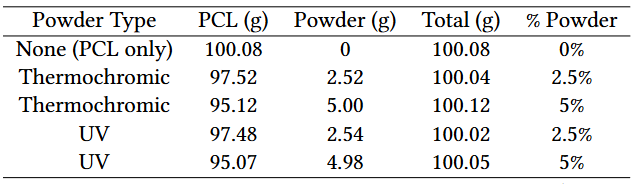
表 1:材料目录:PCL-粉末混合物(热致变色和紫外)
4.2 直纤维拉拔试验
为了评估机器人控制下纤维的质量和厚度,我们对热致变色和光致变色粉末混合物进行了拉拔试验。每个托盘固定在加热板上并重新加热至100℃,然后放置在配备InSituWear单钉末端执行器的机械臂(xArm6)下方。该工具下降到熔融材料下方5 mm的深度,保持5秒钟,然后缩回(图8)。纤维以200 mm/s²的加速度垂直拉拔至700 mm的高度,拉出单根纤维丝。每种粉末溶液均在三种不同的速度下进行测试:100 mm/s、300 mm/s 和 500 mm/s,以确定速度对纤维厚度的影响。
实验结果表明,提高拉伸速度可生成更细的纤维,而较高浓度的粉末则始终生成更粗的纤维,最小宽度为 0.03 mm,最大宽度为 0.42 mm(图 9)。此外,粉末质量浓度为 7.5% 的混合物在达到 700 mm 高度之前即发生断裂,因此无法收集纤维进行成像。这表明材料组成和制造动力学对纤维形成具有耦合效应,并表明可以通过调整特定的混合比例和机器人参数来控制纤维的几何形状。
4.2 Straight Fiber Pull-Outs
To evaluate strand quality and fiber thickness under robotic con-trol, we conducted pull-out tests with the thermochromic and pho-tochromic powder mixtures. Each tray was secured and reheated to100 ◦C on a heating plate, then placed under a robotic arm (xArm6)equipped with InSituWear’ single-nail end effector. The tool waslowered to a depth of 5 mm beneath the molten material, held forfive seconds, and then retracted (Figure 8). The fiber was pulledvertically to a height of 700 mm at an acceleration of 200 mm/s2 ,drawing a single fiber filament. Each powder solution was testedat three different speeds: 100 mm/s, 300 mm/s, and 500 mm/s, todetermine how speed impacts the thickness.
The results of the experiment showed that increasing pullingspeed generated thinner fibers, while higher concentrations of pow-der produced consistently thicker fibers, with minimum width at0.03mm and maximum width at 0.42mm (Figure 9). Moreover, mix-ture concentrations of 7.5% powder by weight consistently brokebefore reaching 700mm height, and thus their fibers could not becollected for imaging. This demonstrates the coupled effect of ma-terial composition and fabrication dynamics on fiber formation,indicating specific mixture ratios and robotic parameters can betuned to control fiber geometry.
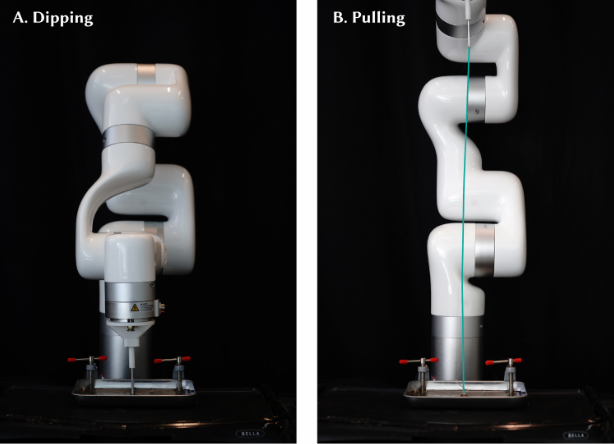
图 8:单根 PCL 长丝的机器人拉丝过程(为便于观察,纤维已着色)
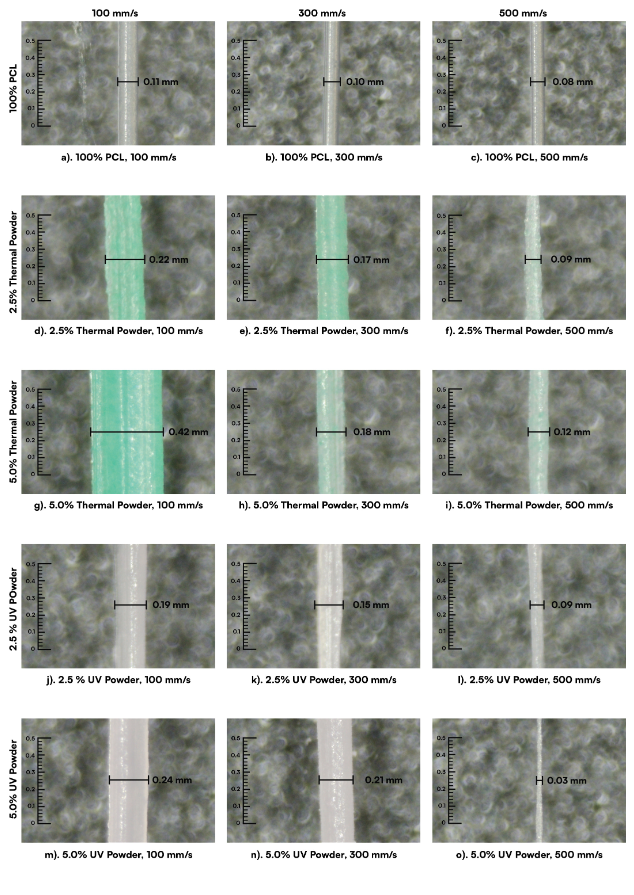
图 9:不同速度和粉末浓度下产生的纤维宽度。
08 纤维结构模式
Fiber Structure Patterns
InSituWear纺织品的性能不仅取决于材料本身,还取决于纤维如何聚集形成结构。本文探讨了计算机辅助工具路径规划如何转化为机器人拉伸缠绕模式。我们证明,原位制造的纤维结构为定制化可穿戴设备创造了可调的设计空间。
5.1 制版装置
实验装置包括:(1) UR20 机械臂作为机器人平台,搭载 In-SituWear 公司的单针末端执行器;(2) 一个水平圆柱体(直径 10 cm × 长度 25 cm),放置在离地 1.5 m 处,作为目标制造体积;(3) 一个 23 cm × 23 cm 的加热板,放置在离地 40 cm 处(图 10)。
5.2 浸涂和刮取策略
纤维的稳定形成需要浸涂(图 11)和刮取(图 12)操作流程。每个循环包括旋转工具中心点 (TCP),浸入熔融表面,并进行 1.5 cm 的刮取动作以捕获材料,然后再进行拉伸和沉积。每次浸涂和拉伸操作都会在纤维脱离处留下一小堆半熔融的 PCL。如果工具在凸起物沉降之前再次下压,凸起的材料就会堆积,粘附在末端执行器上,从而破坏丝状物的形成。为了避免这种情况,我们将下压点分布在16个点的阵列上,最小间距为4厘米,这样可以使表面有时间重新平整,减少材料堆积,最终形成更光滑、更均匀的丝状物。
5.3 刀具路径到图案的转换
图 13 展示了我们通过直接投影将刀具路径初步转换为纤维铺放映射的过程。通过在目标几何体上投影纤维轨迹,我们在制造前可视化并调整了角度、密度和环数。
5.4 缠绕图案
我们通过改变几何参数并记录其结果,评估了三种缠绕策略(图 14)。
(1) 平行缠绕。以恒定(2 mm)或可变(1–25 mm)间距排列的纤维形成紧绷的网状薄片。理论上,平行结构应该是最弱的,因为力主要沿单一轴作用。实际上,由于轻微的沉积不规则性而产生的偶然交联提供了有限的内聚力。
(2) 交叉缠绕。以 30° 和 45° 角缠绕形成双向网格。这些图案增加了纤维间的摩擦和锁结,从而提高了撕裂强度,优于平行网格结构。然而,侧面密度较低,导致应力分布不均,形成强度较弱的表面。
(3) 斜交网格缠绕。将交叉原理延伸至连续螺旋结构,生成了所有表面均均匀编织的斜交网格结构。这种对称性解决了交叉样品中观察到的强度较弱的表面问题,从而制备出稳定性强、撕裂强度均衡的管状织物。
通过这些研究,我们观察到图案规划如何直接影响物理图案的生成和初步的纺织品性能。平行网格在应力作用下容易分离,交叉图案虽然重新分配了载荷,但会引入薄弱面,而斜交网格则提供了跨方向的冗余支撑。这些见解为后续实验提供了指导,展示了如何调整包裹图案,以在刚度、弹性和强度之间取得平衡,同时兼顾制造的复杂性。
The performance of InSituWear textiles depends not only on the ma-terial itself but also on how filaments are aggregated into structures.Here we examine how computational toolpath planing translatesin to robotic pull-and-wrap patterns. We show that fiber struc-tures fabricated in-situ create a tunable design space for custom-fitwearables.
5.1 Pattern Making SetupThe experimental setup consists of: (1) a UR20 robotic arm as therobotic platform carrying the single needle end effector from In-SituWear’s end effector suite (2) a horizontal cylinder (10 cm indiameter × 25 cm in length), placed at 1.5m above the ground, astarget fabrication volume, and (3) a 23cm x 23cm heating plateplaced 40cm above the ground (Figure 10).
5.2 Dipping and Scooping StrategiesStable formation of fibers required a dipping (Figure 11) and scoop-ing protocol (Figure 12). Each cycle rotated the tool center point(TCP), dipped into the molten surface, and performed a 1.5cm scoop-ing motion to capture material before elongation and deposition.Each dip-and-pull leaves behind a small mound of semi-moltenPCL where the filament detaches. If the tool dips again before thismound has time to settle, the raised material accumulates, stickingto the end effector and disrupting filament formation. To avoid this,we distributed dips across a 16-point array with 4 cm minimumspacing, giving the surface time to re-flatten and reducing materialbuildup, which resulted in smoother, more uniform filaments.
5.3 Toolpath-to-Pattern TranslationFigure13 shows our preliminary translation from toolpaths to fiberplacement mapping through direct projection. Through projectedfiber trajectories on the target geometry, we visualized and adjustedangle, density, and loops before fabrication.
5.4 Wrapped PatternsWe evaluated three categories of wrapping strategies by varyinggeometric parameters and documenting their outcomes (Figure 14).(1) Parallel Wrappings. Filaments arranged in constant (2 mm)or variable (1–25 mm) spacing produced taut, mesh-likesheets. In principle, parallel structures should be weakestsince forces act predominantly along a single axis. In practice,incidental cross-links from minor deposition irregularitiesprovided limited cohesion.(2) Crossing Wrappings. Wrappings at 30◦ and 45◦ producedbi-directional grids. These patterns increased inter-fiber fric-tion and locking, yielding higher tear resistance than parallelmeshes. However, the lateral sides remained less dense, pro-ducing weak faces where stress was unevenly distributed.(3) Diagrid Wrappings. Extending the crossing principle into acontinuous spiral generated diagrid structures with uniformweaving across all faces. This symmetry resolved the weakfaces observed in crossing samples, producing tubular fabricswith strong stability and balanced tear resistance.
Through these studies, we observed how pattern planning di-rectly shaped physical pattern generation and preliminary textileperformance. Parallel meshes tended to separate under stress, cross-ing patterns redistributed loads but introduced weak planes, anddiagrids provided redundant support across orientations. These in-sights informed later experiments, showing how wrapping patternscan be tuned to balance rigidity, elasticity, and strength againstfabrication complexity.
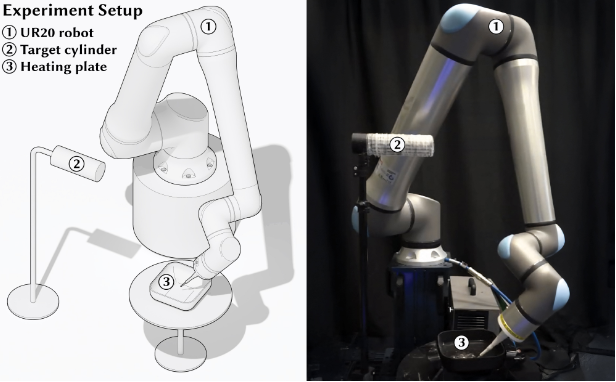
图 10:使用 UR20 机械臂和单针末端执行器进行机器人 PCL 张力缠绕的实验装置的照片(左)和数字模拟(右)。
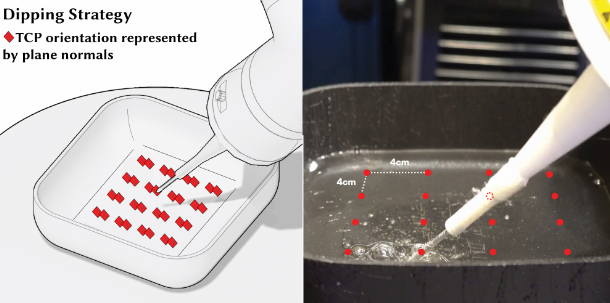
图 11:PCL 纤维捕获浸渍策略的照片(左)和模拟结果(右)
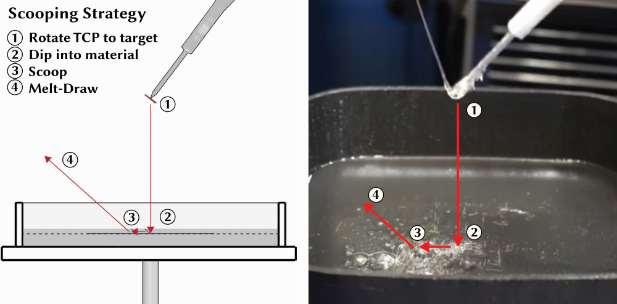
图 12:PCL 纤维捕获的舀取策略照片(左)和模拟结果(右)。
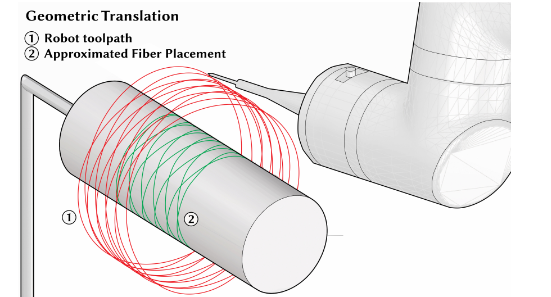
图 13:刀具路径到目标的转换:外部 TCP 刀具路径和圆柱体上的投影光纤放置位置
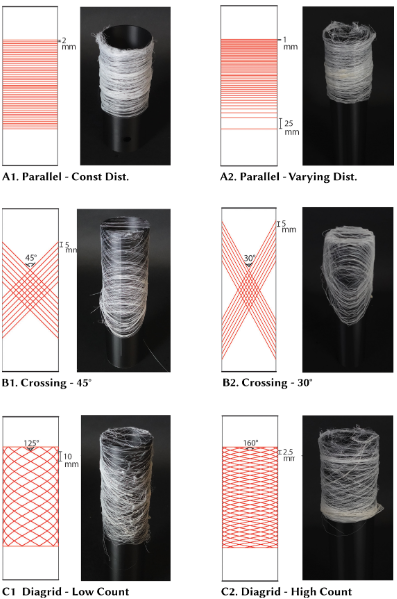
图 14:通过平行、交叉和斜交网格缠绕策略制备的纤维结构样品
09 熔拉伸纺织品的力学性能评价
Mechanical Evaluation of Melt-DrawnTextiles
基于第5节中开发的纤维结构,我们对相同的样品进行了拉伸试验,以了解其力学性能。本节将熔融拉伸的PCL结构与机织物进行对比,初步表征了不同的刀具路径、方向和密度如何影响InSituWear织物的耐久性和变形能力。
6.1 实验设置
我们测试了第5节中制备的六个熔融拉伸PCL样品,以及一系列传统纺织品(亚麻、棉和丝质欧根纱)。所有材料均使用Instron单柱万能试验机,采用标准化的条带试验方案进行评估。每个试样均被切割成均匀的矩形条(约25 mm × 100 mm)。试样使用平面拉伸夹具进行固定,以确保均匀的夹紧压力,标距为50 mm。试验在位移控制模式下进行,速率为10 mm/min,直至试样断裂,并连续记录载荷(N)和延伸量(mm)。
此外,所有样品均进行了称重和测量,以计算其单位面积质量(克/平方米,GSM),从而可以比较不同密度和厚度的材料。
6.2 力学性能结果
我们将第5节中的六个熔融拉伸PCL样品与代表性机织物进行了比较(图16,表2)。就单位面积质量(GSM)而言,PCL结构(194–293 g/m²)的质量介于棉(168 g/m²)和亚麻(424 g/m²)之间,处于较重商用织物的质量范围内。就承载能力而言,PCL样品在进入变形平台期之前达到了37–84 N的峰值载荷,与棉(68–101 N)和真丝欧根纱(41–76 N)等低克重织物相当。最后,就延展性而言,PCL结构在峰值载荷下伸长了5–16 mm,与真丝欧根纱(5–15 mm)相似。综合来看,这些结果表明熔融拉伸的PCL可以在与普通纺织品相当的可用机械范围内运行,这表明可以对其进行微调,以用于实际的可穿戴应用。
熔融拉伸和机织样品的失效方式存在显著的质的差异(图 16)。机织织物表现出突发性断裂(例如,真丝欧根纱在 50 N 以下的载荷下几乎没有延伸就断裂,而亚麻布在 150–175 N 的载荷下发生剧烈撕裂)。相比之下,PCL 网络并未发生灾难性撕裂:它们进入塑性变形区域,在拉伸的同时继续承受载荷。这种延展性和能量吸收特性表明,熔融拉伸织物在局部应力作用下可能具有更高的韧性。
总体而言,这些结果表明,InSituWear 织物在克重、强度和延伸率方面均达到了商用织物的实用水平,表明其适用于实际可穿戴设备。此外,角度几何形状对性能的显著影响表明,可以通过计算设计和调整力学性能,以实现不同应用所需的特定性能。
Building on the fiber structures developed in Section 5, we per-formed tensile tests on those same samples to understand their me-chanical performance. Benchmarking melt-drawn PCL structures towoven textiles, this section establishes an initial characterization ofhow different toolpaths, orientations, and densities affect durabilityand deformation of InSituWear fabrics.
6.1 Experiment Set upWe tested the six melt-drawn PCL samples produced in Section 5alongside a set of conventional textiles (linen, cotton, and silk or-ganza). All materials were evaluated on an Instron single-columnuniversal testing machine using a standardized strip-testing pro-tocol. Each specimen was cut into a uniform rectangular strip (ap-proximately 25 mm × 100 mm). Specimens were mounted usingflat-faced tensile grips to ensure even clamping pressure, and a50 mm gauge length. Tests were run under displacement controlat 10 mm/min until rupture, with load (N) and extension (mm)recorded continuously.
In addition, all samples were weighed and measured to computetheir mass per unit area (grams per square meter, GSM), enablingcomparison across materials with different densities and thick-nesses.
6.2 Mechanical Performance Results We compared the six melt-drawn PCL samples from Section 5against representative woven textiles (Fig. 16, Table 2). In terms ofmass per area (GSM), the PCL structures (194–293 g/m2) fall withinthe range of heavier commercial fabrics, between cotton (168 g/m2)and linen (424 g/m2). In terms of load resistance, the PCL sam-ples reached peak loads of 37–84 N before entering a deformationplateau, comparable to lower GSM fabrics such as cotton (68–101N) and silk organza (41–76 N). Finally, in terms of extensibility,the PCL structures elongated by 5–16 mm at peak load, similar tosilk organza (5–15 mm). Taken together, these results indicate thatmelt-drawn PCL can operate within a usable mechanical regimecomparable to common textiles, suggesting viability for fine-tuningfor real-world wearable use.
A notable qualitative difference emerged in how melt-drawnand woven samples failed (Fig. 16). Woven textiles exhibited abruptrupture (e.g. silk organza failed below 50 N with almost no extension,and linen tore sharply at 150–175 N). In contrast, PCL networks didnot tear catastrophically: they entered a plastic deformation region,continuing to carry load while stretching. This ductile, energy-absorbing behavior could suggests that melt-drawn textiles mayoffer greater resilience in scenarios involving localized stress.
Overall, these results show that InSituWear textiles performwithin the practical range of commercial fabrics in terms of GSM,strength, and extension, pointing towards their feasibility for real-world wearables. In addition, the clear influence of angle geometryon performance indicates that mechanical behavior can be designedand tuned computationally to achieve specific behaviors for differ-ent applications.
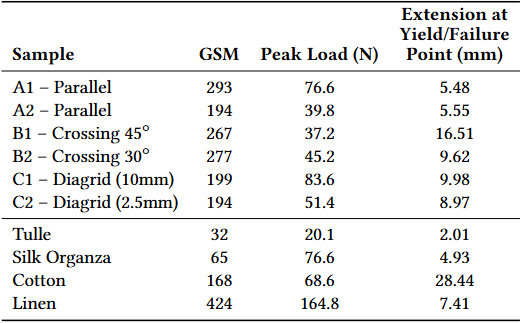
表2:熔融拉伸PCL样品和参考纺织品的力学性能。峰值载荷和屈服或断裂点的延伸率均提取自拉伸试验(图16)。
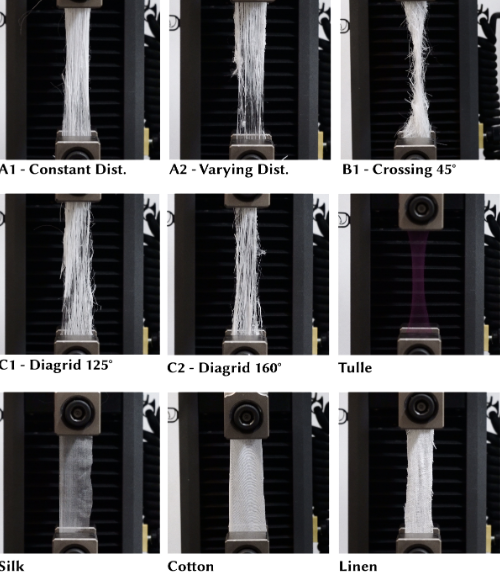
图 15:拉伸试验期间 InSituWear 样品(A1、A2、B1、C1、C2)和商业纺织品(薄纱、丝绸、棉布、亚麻布)的照片。
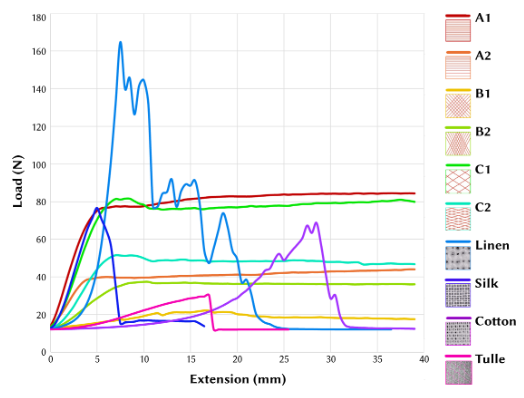
图 16:PCL 纺织品和商用织物拉伸试验中的载荷-延伸曲线(N 与 mm)。
10 纺织智能
Textile Intelligence
在确定了熔融拉伸织物的结构和力学性能后,我们接下来研究如何赋予这些纤维适用于人机交互的功能性响应特性。本节重点关注热激活,评估热致变色添加剂对嵌入式电阻加热的响应。通过比较不同线径和集成到熔融拉伸结构中的导电线,我们初步验证了构建响应式交互纺织元件的可行性。
7.1 实验装置
为了评估嵌入式加热元件对材料的活化效果,我们用几种导电材料制作了网格(图 17),并在网格上缠绕了一层张力包裹的 5% 热致变色 PCL 混合物(详见第 3 节)。
我们制备了五个 150 mm × 150 mm 的框架,每个框架分别串入一种导电元件:36、32、28 和 22 AWG 线规,以及导电钢线。每个网格框架外都留有足够的导线长度,以便通过鳄鱼夹连接到电源。22 AWG 和 28 AWG 网格的单个线段长度为 17 cm,而 32 AWG、36 AWG 和导电钢线网格的单个线段长度为 10 cm。
在评估过程中,我们将每根导线首尾相连连接到电源,并逐渐增加电压和电流,直至观察到纤维颜色变化。表3总结了结果,其中列出了激活所需的最小电流和电压,以及每种导线类型的相应长度和电阻。
7.2 激活结果及设计启示
在电气方面,激活阈值符合预期趋势:较粗的导线(22–28 AWG)在低电压下需要更高的电流,而较细的导线(32–36 AWG)则在较低电流下需要更高的电压才能激活。所有测试配置均在安全的低电压范围(1.0–3.2 V)内工作,且电流消耗与小型加热元件相当(0.13–1.84 A),因此可与便携式电源兼容。
在热学方面,两种铬粉的激活温度相匹配:低温型为 29℃,高温型为 45℃。由于皮肤温度通常为 32–37℃,因此 29℃ 的铬粉无需电子元件即可被动激活。45℃ 的铬粉需要电阻加热,但在我们的原型中,加热器与皮肤之间由 PCL 层隔开,从而起到绝缘作用。这些结果表明,在适当的绝缘条件下,短时激活是可行的,但仍需进一步测试以确定长期佩戴的安全使用方式。
线规也会影响空间热分布。较粗的线(22、28 AWG)由于热容量更大,扩散区更宽,从而产生平滑的激活梯度。较细的线(32、36 AWG)和导电线则产生更窄、更局部的激活,并为纺织品集成提供了更大的机械灵活性。这些差异使得设计人员可以选择扩散或高度局部的加热效果。
总体而言,结果表明,熔融拉伸纺织品可以使用低压系统安全有效地集成热响应功能。体温激活提供被动响应,而可控电阻加热则支持可编程交互。这些发现共同为未来的应用奠定了实践基础,例如情绪响应服装、热驱动闭合装置、自适应视觉信号或直接嵌入 InSituWear 纤维中的交互式材料行为。
Having established the structural and mechanical viability of melt-drawn textiles, we next investigate how these fibers can be endowedwith functional, responsive behavior suitable for human materialinteraction. In this section we focus on heat-based activation, eval-uating how thermochromic additives respond to embedded resis-tive heating. By comparing different wire gauges and conductivethreads integrated into the melt-drawn structure, we provide initialvalidation for creating responsive and interactive textile elements.
7.1 Experiment Setup
To evaluate material activation with embedded heating elements,we fabricated grids from several conductive media (Figure 17) andapplied a tension-wrapped layer of the 5% thermochromic PCLmixture introduced in Section 3.
Five 150 mm x 150 mm frames were prepared, each strung withone type of conductive element: 36, 32, 28, 22 AWG, as well asconductive steel thread. Each grid included sufficient excess wirelength outside of the frame to allow attachment to a power sourcevia alligator clips. Individual segments measured 17 cm for the 22AWG and 28 AWG grids, and 10 cm for the 32 AWG, 36 AWG, andconductive thread tests.
For evaluation, individual wires were connected end-to-end witha power source, and voltage and current were gradually increaseduntil fiber color change was observed. Results are summarized inTable 3, which reports the minimum current and voltage requiredfor activation, as well as the respective lengths and resistances foreach wire type.
7.2 Activation Results and Design Implications
Electrically, activation thresholds followed expected trends: thickerwires (22–28 AWG) needed higher currents at low voltages, whilethinner wires (32–36 AWG) activated with lower currents but highervoltages. All tested configurations operated within safe, low-voltageranges (1.0–3.2 V) and drew currents comparable to small heatingelements (0.13–1.84 A), making them compatible with portablepower sources.
Thermally, activation temperatures matched the two chromicpowders: 29◦C for the low-temperature variant and 45 ◦C for thehigh-temperature one. Since skin is typically 32–37 ◦C, the 29 ◦Cpowder can activate passively, without electronics. The 45 ◦C pow-der requires resistive heating, but in our prototypes the heater isseparated from skin by a PCL layer, providing insulation. Theseresults suggest short-duration activation is feasible with proper in-sulation, though further testing is needed to define safe long-termwearable use.
Wire gauge also influenced spatial heat distribution. Thickerwires (22, 28 AWG) exhibited broader diffusion zones due to higherthermal mass, producing smooth activation gradients. Thinnerwires (32, 36 AWG) and conductive thread generated narrower,more localized activation, and offered greater mechanical flexibilityfor textile integration. These differences allow designers to selectbetween diffuse or highly localized heating effects.
Overall, the results show that melt-drawn textiles can integrateheat-responsive behavior safely and effectively using low-voltagesystems. Body-heat activation offers passive responsiveness, whilecontrolled resistive heating supports programmable interaction.Together, these findings establish a practical foundation for futureapplications such as mood-responsive garments, thermally actuatedclosures, adaptive visual signaling, or interactive material behaviorsembedded directly within InSituWear fibers.
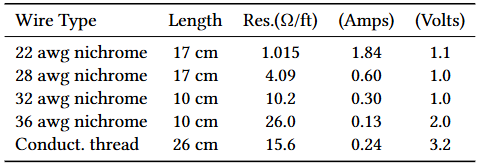
表3:不同线型、长度和电阻下光纤激活所需的最小电流和电压
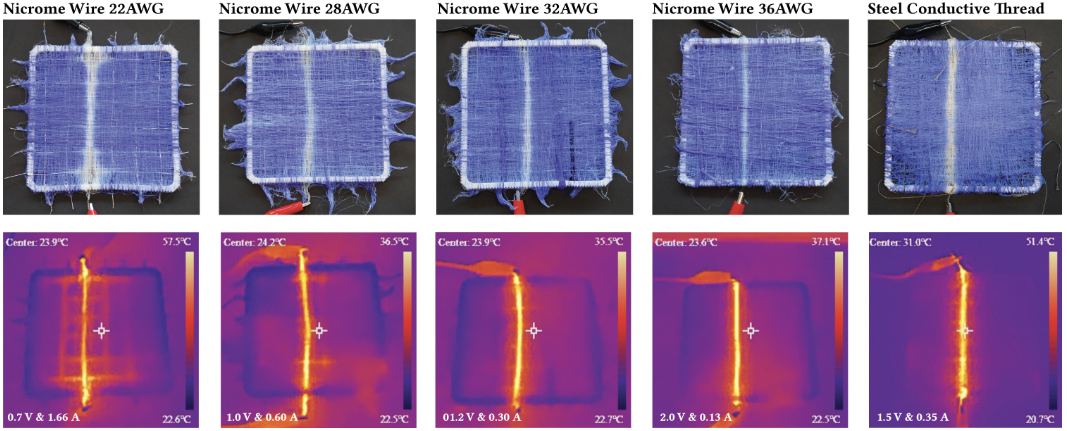
图 17:按材料和规格划分的纺织集成加热元件的热扩散。
11 应用与演示
Applications & Demos
我们展示了两个人体穿戴原型,分别体现了InSituWear方法的两个不同方面:图案控制和嵌入式纺织智能。随后,我们将应用范围扩展到可穿戴设备之外,展示了其在家具和建筑轻型结构框架方面的潜在应用。这些案例研究共同阐明了机器人熔融拉伸技术如何从可控纤维沉积发展到交互式服装,并拓展到更广泛的领域。
8.1 袖子
我们的袖子原型(图18和图19)展示了人体穿戴制造和可控图案执行的可行性。我们使用纯PCL混合物、UR20机械臂以及InSituWear套件中的单针末端执行器,在22分钟内制作了一个35厘米长的编织袖子。该工艺实现了第五章中介绍的90度交叉图案,但精度和稳定性更高。该案例突显了该方法将图案策略扩展到全身应用的能力,同时保持与穿着者安全可靠的交互。
8.2 手套
手套原型(图 20 和 21)展示了将嵌入式智能集成到纺织品本身的过程。该原型使用聚己内酯 (PCL) 和热致变色粉末混合物(粒径 10 μm,体积比 5%)制成,仅用时 15 分钟。手掌部分采用多针末端执行器,手指部分采用单针末端执行器。每个指尖都嵌入了镍铬丝(32 号线规),并连接到 4.5 V 电池。当任何手指接触拇指时,闭合电路会加热镍铬丝,从而激活局部颜色变化。更广泛地说,热致变色颗粒还会对体温升高做出响应,产生渐变效果:较厚的区域保持蓝色,而周围区域则变为白色。该作品展示了如何利用 PCL 熔融拉伸工艺将传感和响应功能直接嵌入到可穿戴设备中。
8.3 其他应用
除了服装之外,InSituWear 技术还可以扩展到空间应用领域,通过包裹三维框架而非人体来实现。由于该工艺可以在任何几何形状周围形成连续的纤维网络,因此可以通过包裹杆、圆锥体或开放式晶格框架来制造轻质结构单元。这些单元还可以使用树脂等材料进行加固,以提高结构性能。图 22 中的示例展示了这一方向:用作基础几何形状的原型圆锥框架、物理机器人包裹研究以及推测性设计成果,例如由多个包裹单元组装而成的凳子和穹顶状展馆。虽然这些研究尚处于探索阶段,但它们展示了熔融拉伸纺织品如何应用于家具和建筑领域,从而能够利用与人体制造相同的原理,实现快速、轻便的纤维结构。
We present two on-body prototypes that demonstrate distinct as-pects of the InSituWear method: pattern control and embeddedtextile intelligence. We then extend beyond wearables to show po-tential applications to lightweight structural frames for furnitureand architecture. Together, these case studies illustrate how roboticmelt-drawing moves from controlled fiber deposition, to interactivegarments and beyond.
8.1 Sleeve
Our sleeve prototype (Figure 18 & Figure 19) demonstrates feasibil-ity of on-body fabrication and controlled pattern execution. Usinga pure PCL mixture, the UR20 robotic arm, and the single-needleend effector from the InSituWear suite, we produced a 35 cm wo-ven sleeve in 22 minutes.The process implemented the crossing90-degree pattern introduced in Chapter 5, but at a higher levelof precision and stability. This case highlights the method’s abil-ity to scale a patterning strategy to full-body applications whilemaintaining safe and reliable interaction with the wearer.
8.2 Glove
The glove prototype (Figure 20 & 21) demonstrates the integrationof embedded intelligence within the textile itself. The prototype wasfabricated in 15 minutes with a PCL and thermochromic powdermixture (10 𝜇m particle size, 5% by volume) using a multi-needle endeffector for the palm and a single-needle end effector for the fingers.Nichrome wires (32 gauge) were embedded in each fingertip andconnected to a 4.5 V battery. When any finger touches the thumb, aclosed circuit heats the wire, activating localized color change. Morebroadly, thermochromic particles also respond to increased bodyheat, creating a gradient effect where thicker regions remain bluewhile surrounding areas shift to white. This piece illustrates howPCL melt-drawn fabrication can embed sensory and responsivebehaviors directly into wearable forms.
8.3 Other Applications
Beyond garments, InSituWear can be extended to spatial applica-tions by wrapping three–dimensional frames rather than the humanbody. Because the process forms continuous fiber networks aroundany geometry, lightweight structural units can be fabricated bywrapping rods, cones, or open lattice frames. These units can alsobe reinforced with materials such as resin to increase structuralperformance. The examples in Figure 22 illustrate this direction: aprototypical conical frame used as a base geometry, physical roboticwrapping studies, and speculative design outcomes such as a stooland a dome-like pavilion assembled from multiple wrapped units.While exploratory, these studies demonstrate how melt-drawn tex-tiles could translate to furniture and architectural contexts, enablingrapid, lightweight, fiber-based construction using the same princi-ples developed for on-body fabrication.
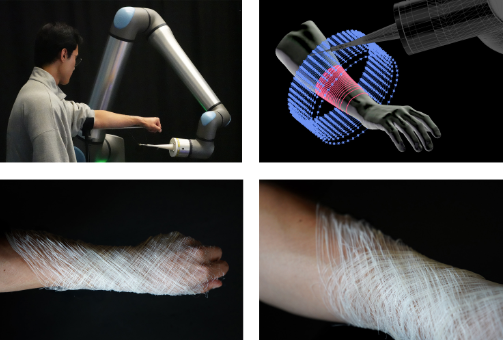
图 18:机器人对体包裹的 PCL 套管原型。图像阵列显示了制造过程(左上)、刀具路径仿真(右上)、侧视图(左下)和细节视图(右下)。
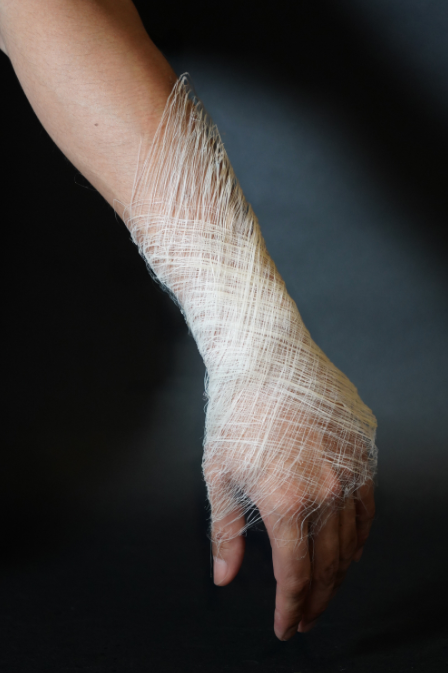
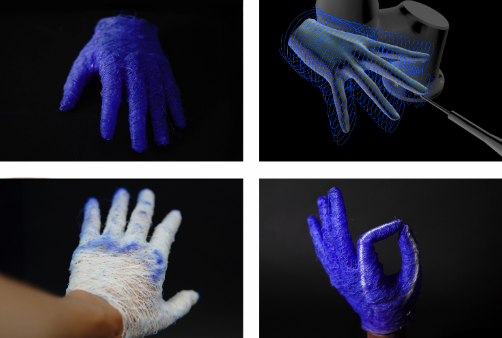
图 20:熔融拉伸成型的人体穿戴式手套原型。图像阵列显示了正面视图(左上)、刀具路径模拟(右上)、全手热致变色激活(左下)和局部镍铬丝激活(右下)。
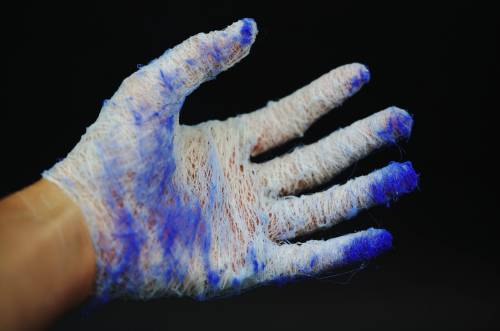
图 21:一体成型手套。热致变色添加剂会随温度变化而改变颜色,从而凸显织物的较厚区域。
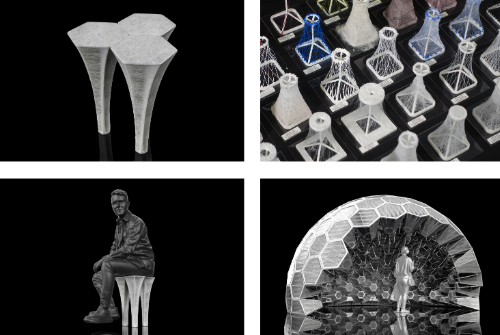
图 22:基于 3D 框架的推测性应用拼贴画,包括:模拟包裹圆锥形框架(左上)、物理研究熔融包裹 3D 打印框架(右上)、推测性包裹凳子概念(左下)以及由多个包裹单元组装而成的建筑穹顶(右下)。
12 讨论
Discussion
我们对 InSituWear 的探索引发了关于可持续性、交互性、设计方法和具身制造的更广泛思考,同时也揭示了其局限性以及未来工作的方向。
- 可持续性。InSituWear 将可穿戴设备的制造重新构想为一种零浪费、可回收的工艺。通过直接在人体上进行加工,它消除了裁剪浪费并减少了过度生产,符合循环经济的目标[10]。此外,使用可回收的聚己内酯 (PCL) 表明,这为可持续的材料循环提供了一条途径,服装可以被重新熔化和重塑,而不是被丢弃。
- 交互性。InSituWear 将可穿戴设备定位为用于制造的交互系统。现场制造的即时性模糊了制造和穿着之间的界限,将制造本身定位为一个交互场所。这与人机交互 (HCI) 对具身设计[19]和以材料为中心的交互[42]的持续关注相一致。我们的材料探索进一步凸显了这种潜力:嵌入热致变色和紫外线反应粉末的PCL纤维展示了纤维本身如何动态响应环境或生理信号。在此,纺织智能直接源于材料本身,而非通过外部硬件层层叠加,这为交互设计指明了新的方向,使物质本身成为表达的载体。
- 设计启示。在方法论上,InSituWear将制造过程从“强加形状”转向“生成形态”。我们的工艺并非将数字模型强加于被动的物质之上,而是将材料特性——例如PCL的弹性、熔融时的延展性以及冷却时收缩并紧密包裹轮廓的特性——作为设计的主动驱动力。这些特性使得材料在沉积过程中能够紧密贴合人体曲线。这指向了一种具身制造的范式,一种通过人体、机器和材料之间的互动来生成形态的设计方法。
- 局限性。尽管 InSituWear 证明了体表熔融拉伸技术的可行性,但仍存在一些挑战。与其他制造方法相比,熔融拉伸技术本身就受到锚定表面几何形状的限制,无论是人体还是物理框架。平坦或高度凹陷的区域仍然难以加工。虽然多针末端执行器提高了制造速度,但与工业纺织工艺相比仍然较慢,而且在复杂几何形状上实现纤维的一致放置需要更高的图案精度。其他末端执行器(例如,空心或钩状尖端)尚未进行评估,但可能有助于提高纤维的控制。PCL 的长期耐久性、舒适性和在反复弯曲下的性能需要进一步研究。同样,部署前仍需要一套完善的人机交互安全协议。最后,虽然我们对建筑和产品级应用的初步探索凸显了有前景的方向,但这些场景仍处于推测阶段,需要进行针对性验证。这些局限性共同表明,要实现更广泛的应用,需要在技术、材料和方法方面进行改进。
- 未来方向。这些局限性也为研究开辟了富有成效的途径。InSituWear 的未来迭代版本可以扩展到全身服装,集成传感器以实现智能可穿戴设备,并扩展到用于响应性纺织品的多材料制造。通过在包裹过程中改变纤维特性,例如结合刚性纤维和柔性纤维,设计师可以局部调整刚度和顺应性。此外,集成计算机视觉将使系统能够在制造过程中动态响应人体运动,从而实现更安全、更具适应性和个性化的结果。此外,我们正在将 InSituWear 的硬件和软件组件开发成开源工具,并计划将其发布给社区。这将为研究人员和从业人员提供易于获取的资源,以探索、扩展和改进原位机器人制造技术。最后,我们设想在制造过程中,通过机器人直接分配导电细丝,而不是手动嵌入导电线或导线。这些材料可以通过热编程按需激活,从而实现新型的交互行为和纺织智能。
总而言之,这些方向使 InSituWear 不仅成为一种制造方法,更成为一个探索响应式、智能化和具身化纺织品未来的平台。
Our exploration of InSituWear raises broader implications for sus-tainability, interaction, design methodology, and embodied fabri-cation, while also surfacing limitations and directions for futurework.
- Sustainability. InSituWear reimagines wearable fabricationas a no-waste, recyclable process. By drawing directly on thebody, it eliminates cutting waste and reduces overproduction,aligning with circular economy goals [10]. Moreover, the useof recyclable PCL suggests a pathway toward sustainablematerial cycles where garments can be re-melted and re-formed rather than discarded.
- Interaction. InSituWear situates wearables as interactivesystems for fabrication. The immediacy of in-situ fabricationcollapses the distinction between making and wearing, posi-tioning fabrication itself as a site of interaction. This alignswith HCI’s ongoing interest in embodied design [19], andmaterial-centered interaction [42]. Our material explorationfurther highlights this potential: PCL fibers embedded withthermochromic and UV-reactive powders demonstrate howfibers themselves can respond dynamically to environmen-tal or physiological cues. Here, textile intelligence emergesdirectly from the material rather than being layered throughexternal hardware, suggesting new directions for interactiondesign where matter itself becomes expressive.
- Design implications. Methodologically, InSituWear shiftsfabrication from "shape-imposing" toward "form-finding"fabrication. Rather than imposing digital models onto pas-sive matter, our process foregrounds material properties—such as PCL’s elasticity, stretchability when melted, and itstendency to shrink and wrap tightly around contours asit cools— as active forces in design. These behaviors allowthe material to conform closely to body curvature duringdeposition. This points toward a paradigm of embodied fab-rication, a design approach in which form emerges throughnegotiation between body, machine, and material.
- Limitations. While InSituWear demonstrates the feasibilityof on-body melt-drawing, several challenges remain. Com-pared to other fabrication methods, melt-drawing is inher-ently constrained by the geometry of the anchor surface,whether the human body or a physical frame. Flat or highlyconcave regions remain particularly challenging to workwith. Fabrication speed, though improved with multi-needleend effectors, remains slow compared to industrial textileprocesses, and greater patterning precision is needed forconsistent fiber placement on complex geometries. Alter-native end-effector ends (e.g., hollow or hooked tips) havenot yet been evaluated and may improve filament control.PCL’s long-term durability, comfort, and behavior underrepeated flexing require further study. Likewise, a robustsafety protocol for human–robot interaction is still neededfor deployment. Finally, while our initial exploration of archi-tectural and product-scale applications highlights promisingdirections, these scenarios remain speculative and warranttargeted validation. Together, these limitations point towardtechnical, material, and methodological refinements neces-sary for broader deployment.
- Future Directions. These limitations open productive av-enues for research. Future iterations of InSituWear couldscale toward full-body garments, integrate sensors to enableintelligent wearables, and extend into multi-material fabri-cation for responsive textiles. By varying fiber propertiesduring wrapping, such as combining rigid and flexible fibers,designers could locally tune stiffness and compliance. More-over, integrating computer vision would allow the system torespond dynamically to body motion during fabrication, en-abling safer, more adaptive, and personalized outcomes. Fur-thermore, we are developing both the hardware and softwarecomponents of InSituWear as an open-source tool, whichwe plan to release to the community. This will provide re-searchers and practitioners with accessible resources to ex-plore, extend, and adapt in-situ robotic fabrication. Last butnot least, instead of manually embedding conductive threadsor wires, we envision robotic dispensing of conductive fila-ments directly during fabrication. These materials could bethermally programmed to activate on demand, enabling newforms of interactive behavior and textile intelligence.
Together, these directions position InSituWear not only as a fabrica-tion method but as a platform for exploring responsive, intelligent,and embodied textile futures.
13 结论
Conclusion
本文介绍了一种名为 InSituWear 的单步成型人体制造方法,该方法利用机器人将低温聚己内酯 (PCL) 长丝直接熔化拉伸到人体上。这种方法无需三维捕捉、数字建模或后组装,即可实现个性化、贴合且零浪费的可穿戴设备。我们的贡献包括:(1) 开发了一套制造流程和定制的末端执行器套件,用于与两种工业机器人平台兼容的机器人熔化拉伸;(2) 进行了一项技术评估,分析了制造参数如何影响材料和结构结果;(3) 展示了用于可穿戴设备及其他领域的定制化、可回收和智能纤维的示范应用。
从更宏观的角度来看,我们的愿景是推进一种具身化、成型和零浪费的机器人制造范式。 InSituWear 将制造过程视为人体、机器和材料之间的一种协商,而非预设数字形式的强加,从而为可穿戴设计指明了更可持续、更具适应性的未来方向。我们看到,通过多材料具身制造、嵌入式传感以及利用开源工具进行社区参与,可以拓展这一方法,并将原位机器人制造定位为人机交互和设计研究的一个充满潜力的新方向。
2In this paper, we introduced InSituWear, a one-step, form-finding,on-body fabrication method that robotically melt-draws low tem-perature PCL filaments directly onto the human body. This ap-proach eliminates the need for 3D capture, digital modeling, orpost-assembly, while enabling personalized, conformal, and waste-free wearables. Our contributions include: (1) the development ofa fabrication pipeline and custom end-effector suite for roboticmelt-drawing compatible with two industrial robot platforms; (2)a technical evaluation that characterizes how fabrication parame-ters affect material and structural outcomes; and (3) demonstrativeapplications that showcase custom-fit, recyclable, and intelligentfibers for wearables and beyond.
Stepping back, our broader vision is to advance a paradigmof embodied, form-finding, and no-waste robotic fabrication. Bytreating fabrication not as the imposition of pre-defined digitalforms but as a negotiation between body, machine, and material,InSituWear points toward more sustainable and adaptive futures forwearable design. We see opportunities for extending this approachthrough multi-material embodied fabrication, embedded sensing,and community engagement via open-source tools, positioningin-situ robotic fabrication as a fertile new direction for HCI anddesign research.
14 致谢
Acknowledgments
我们衷心感谢麻省理工学院媒体实验室关键物质研究小组的成员们在本项目过程中提供的宝贵贡献和支持。我们尤其感谢丛浩天(Frank (Haotian) Cong)对系统早期开发的贡献,以及保罗·萨尔瓦吉奥内(Paolo Salvagione)在机械和电气工程方面的专业指导。本研究部分由麻省理工学院-LUMAGrant项目资助。
OWe thank the members of the Critical Matter Group at the MITMedia Lab for their valuable contributions and support throughoutthis project. We especially thank Frank (Haotian) Cong for hiscontributions to the early development of the system, and PaoloSalvagione for his expert guidance on mechanical and electricalengineering. This work is supported in part by the MIT–LUMAGrant.
最后,
翻译不易,如有不准确的地方,欢迎指正。
如果你也喜欢这样的文章,点赞和在看是对我们的鼓励哦~