01 摘要
Abstract
BinCam是一个应用“Design Persuasive“的设计方法,旨在激发年轻人对食物垃圾和回收习惯的反思和行为改变。该系统取代了现有的厨房垃圾桶,并通过安装在垃圾桶盖下的智能手机捕获数字图像,自动记录处理后的物品。捕获的图像将被上传到Facebook上的BinCam应用程序中,BinCam系统的所有用户都可以浏览它们。与BinCam的合作旨在适应用户现有的日常生活,并将垃圾和回收利用的反思变成一种有趣和共享的群体活动。一项用户研究的结果显示,用户对其垃圾管理的认识和反思,以及对提高其相关技能的动机都有所提高。通过BinCam,我们还探索了信息和规范的社会影响作为变化的来源(例如,社会唤起了对不回收或食物处置的“罪恶感”),这一点迄今为止在有说服力的HCI中尚未得到充分的探索,提出了对反思和社会说服的设计意义。
BinCam is a social persuasive system to motivate reflection and behavioral change in the food waste and recycling habits of young adults. The system replaces an existing kitchen refuse bin and automatically logs disposed of items through digital images captured by a smart phone installed on the underside of the bin lid. Captured images are uploaded to a BinCam application on Facebook where they can be explored by all users of the BinCam system. Engagement with BinCam is designed to fit into the existing structure of users’ everyday life, with the intention that reflection on waste and recycling becomes a playful and shared group activity. Results of a user study reveal an increase in both users’ awareness of, and reflection about, their waste management and their motivation to improve their waste-related skills. With BinCam, we also explore informational and normative social influences as a source of change (e.g., socially evoked feelings of ‘guilt’ for non- recycling or food disposal), which has to date been underexplored in persuasive HCI. Design implications for reflection and social persuasion are proposed.
02 关键词
Author Keywords
有说服力的;技术;社会说服;反思;行为改变;社交网络;可持续的HCI。
Persuasive; technology; social persuasion; reflection; behavioral change; social networks; sustainable HCI.
03 学术分类关键词
ACM Classification Keywords
H.5.m[信息接口和演示(例如,HCI)]:Miscellaneous;
H.5.m [Information interfaces and presentation (e.g., HCI)]: Miscellaneous;
04 一般术语
General Terms
设计、人为因素
Design, Human Factors.
05 介绍
INTRODUCTION
最近,在人机交互领域,人们对技术改变人们的信念、塑造态度和影响行为的潜力进行了大量的研究[12]。说服技术[11]已被应用于许多领域,包括医疗保健(例如,激励用户锻炼,选择更健康的食物或监测他们的情绪状态[22])、教育与培训[12],以及环境可持续性,例如,它被用于促进能源消耗的减少[17]和更环保的交通习惯[14]。
本文旨在帮助人们了解技术如何促进个人的生态意识和环境可持续的生活方式[7]。以往许多方法都是收集有关个体行为的信息,并将其反馈给个体,通过自我反思的过程来增加他们对这种行为及其环境影响的意识和理解[1,8,18]。这种方法往往寻求培养一种“个人道德”,并认为个人是负责任的行为者,当他们能够利用关于自己的准确信息时,他们就会做出理性的决定。通常,他们忽略了一个人的能力和自由选择的机会中可能存在的限制,以及改变的其他成本[例如,7,8,22,27]。
在实践中,自我反思是一项非常重要的活动,它既需要用户付出大量的努力,又需要对特定的行为或主题感兴趣[参考,18]。要使个人对他们可能不感兴趣的信息进行反思,如废物处理,就需要使用有效的激励战略。此外,HCI对行为改变的研究和设计主要集中于激励孤独的个体[8],而很少关注强大的社会说服策略[11],如信息和规范的社会影响。同样,使用和研究社交媒体来推动变革的探索仍然相对缺乏[13,21]。
BinCam通过一个社交说服系统来探索这些问题,该系统为用户在社交网站Facebook上展示自己和他人的垃圾桶内容,被动地反思自己,以及其他人的回收和食物浪费的行为。Facebook有潜力支持与BinCam的互动,但也可以用来实现各种形式的社会影响以推动变革。
由于垃圾管理通常是由一家人共同完成的,因此我们在4户5-7人居住的厨房中嵌入了一个BinCam垃圾箱,将该系统置于现有的家庭社会结构中,扩展了我们对行为和行为变化的理解,超越了“个人道德”层面。此外,集体使用BinCam可以培养每个家庭的群体成员感,以促进社会说服的过程。
虽然我们通过BinCam解决了与回收和食物浪费相关的环境问题,但目前的工作并没有研究可持续性本身,而是将它作为一个应用领域,探索借鉴社会心理学的策略,通过数字设计促进反思和行为改变[4,11]。因此,我们对BinCam设计和评估的描述揭示了:(1)一种让个人参与反思其垃圾管理行为的新方式;(2) 利用社交网站Facebook等社交说服策略来激励和改善环保行为的潜力;(3)如何将这样一个系统紧密地融入个人的日常生活中,以支持参与和遵守旨在促进行为改变的互动系统。
Recently, significant research has been carried out in HCI into the potential of technology to change people’s beliefs, to shape their attitudes, and to influence their behavior [12]. Persuasive technologies [11] are now applied in many domains, including healthcare (e.g., motivating users to exercise, to make healthier food choices or monitortheir mood states [22]), education and training [12], and environmental sustainability where it has been used for instance to promote reductions in energy consumption [17] and greener transportation habits [14].
This paper aims to contribute to an understanding of how technology can promote ecological awareness and environmentally sustainable lifestyles in individuals [7]. Numerous previous approaches collect information about an individual’s behavior and present it back to the individual to increase their awareness and understanding of such behavior and its environmental impact through processes of self-reflection [1,8,18]. Such approaches often seek to foster a ‘personal morality’ and considerindividuals as responsible actors who make rational decisions when they can draw on accurate information about themselves. Typically they ignore possible restrictions in a person’s abilities and opportunities to choose freely as well as other costs for change [e.g.,7,8,22,27].
In practice, self-reflection is a non-trivial activity that requires both considerable effort on the part of the user and an interest in the particular behavior or topic [cf18]. Engaging individuals to reflect on information that might not be of general interest to them, such as waste disposal, requires the use of effective motivational strategies. Furthermore, HCI research and design on behavioral change largely focuses on motivating the lone individual [8] and has paid little regard to powerful social persuasive strategies [11], such as informational and normative social influence. Likewise, the use and study of social media to motivate change is still relatively underexplored [13,21].
BinCam explores these issues through a social persuasive system that provides users with a display of pictures of their own, and others’, refuse bin contents on the social network site Facebook to passively invite reflections on their own, as well as other peoples’ recycling and food waste behaviors. Facebook has the potential to support engagement with BinCam, but can also be leveraged to realize various forms of social influence to motivate change. Since the management of waste is often a shared
effort between several members of a household, we embedded a BinCam bin in the kitchen of 4 households of 5-7 people living together. Placing the system within the existing social structure of the household extends our understanding of behavior and behavior change beyond aspects of ‘personal morality’. In addition, the collective use of BinCam can foster a sense of group membership in each household to facilitate processes of social persuasion.
Although we address with BinCam environmental issues related to recycling and food waste, the present work does not research sustainability per se but instead uses it as an application area to explore strategies borrowed from social psychology to facilitate reflection and behavioral change through digital design [4,11]. As such, our account of the design and evaluation of BinCam reveals: (1) a new way of engaging individuals in reflections on their waste management behaviors; (2) the potential for employing strategies of social persuasion – using the social network site Facebook – to motivate and improve environmentally friendly behaviors; and (3) how a close incorporation of such a system within individuals’ everyday lives may support engagement with, and adherence to, interactive systems designed to promote behavior change.
06 说服人们改变行为
PERSUADING CHANGE IN BEHAVIORS
说服是指有目的地试图改变一个人的态度或行为[12]。为此,计划行为理论(TPB)[2]提供了一个有用的概念框架,通过它我们可以解释和预测行为。它在之前已经被应用于循环行为的研究,并得到了充分的经验证据的支持[16]。
Persuasion is the purposeful attempt to a person change person’s attitude or behavior [12]. To this end, the Theory of Planned Behavior (TPB) [2] provides a useful conceptual framework by which we can explain and predict behavior. It has previously been applied to the study of recycling behaviors and is well supported by empirical evidence [16].
07 人类行为的决定因素
Determinants of Human Behavior
TPB(见图1)将一个人的行为分为具有三个概念上独立的决定因素:对行为的态度、主观规范和感知的行为控制。态度是由一个人对有利行为结果的期望以及与此结果相关的价值决定的(例如,对环境的重要贡献)。主观规范与一个人感知到的执行该行为的社会压力的程度有关,包括他人对这个人的重要期望的规范性信念(例如,他们会批准这种行为),以及一个人遵守这些期望的动机[2,20,24]。第三个部分——感知行为控制,指一个人是否觉得自己能够执行行为;例如,某一特定行动所需的资源(如,回收设施)、机会或技能是可用的[20]。
The TPB (see Figure 1) identifies a person’s behavior as having three conceptually independent determinants: attitude toward the behavior, subjective norms and perceived behavioral control. Attitudes are informed by a person’s expectations of a a favorable behavioral outcome and the values attached to this outcome (e.g. important contribution to the environment). Subjective norms relate to the degree to which a person perceives social pressure to perform the behavior, including normative beliefs about what important others expect of the person (e.g. would they approve the behavior), and a person’s motivation to comply with these expectations [2,20,24]. The third component, perceived behavioral control, refers to whether or not a person feels able to perform the behavior; for instance if the resources (e.g. recycling facilities), opportunities or skills required for a particular action are available [20].
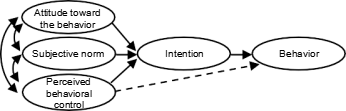
图1。计划行为理论[2]。
所有这三个组成部分都有助于促进人们行动的行为意图。参与这种行为的意图和感知能力越大,行为就越有可能被执行[2,12]。到目前为止,一个人的态度,而不是主观规范,往往更能预测意图。然而,Ybarra和Trafimow[30]的研究表明,增加一个人的群体成员感,而不是态度,会导致社会规范和行为意图之间的更高相关性。尽管如此,意图的三个决定因素的相对重要性还是可能因情况和行为而异[2,20],每种因素都需要得到支持以增加目标行为。
All three components contribute to the behavioral intentions that inform later actions. The greater the intention and the perceived ability to engage in the behavior, the more likely it will be performed [2,12]. To date, a person’s attitudes, as opposed to subjective norms, have often been found to more strongly predict intentions. Research by Ybarra and Trafimow [30] however, shows that increasing a person’s sense of group membership, rather than attitude, leads to higher correlations between social norms and behavioral intentions. Even though, the relative importance of the three determinants of intention can vary across situations and behaviors [2,20] each needs to be supported to increase the target behavior.
08 行为改变策略
Strategies for Behavioral Change
虽然TPB在确定人类行为的决定因素方面很有价值,但它并没有涉及执行特定行为的重要程序方面。Prochaska等人的[24]跨理论模型(TTM)提供了基于阶段的策略,以支持个体逐步实现变革。它把有意的行为改变看作是一个包含五个阶段的过程:预思考、思考、准备、行动和维持。在预思考中,个体没有意识到或没有意识到某一特定的行为需要改变,他们通常只会因为他人的压力而改变他们的行为。在思考过程中,人们意识到并认真考虑改变他们的行为,但还没有准备好付诸行动。准备阶段的特点是有意改变,并做出第一个小的改变。实际的行为修改发生在行动阶段,并在改变持续的情况下得到维持。
我们研究的针对的是18-35岁之间的人,他们被认为[28]要么没有意识到回收利用,要么没有认真考虑在这方面采取积极行动。改变的早期阶段需要特定的促进策略,不仅要克服常见的改变障碍,如不情愿或动机不足,而且要提高一个人对自己及其行为的意识,并增加体验与目标行为相关的积极情绪的可能性。这些策略允许重新评估一个人对一种行为的认知和情感价值,从而促进内在动机并促使改变[20,24]。
While valuable in identifying the determining factors of human behavior, the Tof human behavior, the TPB does not address important procedural aspects of performing a specific behavior. Prochaska et al.’s [24] transtheoretical model (TTM) provides stage-based strategies to support the individual in gradually achieving change. It regards intentional behavioral change as a process encompassing five stages: precontemplation, contemplation, preparation, action and maintenance. In precontemplation, individuals are unaware or under-aware that a particular behavior needs changing and often only modify their behavior because they are pressured by others. During contemplation, people are aware and seriously consider changing their behavior but are not yet ready to commit to it. The preparation stage is characterised by the intention to change and making the first small changes. The actual behavior modification occurs during the action stage and is maintained if the change is sustained.
Our research targets young people between the age of 18- 35, who were identified by [28] to be either recycling unaware or are not seriously contemplating becoming active in this regard. Early stages of change require specific promotion strategies not only to overcome common barriers to change, such as reluctance or inadequate motivation, but also to raise a person’s awareness about themselves and their behaviors, and increase the possibility to experience positive emotions related to a target behavior. These strategies allow for a re-evaluation of a person’s cognitive and affective values towards a behavior, which can promote intrinsic motivation and facilitate change [20,24].
09 社会劝说与行为动机
Social Persuasion and Behavioral Motivation
虽然建议的行为改变策略为有说服力的设计提供了有意义的信息,但必须记住,TTM呈现的是一个理想的选择。个体可能会发现自己在不同的时间处于不同的变化阶段,并且可能不会从一个阶段持续到下一个阶段[1]。此外,TTM与行为变化的个体过程相一致,其中支持变化的社会过程是相互交织的。因此,下一章节将扩展如何通过社会影响和其他形式的行为动机来调节行为。
考虑到一个人的情感、思想和行为受到他人存在的影响,Deutsch和Gerard[6]将社会影响分为两种形式:信息性影响和规范性影响。
信息性社会影响
其他人可以作为一个有价值的信息来源,以准确地评估一个人的行为。这在人们不确定如何表现的情况下尤为重要。为了克服对信息的自然需求,他们会与他人交流,但也会倾向于观察和模仿他人的实际行为[4]。一个人的态度或行为的变化可能是根深蒂固的、内隐的和持久的[6],因为他们的动机是在目标情况下行为得体。
规范性社会影响
人类有一种对于归属感的基本需要[10]。因此,为了发展和保持有意义的人际关系,并被社会接受,人们倾向于认同他人的价值观、信仰、态度或行为[4]。这些人对个体(如朋友、家人)越重要,则对符合他人积极期望而产生的规范性社会影响越强[6]。然而,由于服从规范的影响而导致的态度或行为表达的变化,并不一定反映内部的变化,而可能是表面的,且只是公开显示和短暂的。他们的动机是为了获得社会的认可和避免被他人拒绝,通常只有在这个人处于一定程度的社会监督下时才会持续下去。
行为动机
人们通常会做出有内在回报(如对环境做出贡献的满足感)或外在回报(如减少浪费的账单)的行为,但同时也会调整自己的行为以避免负面体验,如内疚或羞愧[10]。奖励理想行为的策略经常应用于有说服力的计算系统,规避或惩罚的策略通常被批评为不恰当的,这不仅是出于道德的原因[11,12],还因为用户在受到系统的打扰或指责时会停止使用系统[参考,5]。然而,Foster等人[13]已经证明,如果谨慎而有趣地呈现厌恶性反馈,并不一定会让用户感到不自在,而是使其作为一种有价值的行为改变工具发挥作用。
While the suggested strategies for behavioral change meaningfully inform persuasive designs, it has to be kept in mind that the TTM presents an ideal. Individuals may find themselves in various stages of change at different times and may not proceed continuously from one stage to the next [1]. Further, the TTM is aligned to individual processes of behavioral change, in which social processes to support change are interwoven. Thus, the next sections expand on how behavior can be regulated through social influence and other forms of behavioral motivation.
Considering that a person’s feelings, thoughts and behaviors are influenced by the presence of others, Deutsch and Gerard [6] distinguish two forms of social influence: informational and normative.
Informational Social Influence
Other people can serve as a valuable source of information to accurately evaluate one’s behavior. This is particularly relevant in situations where people are uncertain about how to behave. To overcome the natural need for information, they communicate with others, but also tend to observe and copy the actual behavior of others [4]. Resulting changes in a person’s attitudes or behaviors can be deep-seated, private and enduring [6], as they are motivated by the desire to behave appropriately in the target situation.
Normative Social Influence
Human beings also have a fundamental need to belong to others [10]. Thus, in order to develop and preserve meaningful relationships and to be socially accepted, people have a tendency to agree on the values, beliefs, attitudes or behaviors of others [4]. The normative social influence arising from conforming to positive expectations of others is stronger the more important these people are to the self (e.g., friends, family) [6]. Changes in the expressions of attitudes or behaviors as a result of obeying to normative influences, however, do not necessarily reflect an internal change, but instead can be superficial, only publicly shown and transitory. They are motivated by the person’s desire to obtain social approval and avoid social rejection by others, and usually persist only while the person is under a certain level of social surveillance.
Behavioral Motivation
People generally engage in behaviors that are either intrinsically rewarding (e.g. satisfaction about contributing to the environment) or extrinsically rewarding (e.g. a reduced bill on waste), but also tailor their actions towards avoiding adverse experiences such as feelings of guilt or shame [10]. While strategies for rewarding desirable behaviors are often applied in persuasive computing systems, strategies of aversion or punishment are typically criticized as being inappropriate, not only for ethical reasons [11,12], but also because users are assumed to simply stop using a system if they are nagged or blamed by it [cf.,5]. Foster et al. [13] however, have shown that aversive feedback, if carefully and playfully presented, does not necessarily disengage users, but functions as a valuable tool for behavioral change.
10 相关工作
Related Work
到目前为止,已经提出了许多解决人们的废物管理和可持续性行为的设计。Gartland和Piasek[15]介绍了他们的“称量垃圾”系统,它是一个交互式的垃圾桶,带有一个集成的秤来称量一个家庭产生的垃圾数量。垃圾的重量和经济成本都会显示在触摸屏上,以及如何减少一般垃圾的进一步信息。我们希望将减少废物产生的经济效益可视化,以推动采取更环保的行动。虽然这是一个很有前途的设计概念,但它对人们行为的影响尚未被评估。
Jetsam [23]是一个城市公共垃圾桶,经过强化,可以向街上的城市居民展示收集到的垃圾。该系统的设计目的不是为了提高环境意识,而是为了激发个人和集体对城市生活各个方面的好奇,并围绕可视化的垃圾讲故事。这个想法激发了个人和社会层面的思考,也启发了清洁系统[25]的设计,该系统专注于教育公民避免因垃圾乱放而造成环境污染。为此,它追踪了人们与各种垃圾桶的互动,并将其展示在可穿戴的笑脸徽章、月度个人报告和公共展示上。尽管Jetsam和Cleanly都认为社区和个人会影响一个人的行为,但他们并没有明确地将社区视为社会影响的来源。且它们对人们环保行为的影响也没有得到评估。
To date, a number of designs have been proposed which address people’s waste management and sustainability behavior. Gartland and Piasek [15] describe with their Weigh Your Waste system, an interactive disposal bin with an integrated scale to weigh the amount of waste produced by a household. Both the weight of the waste and its financial cost are then displayed on a touch screen, together with further information on how general waste can be reduced. It was hoped that visualizing the financial benefits of producing less waste would motivate environmentally friendlier actions. Although a promising design concept, its impact on people’s behavior has not been evaluated.
Jetsam [23] is a public city trashcan, augmented to project a visualization of collected trash items to urban dwellers on the street. The system is not designed to raise environmental awareness, but to prompt personal and collective sense of wonder as to aspects of urban life and to provoke storytelling around the visualized trash. The idea to stimulate reflection on both the personal and communal level also informed the design of the Cleanly system [25] which focused on educating citizens to avoid environmental pollution through misplaced trash. For this purpose, it tracked people’s interactions with various bins and displayed these on wearable smiley badges, in monthly personal reports and on public displays. Even though both Jetsam and Cleanly consider that the community and the individual inform a person’s behavior, they do not explicitly consider the community as a source for social influence. They also have not been evaluated in terms of their impact on people’s pro-environmental behavior.
11 BINCAM的设计
THE DESIGN OF BINCAM
BinCam是一个由两部分组成的系统,包括一个BinCam垃圾箱和一个Facebook上自定义的BinCam应用程序(简称“应用程序”)。该系统基于行为变化的理论,旨在通过从家庭垃圾桶拍摄的照片中包含的信息,为用户提供评估自己以及他人相关行为的机会。BinCam系统在三个层面上促进了规范性社会影响:(i)家庭内部;(ii)使用BinCam的家庭之间;(iii)在Facebook上可能存在潜在的更广泛的朋友圈。下面将介绍旨在激励和吸引用户使用该系统的策略。
BinCam is a two-part system consisting of a BinCam bin and a custom BinCam application (short ‘App’) on Facebook. Based on theories of behavioral change, the system is designed to provide users with the opportunity to evaluate their own, as well as other people’s, bin related behavior through information contained in the pictures taken from a household’s rubbish bin. The BinCam system facilitates normative social influence on three levels: (i) within households; (ii) between BinCam households; and
(iii) amongst a potentially wider circle of friends on Facebook. The strategies that aim to motivate and engage users with the system are introduced below.
12 BinCam垃圾箱
The BinCam Bin
大多数人,特别是年轻人,对自己的垃圾处理信息并不感兴趣[参考,28]。这对收集相关数据构成了重大的设计挑战[参考,18,24]。为了解决缺乏动机和收集用户信息所需的时间问题,BinCam的数据收集过程是完全自动化的。此外,我们试图将BinCam设计为最小限度的干预,并考虑到了英国家庭的回收设施包括至少一个和最多五个回收容器,我们发现BinCam垃圾箱是所有垃圾箱中唯一的标准。它提供了关于个人垃圾行为的丰富数据,因为它通常会捕获不可回收垃圾、厨余垃圾以及扔错的可回收垃圾。因此,BinCam垃圾桶只是简单地取代了现有的厨房垃圾桶,并通过安装在垃圾桶盖子底部的智能手机拍摄的数字图像自动捕捉被丢弃的物品(见图2)。手机的加速计可以感知盖子的运动,并在每次打开和关闭盖子时触发摄像头。通过3G或Wi-Fi连接,手机将捕获的图像上传到Facebook上的BinCam应用程序,所有BinCam成员都可以立即看到。与“废弃日记”等现有方法相比,这种由系统驱动的对个人扔垃圾相关行为的捕获大大简化了个人数据的收集[18]。
Information about one’s own waste activities are of little interest to most people, in particular young adults [cf.,28], and this poses a significant design challenge for the collection of waste related data [cf.,18,24]. To address the lack of motivation, and the time required, to gather information on the users’ part, the process of data collection in BinCam is entirely automated. In addition, seeking to design BinCam as a minimal intervention and considering that recycling facilities in UK households range from having at least one and up to five recycling containers, we found the refuse bin to be the only standard amongst all. It provides rich data about individuals’ waste behavior, as it generally captures landfill waste, food waste as well as misplaced recyclables. Thus, the BinCam bin simply replaces an existing kitchen refuse bin and automatically captures thrown away items through digital images taken with a smart phone installed on the underside of the bin’s lid (see Figure 2). The phone’s accelerometer senses movement of the lid and triggers the camera each time the lid is opened and then closed. Using either a 3G or Wi-Fi connection, the phone uploads captured images to the BinCam application on Facebook where they are immediately visible to all BinCam members. This system- driven capture of individuals’ waste-related behavior significantly eases the collection of personal data [18] compared to existing methods such as ‘waste diaries’ [19].
13 Facebook上的BinCam应用程序
The BinCam Application on Facebook
使用Facebook作为BinCam的平台来反思个人和他人的行为有几个原因。首先,Facebook易于访问,并被我们的目标用户群体广泛使用和接受。它提供了一个完善的社会网络结构,不仅能够形成和保持与相关者的联系,还可以利用个人强烈的自我利益被社会接受[10]。通过在Facebook中嵌入BinCam应用程序,使个人定期使用该系统,同时也通过网络本身的社会动态来促进行为改变。为了促进日常参与,并实现社会信息性和规范性影响,BinCam应用程序包括了我们称之为“BinPictures”和“BinLeague”的功能。
There are several motivations for using Facebook as BinCam’s platform for reflection on personal, as well as other people’s, behavior. Facebook is easy to access, self- instructing and widely used and accepted by our target user group. It provides a well-established social network structure which enables not only the formation and preservation of connections to relevant others but also leverages individuals’ strong self-interest to be socially accepted [10]. By embedding the BinCam application within Facebook, we aim to engage individuals in regular use of the system, but also to promote behavioral change through the social dynamics within the network itself. To foster day-to-day engagement and to enable social informational and normative influences, the BinCam App includes functionality, which we termed ‘BinPictures’ and the ‘BinLeague’.
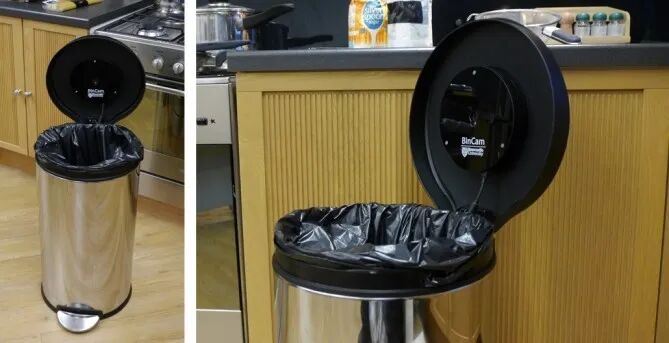
图2。一个装有索尼爱立信XperiaTM X10迷你智能手机的BinCam垃圾箱。
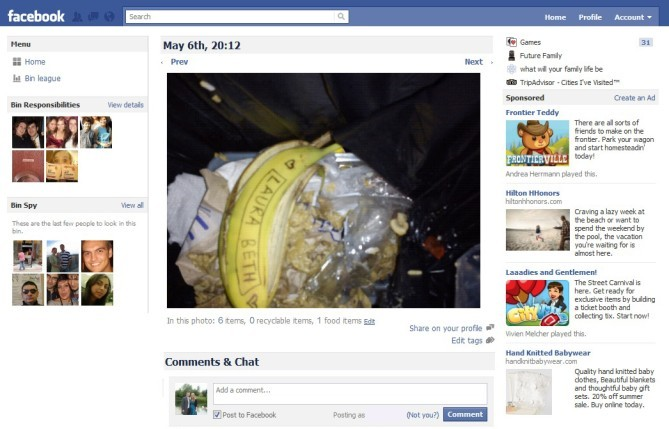
图3。BinCam界面的一部分显示了垃圾箱的责任人和监督者的图片,中间是放大的、有标记的垃圾箱图片,香蕉皮上写着参与者的信息。
BinPictures(图片)
在Facebook上,BinCam垃圾箱中的图片显示为连续的照片流,每张照片都可以放大,以便更好地查看垃圾箱中的各个物品(见图3)。该界面还显示了负责垃圾箱及其内容的所有者(“Bin Responsibilities”),以及最近查看这些图片的人(“Bin Spy”)。被添加到照片流中的新照片会被同时发送到亚马逊的众包服务平台(AMT,www.mturk.com),这是一个在线劳动力市场,在那里,“工作人员”可以获得少量的报酬来完成小任务(在我们的例子中,每张图片0.02美元)。这些“任务”是为每张垃圾桶图片自动创建的,要求工作人员得到明确的指示后,识别每张照片中的物品总数、可回收物品的数量和食物的数量。食物垃圾的测量是一个新的方面,以前的工作都没有涉及到,与能源消耗的测量相比,这是相当困难的。因此,众包技术能够帮助检测和区分图片中的可回收、不可回收和厨余垃圾,即使是被压扁或半覆盖——这对于基于计算机视觉的自动解决方案来说太复杂了。一旦被工作人员标记,得到的数据就会显示在相应的图片旁边。如果物品被错误地识别,Bin所有者可以手动编辑标签,且可以删除照片。
正如TTM所建议的[24],BinPictures的展示旨在提高人们对个人废弃物管理的认识。为了进一步促进规范性社会影响,每个BinCam垃圾箱所拍摄的照片不仅对一个家庭的所有成员都可见,而且对所有BinCam用户都可见。虽然只有BinCam用户可以使用该应用程序,但他们可以通过将选定的图片链接到他们自己的Facebook主页上,与更广泛的朋友圈分享BinPictures。在像Facebook这样的公共平台上显示这些个人数据,不可避免地会引发隐私和道德问题。扔掉的物品通常是个人不想再与之联系在一起的物品,而这些图片的发布会对个人造成被公开羞辱的风险。而只在多人居住的房屋中放置BinCam就改善了这种风险,因为垃圾箱里的内容不能直接归属于任何特定的个人。这样的决定是设计权衡的一部分,因为这种集体本身也使个人行为的影响不那么明显,因此可能导致前面描述的社会影响效应的减少。
BinLeague(等级)
由AMT生成的数值有助于BinLeague的每周计算。BinLeague将每个箱子可视化为两种分数:(i)将回收成果可视化为“树上的叶子”;(ii)将节省下的食物显示为“金条”。垃圾桶中可回收物的减少,树上的叶子就会相应的增加,食物浪费的减少则能够增加金条的数量。每个家庭从5片叶子和5条金条开始(范围为0-10)。为期一周,计算并可视化每个家庭的百分比变化(见图4)。树和金条图像借鉴了生态可视化中常用的隐喻[参考,17],并被选择作为每个家庭对回收和食物浪费行为的抽象表现。它们还可以弥补Dourish[8]所概括的可伸缩性问题,因为个人对整体环境的贡献的结果难以可视化。
BinLeague旨在激励BinCam家庭之间的竞争,以支持行为改变。一方面,支持室友和家庭的成就就会使规范性社会影响更加突出,而将自己的努力与其他家庭的进步进行比较,则会产生信息性社会影响[4,6]。另一方面,竞争可以培养理想的行为,提供一种积极的胜利观,如[2,p.184]所述,即“成功的激励价值”,也可以激励个人不要失去自我,从而避免失败感[10]。
BinPictures
On Facebook, pictures from the BinCam bin are presented as a continuous stream of photos which can each be enlarged to furnish a better view of individual items in the bin (see Figure 3). The interface also displays the owners that are responsible for the bin and its contents (‘Bin Responsibilities’) as well as other people who recently viewed the pictures (‘Bin Spy’). As new pictures are added to the photo stream, they are simultaneously sent to Amazon’s Mechanical Turk crowd-sourcing service (AMT, www.mturk.com), an online labor market where ‘workers’ are paid small amounts of money to complete micro tasks (in our case $0.02 per image). These ‘tasks’ are created automatically for each bin picture and require workers, who are given clear instructions, to identify the total number of items, the number of recyclable items and the number of food items in each photo. Particularly the measurement of food waste is a novel aspect that none of the previous work touched upon, and which is considerably difficult, i.e. when compared to measures of energy consumption. Thus, the crowd sourcing technique endeavored to help detect and distinguish recyclable, non-recyclable and food waste items in the pictures, if even squashed or semi-covered – a problem considered too complex for an automatic computer-vision based solution. Once tagged by the workers, the resulting data is presented alongside the respective picture. Bin owners can manually edit the tags if items are incorrectly identified, and they can delete photos.
As suggested by the TTM [24], the display of the BinPictures aims to increase awareness of an individual’s waste management. To further facilitate normative social influences, the pictures taken by each BinCam bin are not only visible to all members of one household, but to all BinCam users. Although access to the App is provided to BinCam users only, they can share BinPictures with their wider circle of friends by linking selected pictures to their own Facebook profile. Inevitably, the display of such personal data on a public platform like Facebook raises privacy and ethics issues. Disposed of items are normally objects that individuals do not want to be identified with anymore, and the publication of these pictures poses a risk to the individual of being publicly humiliated. This risk, however, is ameliorated by the deployment of BinCam only in shared houses, in that the contents of a bin cannot be directly attributed to any particular individual. However, such decisions are part of a design trade-off, as this aggregation itself also makes the impact of individual’s behavior less visible and as a consequence may lead to a reduction in the social influence effects described earlier.
BinLeague
The numeric values generated by AMT contribute to weekly calculations of the BinLeague. This league visualizes two scores for each bin: (i) for recycling achievements visualized as ‘leaves on a tree’; and (ii) for preventing food waste displayed as ‘gold bars’. A decrease of recyclable materials in the bin leads to a growth of leaves on the tree, and a reduction of food waste increases a household’s amount of gold. Each household starts at a baseline of 5 leaves and 5 gold bars (of a range of 0-10). From one week to the next, the percentage change is calculated and visualized for each household (see Figure 4). The tree and gold images draw on common metaphors used in eco-visualizations [cf.,17] and were chosen as abstractions of each household’s performance on recycling and food waste behaviors. They may also compensate for what Dourish [8] outlines as the problem of scalability, in that the consequences of an individual’s contribution to the overall environment are difficult to visualize.
The BinLeague aims to motivate competition between the BinCam households to support behavioral change. On the one hand, supporting one’s housemates and one’s household achievements makes normative social influences more salient, while a comparison of own efforts with the progress of other households presents a social informational influence [4,6]. On the other hand, the element of competition can foster desirable behaviors in providing a positive outlook on winning, described by [2, p.184] as the “incentive value of success”, but also motivates individuals not to lose, and thus, to avoid feelings of failure [10].
14 BINCAM的评价
EVALUATION OF BINCAM
为了了解其潜力和有效性,HCI可持续性研究[8,27]强调了设计在日常生活中使用和研究的技术的重要性。因此,为了深入了解个体如何理解BinCam系统,以及他们如何与它的不同特征相关联,我们对共同居住家庭(5-7人)的年轻人(18-35岁)进行了一个案例研究。为了促进与BinCam应用程序的互动,参与者还被要求拥有一个定期访问和使用的Facebook账户。
In order to understand their potential and effectiveness, HCI research on sustainability [e.g.,8,27] emphasizes the importance of designing technologies to be used and studied in everyday life. Thus, to gain insight into how individuals interpret the BinCam system and how they relate to its different features, we conducted a case study with young adults (18-35 years), living together in shared households (5-7 occupants). To facilitate engagement with the BinCam App, participants were also required to have a Facebook account, which they access and use regularly.
15 方法
Method
通过海报、传单和研究团队成员的个人联系招募了22名18岁以上的参与者(M=23岁、SD=4.6岁、女性=11岁)。在被选中的四个家庭中,除了一个之外,所有家庭的性别都是混合的。在参与者中,16名是学生,6名是个体经营者或失业者。
在第一次访问中,我们评估了他们的回收设施,发现所有的家庭都有一个纸板、塑料和金属的回收箱,其中三个家庭有一个额外的玻璃回收箱,一个家庭有一个额外的堆肥回收箱。每户家庭的垃圾每周收集一次,每两周回收一次。在两周后的第二次访问中,我们将他们现有的厨房垃圾箱替换为BinCam垃圾桶,且分发了调查问卷,并向参与者提供了BinCam应用程序的URL链接。在为期五周的研究期间,他们对该应用的参与是自愿的。为了方便BinCam垃圾箱的使用,并促进每个家庭成员之间的合作,参与者被要求为他们的垃圾箱命名。且这些家庭从研究一开始就互不认识。
22 participants over the age of 18 were recruited (age M = 23, SD = 4.6, females = 11) through posters, flyers and personal contacts of a member of the research team. In all but one of the four chosen households, gender was mixed. Of our participants, 16 were students and 6 were self- employed or unemployed.
Assessing their recycling facilities in an initial visit, we found that all households had a recycling bin for cardboard, plastic and metal, 3 of them had an additional recycling bin for glass and 1 had an extra bin for compost. Refuse waste for each household is collected weekly and recycling biweekly. In a second visit two weeks later, we replaced their existing kitchen bin with the BinCam bin, handed out questionnaires and provided participants with the URL link to the BinCam App. Their engagement with the App during the five-week period of the study however was voluntary. To facilitate appropriation of the BinCam bin and to foster collaboration between members of each household, participants were asked to name their bin. The households did not know each other from the outset of the study.
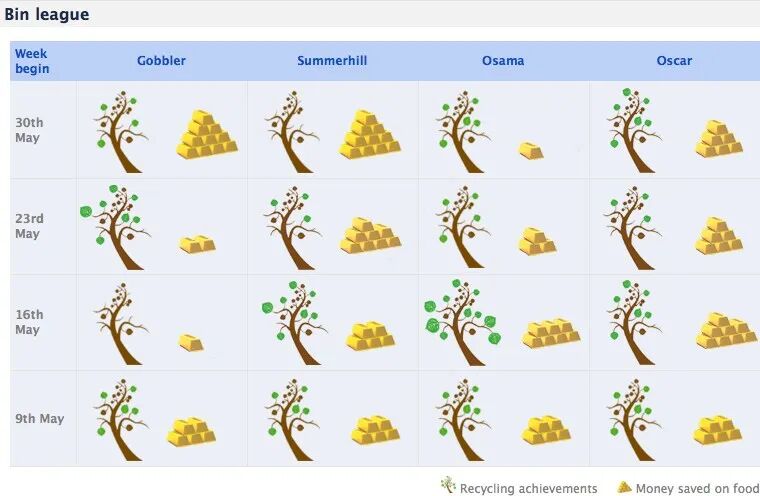
图4。BinLeague展示了所有家庭与其他家庭相比,以及随着时间推移的回收成就(树上的树叶)和节省下来的食物(金条)。
在一份预问卷调查中,通过Ellison等人创建的Facebook强度量表,参与者回答了他们一般的Facebook使用习惯[9]。研究结果显示,该社交网站已被广泛使用。参与者平均有372个好友(SD=251.4),平均每天在该平台上花费86分钟。作为自我报告数据的一部分,参与者进一步表示,Facebook已经成为他们日常生活的一部分,他们利用这个平台了解他人,与他们交朋友或保持联系,如果Facebook关闭,他们会感到遗憾。
在放置BinCam之前,参与者还被问及他们对回收和食物浪费的一般态度和行为。问题详见[29]。与[28]认为年轻人为没有意识到回收利用不同,我们的参与者在0分(一点也不重要)到4分(非常重要)的5分量表中表示,回收利用是重要的(M=3,SD=.8),当他们不得不扔掉食物时,他们非常忧虑(M=3,SD=.8)。这些更全面的陈述还辅以一份36个项目的研究前和研究后问卷,调查参与者对回收和食物浪费的态度和行为。然而,这些定量数据的发现并没有显示随着时间推移的显著变化,因此没有呈现。
在为期五周的研究结束时,我们让参与者在他们的住所进行了平均持续51分钟(min=40,max=77)的焦点小组。我们选择这种方法是为了从他们对BinCam体验的交互式小组讨论中获取丰富而有见地的数据。我们发现,研究后的焦点小组比定期观察或记日记的干扰性更小,非常适合我们的研究目的,即在个人共同生活和体验该系统的共同生活家庭中研究BinCam。焦点小组会议被录音、转录,并使用主题分析进行深入分析[3]。尽管是自愿参与,但每位参与填写问卷和焦点小组的成员都会获得10英镑的报酬。这项研究得到了纽卡斯尔大学伦理委员会的批准。所有参与者的姓名都已被更改。
In a pre-questionnaire, participants were asked about their general Facebook use habits by answering the Facebook Intensity Scale created by Ellison et al. [9]. Results revealed a strong use of the social network site. Participants had on average 372 friends (SD = 251.4) and spent on average 86 min on the website per day. As part of the self-report data, participants further indicated that Facebook had become part of their daily routine, that they used the platform to learn about others, to stay in touch with people they know or met socially and that they would be sorry if Facebook closed down.
Before the start of the BinCam deployments, participants were also asked about their general attitude and behavior related to recycling and food waste. Question items were informed by [29]. In contrast to [28] which identified young adults as recycling unaware, our participants indicated on a 5-point scale ranging from 0 (not at all important) to 4 (very important) that recycling is quite important to them with M = 3 (SD =.8) and that they are fairly concerned when they have to throw away food (M = 3, SD = .8). These more global statements were supplemented by a 36-item pre- and post- study questionnaire on participants’ recycling and food waste attitudes and behaviors. Findings of this quantitative data, however, did not reveal significant changes over time and therefore are not presented.
At the end of the five-week study, we arranged focus groups with participants in their residences, lasting on average 51 min (min = 40, max = 77). We chose this method to capture rich and insightful data evolving from interactive group discussions about their experiences of BinCam. We found post-study focus groups to be less intrusive than regular observations or diary keeping, while very suitable for our research purpose to study BinCam in shared households of individuals’ living and experiencing the system together. Focus group sessions were audio recorded, transcribed and analyzed in-depth using thematic analysis [3]. Although participation was voluntary, each participant was remunerated for filling out questionnaires and taking part in the focus group with £10. The study was approved by the institutional ethics committee at Newcastle University. All names of participants have been changed.
16 焦点小组的调查结果
Results of the Focus Groups
总的来说,参与者喜欢BinCam系统,认为它是个好想法,并会推荐给朋友。该系统被认为是为一种有用的方式,在体验乐趣的同时,提高个人对废物管理的反思;将回收利用变成一种比之前更令人兴奋的活动。然而,三名参与者表示,他们不喜欢在生活的各个方面被监控,虽然他们通常不介意有人看到他们浪费的照片,但他们不希望委员会看到。然而,这些隐私问题与他们暂时参与BinCam项目无关,该项目是他们自己选择并喜欢的。
BinCam在日常生活中的融合
所有的参与者都认为使用BinCam垃圾桶是毫不费力的,他们不必改变他们的日常生活。他们认为这个垃圾桶已经很好地融入到了他们的日常生活中。大多数BinCam用户也非常支持Facebook,且非常肯定BinPictures在平台上的应用。在一个家庭中,参与者称自己是参与度较低的Facebook用户,并对Facebook本身的一些品质持批评态度,称该平台是丑陋、无聊、缺乏创意,对用户不友好的。这些批评也适用于BinCam应用程序。尽管他们提议用一个外部网页取代这款应用,但他们承认他们“可能从来没有看过它”(Jill)。
探索自己和其他家庭的BinPictures
尽管报告称,该应用程序与现有程序整合良好,但参与者只看了几次自己垃圾箱拍摄的照片(日志文件:min=0,max=27,M=3.2),而且主要是在研究开始时。这时,人们对BinCam的好奇心是最高的,参与者被激励去识别自己和家庭其他成员丢弃的物品。例如,Jill说:“哦,好吧,我试着找到我扔掉的东西。我就想‘那个东西在哪里’”,正如Anna所描述的:“你可以识别出属于家庭中不同成员的不同食物包装。”然而,在前两周之后,参与者要么忘记了BinCam应用程序,要么只是对使用它失去了兴趣。Jim解释说:“我认为这仍然很重要,但过了一段时间后,我就有点厌倦看垃圾了。”尽管参与者承认自己有点爱管闲事,并且对探索其他家庭的BinPictures感到好奇,但这个探索的机会几乎从未被利用过(日志文件:max=6)。参与者表示,他们对其他人的垃圾的照片不太感兴趣,主要还是关注自己和家庭成员的垃圾箱的状态。
BinLeague与竞争元素
参与者对BinLeague的看法各不相同。一方面,有“树”和“金条”图形的BinLeague被描述为一个很好的、简单的可视化系统,用于跟踪一个家庭在回收利用方面的进展和在食物浪费方面节省的资金。另一方面,关于如何计算等级位置以及如何实现变化的不确定性导致了参与者的困惑。因为我们发现通过AMT交付的标签在很大程度上是不正确的。在20张随机图片样本中,只有5张图片被正确标记。参与者还表示希望在处理垃圾时能够更频繁地或立即得到反馈。同样,通过BinLeague激发的竞争因素的结果也是喜忧参半。虽然一些参与者确实将BinLeague的成就与其他家庭进行了比较,并感到自己被赋予了权力,受到了鼓励去提高,但另一些人对竞争不那么感兴趣。Sara解释说:“这场竞争从理论上听起来很有趣,但我不知道这是Facebook上的竞争,我想我从来没有真正参与过。我不会特别想尝试去获得一个垃圾桶的奖。”
通过BinCam的行为改变
为了证实我们研究前的问卷调查结果,焦点小组的参与者报告表明,他们要么已经是很不错的回收者,要么至少已经考虑改善他们的废物管理。因此,报告没有显示他们对回收和食物剩余物的态度发生变化也就不足为奇了。然而,研究结果显示了有趣的社会群体效应,以及与他们的浪费行为相关的个人意识、反思和感知行为控制的增加。
群体一致性在集体任务中的作用
虽然垃圾处理通常是一项由个人单独进行的活动,但参与者表示,他们有时会一起看BinPictures,给他们的垃圾箱命名,并互相谈论这个项目。他们交换了回收技巧,并计划进行一些与与垃圾桶相关的有趣的活动,比如在垃圾桶里的香蕉皮上留言(参见图3中放大的垃圾桶图片),或者谈论拆除垃圾桶里的手机来捕捉户外活动,给对方惊喜。然而,不同家庭对该系统的群体努力的一致性有很大差异。在一个家庭里,我们发现只有一半的成员对这个项目有真正的兴趣,而在另一个家庭里,所有成员都对这个项目有同样的投入。在某种程度上,局部群体一致性的影响在以下对话中很明显:Tess:“你不想让你的家庭排名下降”;Kate:“是的,我觉得我们是一个团队。”
社会监督
此外,在每个家庭中,参与者都表示,如果他们不正确地处理可回收物或不得不扔掉食物,他们会感到内疚或羞愧。例如,正如Ben解释的那样:“看着让你感到愧疚的食物浪费和让你感到愧疚的东西,然后想着我居然这么做了,这些不应该在这里,但我也这么做了。”;Beth谈到BinCam时说:“这确实会让你感到内疚,就像你做错了什么一样。”这种罪恶感是由(i)个人行为的可见性引起的;(ii)家庭其他成员可能会注意到自己的行为;(iii)在BinLeague中不好的结果;以及(iv)能够感知到BinCambin的存在。
在这种情况下,参与者也表达了被观察和控制的感觉。Dave:“我认为每个人都觉得自己的行为更像是受到了控制。”在一个表现出更强的群体一致性的家庭中,参与者甚至认为他们的垃圾桶本身是一个社会实体。对他们来说,他们的垃圾桶“有时感觉像一个小室友”(Mia)。他们还在对垃圾桶的描述中使用了人格化属性,比如垃圾箱思考、判断或关心。Lily解释说:“当我把罐子藏起来的时候,我并不是担心人们会为此去评判我。而更像是感觉BinCam会为此来评判我。我不在乎人们是否看到我扔掉了一个罐子,因为我知道他们不在乎,但彷佛Osama(他们的垃圾箱名称)会在乎。”
意识、反思和知觉行为控制
BinCam系统对参与者的最大影响是提高他们对回收和食物浪费的意识,刺激他们进行反思。这种意识有时只是通过BinCam垃圾箱每次拍照时一个安静但可听到的模拟相机快门来触发的。Dave说:“它(垃圾桶)让你更加意识到你的行为,因为你听到了咔哒声,你又想了一遍。我把它放在那里真的对吗?是的,我认为它让你更加意识到你的行为。”被提醒自己的处置行为,会让参与者反思他们的回收技能和能力。参与者越来越意识到,他们对什么是可回收的,什么是不可回收的缺乏了解。Jodi说:“你喜欢问自己,你是否真的可以回收你刚放进垃圾桶的东西。”;Sara说:“回收利用是可以的,但很容易回收错误。”这种关于如何适当地回收利用的不确定性鼓励了年轻人的自我教育。参与者表示,他们开始阅读包装背面的标签,或向他们的室友寻求回收建议。Ben解释到:“嗯,然后你开始读包装的背面,开始寻找什么是可回收的(……)我发现我花了更多的时间来区分什么是可回收的,什么是不可回收的。这对我很有用。”
尽管BinPictures和BinLeague的使用率很低,但参与者仍然被说服反思他们的“食物浪费”和“省钱”之间的关系。Tess解释到:“我认为这是一个和钱有关的问题,因为当你看到你放进垃圾桶的食物时,会让你震惊,就像‘如果我计划得更好,我本可以存下来再吃一顿饭’。”但现在我得去花更多的钱来买更多的食物。”除了对食物的简单认识和回收技能外,参与者还反映了他们的废弃物管理设施。尽管参与者愿意回收,但他们觉得没有好的方法来管理厨房里大量笨重的纸板和塑料,而他们家外的垃圾桶很快就装满了,有时一天之内就会装满,而每两周才清空一次。
其他关于行为改变的轶事证据
虽然参与者对可持续废弃物管理的态度从一开始就是积极的,而他们的回收知识和设施不理想,但参与者试图通过减少食物垃圾来改善他们的行为,表示他们开始分享剩下的食物给室友,试图做更合适的食物,有时只是吃更多而不是处理食物。Anna说:“我可以确保我没有煮得太多,比如,呃,我比以前更善于判断食物的份量。”关于剩下的食物,Beth说:“因为食物太多了,而我不想扔掉,所以我把它们拿出来,然后大家就可以吃,(……)而不是马上把它们扔进垃圾桶。”
参与者表明,他们回收的东西越来越多,例如,罐子和罐头在放进垃圾桶之前被冲洗干净,复合包装被分解成可回收和不可回收的部分。Mia描述到:“自从我们有了像BinCam项目的垃圾桶,嗯,我们回收了比通常情况下更多的东西。”;Ben解释说:“我更注意确保我冲洗的每样东西不只是,呃,我不只是用水冲洗一下。我还要确保没有食物残渣之类的东西。”其中一名参与者Lily甚至从BinCam垃圾桶里拿出了不属于里面的物品。她说:“我想在BinCam项目开始之前,我是不会认真考虑的,就好像我不可能去我们的垃圾桶里找一些肮脏的东西一样。是的,这是事实,我更了解回收,我想,如果我们必须回收,至少我们做得很好。”
Overall, participants liked the BinCam system, appraised it as a good idea and would recommend it to friends. The system was described as a useful way to raise an individual’s reflection on waste management while being experienced as fun; turning recycling into a more exciting activity than it usually is. Yet, three participants stated that they dislike the idea to be monitored in every aspect of their life and although they generally did not mind if somebody saw pictures of their waste, they wouldn’t want the council to see them. These privacy concerns, however, were not associated with their temporary participation in the BinCam project, which was both self-chosen and liked.
Integration of BinCam in Everyday Life
All participants appreciated that using the BinCam bin was effortless and that they didn’t have to change their routine. They felt that the bin was well integrated into their everyday life. The majority of our BinCam users were also very committed to Facebook and valued the incorporation of BinPictures on this website. In one household, participants described themselves as less engaged Facebook users and were critical of a number of qualities of Facebook itself, describing the platform as an ugly website that is boring, uncreative and user unfriendly. These criticisms are also applied to the BinCam App. Although they proposed to replace the App with an external webpage they admitted that they then “might have never looked at it” (Jill).
Exploration of Own and Other Household’s
BinPictures
Despite reporting that the App was well-integrated into existing routines, participants only looked at the pictures taken of their own bin a few times (log file: min = 0, max = 27, M = 3.2) and mainly at the start of the study. At that time, curiosity about BinCam was highest and participants were motivated to identify items disposed of by themselves and their housemates. Jill states for instance: “Oh well, I tried to find things I’ve thrown away. I was like ‘Where is that item’”, and as Anna describes: “You could identify different food packages belonging to a different member in the household.” Yet, after the first two weeks, participants either forgot about the BinCam App or simply lost interest in using it. Jim explains: “I guess it’s still important but I mean I kind of get bored looking at rubbish after a while”. Although participants admitted to have been a little nosy, and curious about exploring other households’ BinPictures, this voyeuristic opportunity was hardly ever taken (log file: max = 6). Participants stated that pictures of other people’s rubbish were not of much interest to them and focused mainly on those activities of their own bin and household.
The BinLeague and the Element of Competition
Participants’ opinions on the BinLeague were mixed. On the one hand, the league with its ‘tree’ and ‘gold bar’ graphics was described as a nice and easy visualization for tracking a household’s progress in recycling and money savings on food waste. On the other hand, the uncertainty as to how the league positions were calculated and how changes could be achieved led to confusion among participants. This was in part due to the fact that we found the tags delivered through AMT to be largely incorrect. Of a random picture sample of 20, only 5 images were correctly tagged. Participants also expressed the wish to receive feedback more frequently, or immediately, when they dispose of items. Similarly mixed were also the results for the element of competition stimulated through the BinLeague. While some participants indeed compared league achievements with other households and felt empowered and encouraged to improve, others were less keen on the competition. Sara explains: “The competition sounds interesting in theory but I don’t know, that’s a competition on Facebook, and I don’t think I ever really got into it. I wouldn’t particularly try and get a bin award.”
Behavioral Change through BinCam
Confirming our pre-study questionnaire results, participants reported in the focus groups to either be already good recyclers or at least contemplated improving their waste management. It is therefore not surprising that they did not report changes in their attitude towards recycling and food waste. Yet, findings show interesting social group effects as well as an increase in individuals’ awareness, reflection and perceived behavioral control related to their waste behavior.
The Role of Group Coherence in Collective Tasks
While the disposing of waste is in general an activity to be performed by an individual alone, participants reported that they sometimes looked at BinPictures together, named their bin collectively, and talked with each other about the project. They exchanged recycling tips and made plans for funny engagements with the bin such as leaving a message on a banana skin in the bin (cf., enlarged BinPicture in Figure 3) or talked about dismantling the phone of the bin to capture outdoor events to surprise each other. However, the coherence of group efforts with regard to the system differed greatly between households. In one house, we found that only half of its members had a real interest in the project, while in another household all members felt equally committed to the project. That there have been, in part, effects of local group coherence is apparent in the following statements: Tess: “You don’t want to let your house down”; and Kate: “Yeah, I felt like we were a team.”
Social Surveillance
Moreover, in each household, participants reported having felt guilty or ashamed if they disposed of recyclables incorrectly or had to throw food away. For example, as Ben explains: “Looking at food waste that you’re guilty of and your items that you’re guilty of and then thinking I’ve done that and I’ve done that and this shouldn’t be in there.”; and Beth says about BinCam: “It does make you feel guilty like you did something wrong”. Such feelings of guilt were found to be evoked by (i) the visibility of one’s own behavior to oneself; (ii) the potential visibility of one’s own behavior to housemates; (iii) unfortunate results of one’s household on the BinLeague; and (iv) the perceived presence of the BinCam bin.
In this context, participants also expressed feelings of being observed and controlled. Dave: “I think like every person individually felt a bit more like controlled in their behavior.” In one household which exhibited stronger group coherence participants even perceived their bin as a social entity itself. For them, their bin “felt like a little flat mate sometimes” (Mia). They also used personifying attributes in their bin descriptions, such as the bin thinks, judges or cares. Lily expounded on this: “When I hid the jar it wasn’t that I was worried that these guys would go to judge me for it. It was more like the BinCam was going to judge me for it. I don’t care if these guys saw that I threw away a jar because I knew that they wouldn’t care but it was like Osama [their name of the bin] would care.”
Awareness, Reflection and Perceived Behavioral Control
The strongest effect of the BinCam system on participants is related to raising their awareness, and stimulation of reflection, about recycling and food waste. This awareness was sometimes simply triggered through a quiet, yet audible, simulated camera shutter carried out each time the BinCam bin took its picture. Dave tells: “It [the bin] makes you more aware because you hear the click and you think about it a second time. Was it really right that I put it in there or wasn’t it? And yeah, I think it makes you more aware.” Being reminded about one’s disposal behavior led participants to reflect on their recycling skills and abilities. Participants became more aware that they had a lack in knowledge as to what is recyclable and what isn’t. Jodi states: “And you like question yourself if you could actually recycle what you just put in the bin.”; and Sara says: “It’s alright to sort of recycle but it’s very easy to recycle wrong.” This uncertainty as to how to recycle properly encouraged self-education among the young adults. Participants reported that they started to read the labels on the back of packages or asked their housemates for recycling advice. Ben explains: “Erm, and then you sort of get to read the back of the package and stuff like that and start looking what is actually recyclable (...) I find I took more time to differentiate between what was recyclable and what wasn’t recyclable. It was useful for me.”
Despite the low usage of the BinPictures and BinLeague, participants were still persuaded to reflect on the relationship between their ‘food waste’ and ‘money savings’. Tess explains: “I think it’s a money thing because you see the food you put in the bin and it makes you shocking like ’If I had just planned better I could have saved for another meal’. But now I have to go and spend more money to get more food.” Apart from the simple awareness about food and one’s recycling skills, participants also reflected about their waste management facilities. Although willing to recycle, participants felt that there is no good way of managing large amounts of bulky cardboards and plastic in their kitchen, and that the container outside their house fills up quickly, sometimes within a day, while only getting emptied every two weeks.
Other Anecdotal Evidence for Behavioral Change
Although participants’ attitudes towards sustainable waste management were positive from the outset, and their recycling knowledge and facilities not ideal, participants tried to improve their waste behavior by creating less food waste, said that they started sharing food left-overs with their housemates, were trying to cook more appropriate meal portions and sometimes simply ate more instead of disposing the food. Anna says for instance: “I kind of make sure I didn’t cook too much like, erm, I’m better in judging portions than I was before.” Regarding food left-overs, Beth states: “Because there’s lots of food in terms of like I don’t want to dispose so I just put it out and then people can eat it because it’s too much, (…) instead of chucking it in the bin straight away”.
Participants also reported having recycled more and better, for example, jars and tins were rinsed and washed out before they were put in the bin, and composite packages broken down into their recyclable and non-recyclable components. Mia describes: “Since we had like the BinCam project bin, erm, we’ve recycled a lot more than we normally would, like generally as a flat.”; and Ben explains: “I am much more aware of making sure that everything I rinsed wasn’t just, erm, I didn’t put just water on it. I rinsed it - I made sure there’s no food residue or anything like that.” One participant, Lily, even took out items from the BinCam bin that didn’t belong in it. She says: “I think it was like I wouldn’t have given it a rough thought before the BinCam project, like there was no way I was going to our bin and fishing out something filthy and stuff. That, like, yeah, it was just the fact that I was more aware about recycling and I was like, well if we gonna have to recycle at least we do it properly.”
17 讨论和经验教训
DISCUSSION & LESSONS LEARNED
BinCam旨在作为一个社会说服系统,为年轻人提供一个有趣的非侵入性机会,让他们反思自己的废弃物管理行为。我们的用户研究结果表明,它提高了个人对自己的回收利用和食物浪费行为的意识。然而,被要求的反思似乎并没有影响到参与者已经确立的态度和意图,改善他们的行为,而是使他们对自己在多大程度上控制目标行为的感知更加突出。这导致参与者认为他们的处理设施不足,并确定他们对什么是可回收或不可回收的知识不足。因此,参与者开始自学有关回收利用的知识,与他人交换回收利用的专业知识,并改善他们的食物规划和分享。此外,参与者对BinCam的反应是高度异质性的,在个人和群体层面上都显示出不同的动机影响。表1列出了这些问题,并在下面讨论了这些问题,和旨在引起反思和通过社会媒体和社会说服策略促进变革的系统设计的建议。
BinCam was intended as a social persuasive system that provides a playful non-intrusive opportunity for young adults to engage in reflections on their waste management behavior. Findings of our user study indicate that it raised individuals’ awareness of their recycling and food wasting behaviors. Invited reflections however did not to seem to impact on participants’ already well-established attitudes and intentions to improve their behavior, but instead made more salient their perception of how much they control the performance of the target behavior. This led participants to view their disposal facilities to be insufficient and to identify deficits in their knowledge about what is or is not recyclable. As a result, participants started to educate themselves about recycling properties, exchanged recycling expertise with others, and improved the planning and sharing of their food. Moreover, participants responses towards BinCam were highly heterogeneous and indicated various motivational influences on both an individual and group level. These are outlined in Table 1 and discussed below along with proposed implications for the design of systems aiming to invite reflection and to promote change through social media and strategies of social persuasion.
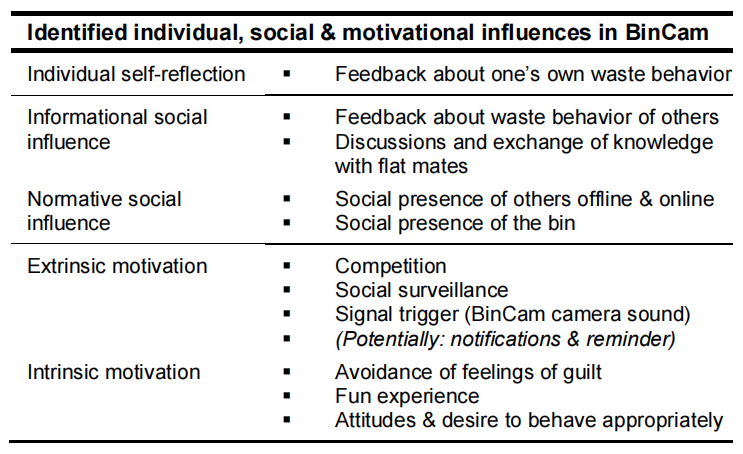
表1。BinCam中的说服。
18 信息对自我和他人的影响
Informational Influence on Self and Others
为了方便与BinCam的交互,该系统经过精心设计,以适应日常生活,如用户定期的使用Facebook和垃圾箱。他们可以选择是否使用BinCam应用程序。虽然这种自愿访问让人们很容易忽略这个应用程序,但它将观察捕捉到的图像变成了一种有意识的,而不是外部强制执行的活动。克服了对信息的自然需求,用户可以访问应用程序,接收关于他们和他人行为的反馈[参考,4]。
反思行为和学习vs.即时反馈
虽然参与者通过该应用程序获得了他们和其他家庭垃圾处理的一般信息,但他们表示希望获得关于如何改善行为的实用指导和信息。BinCam的设计并不是为了教育用户,而是为个人提供一个有趣的平台来进行反思和自我教育,以打破不回收和食物浪费的常规。为了支持这一目的,并增加应用程序的用户粘性,未来的设计应该使用户能够相互交流他们的回收建议和创意。
我们的参与者表示希望立即从他们的垃圾箱中收到关于他们的处理行为是否正确的反馈。虽然这个功能很可能会简化回收过程[10],但它将消除自我激励的深入反思的需要,以及他们自己熟悉和了解其废物回收属性的努力。通过反思改变的态度和行为可以导致内部的变化,并且是持久的[参考,24]。然而,必须承认的是,反思不仅是由表1中列出的因素引起的,而且是通过系统本身的激发性特征引起的。有些东西一旦被丢弃就会被遗忘,这增加了人们的意识并引发反思。此外,BinCam还被设计为一个探索社会影响过程的合作项目,而即时反馈只在个人层面发挥作用。
为了提高信息性社会影响,我们建议设计提供频繁的反馈(例如,每天而不是每周一次),以及不同的可视化和比较自己与他人行为数据的机会。
其他思考:抽象可视化和BinCam
虽然捕捉到的关于一个人的行为的信息应该是准确和可靠的,但是他们的演示设计对于用户的理解似乎同样重要。BinLeague通过树和金条展示了一个抽象和高度简化的用户集体回收成果和食物节约的视图,由于使用AMT对收集的BinPictures进行了错误标记,这两个视图受到了限制。这就解释了为什么一些用户对BinLeague及其可视化感到困惑或不满意。然而,其他人仍然能够理解BinLeague。他们与他们的家庭成员们反思和讨论了图形如何与他们的行为相关联,并感到有动力去改进。我们假设,一个不那么抽象的标签结果的可视化将不会有同样的阐释范围[参考,26]。
To facilitate interaction with BinCam, the system is carefully designed to fit into daily routines such as user’s regular Facebook and bin use. They are left with the choice whether they engage with the BinCam App. While this voluntary access makes it easy to ignore the App, it turns the act of looking at captured images into a conscious and not externally enforced activity. Overcoming the natural need for information, user can access the App to receive feedback about their behaviors and those of others [cf.,4].
Reflection on Behavior & Learning vs. Immediate Feedback
Although participants were presented through the App with general information about their and other household’s waste performances, they expressed the desire for practical guidance and information as to how they can improve their behavior. BinCam was not designed as a system to educate its users, but presents individuals with an engaging and playful platform for reflection and self-education in order to break routines of non-recycling and food waste. To support this purpose and to increase engagement with the App, future designs should enable users to exchange their recycling advice and creative ideas with one another.
Our participants expressed the wish to receive immediate feedback from their bin about whether their disposal behavior was correct. Although this functionality is likely to simplify the recycling process [10it would remove both the need for self-motivated in-depth reflection and their efforts to inform themselves and learn about the recycling properties of their waste items. Changes in attitudes and behaviors through reflection can result in an internal change and be long-lasting [cf.,24]. It has to be acknowledged, however, that reflection is not only motivated by the factors outlined in Table 1, but evoked through the provocative character of the system itself. In foregrounding waste, something that usually falls in oblivion once it is discarded, it increases awareness and invites reflection. In addition, BinCam has been designed as a collaborative project exploring social processes of influence, whereas immediate feedback only functions at the individual level.\To promote informational social influence, we suggest that designs provide frequent feedback (e.g. daily instead of\weekly) as well as diverse visualizations and opportunities for comparisons of own and others’ behavioral data.\Other Invite Reflections: Abstract Visualizations and BinCam\While captured information about a person’s behavior should be accurate and reliable, their presentation design seems equally important for it to be understandable to users. The BinLeague presents through tree and gold graphics an abstract and highly simplified view of users’ collective recycling achievements and food savings, both further limited due to incorrect taggings of collected BinPictures using AMT. This explains why some users were confused or dissatisfied about the league and its visualizations. Yet, others were still able to make sense of the league. They reflected and discussed with their housemates how the graphics relate to their behavior, and felt motivated to improve. We assume that a less abstract visualization of the tagging results would not have allowed for the same fortunate interpretational scope [cf.,26].\19 规范性社会影响\Normative Social Influence\总体而言,BinCam的规范性社会影响并没有预期的那么显著。这可能是由于参与其中的家庭缺乏群体一致性,以及他们很少使用BinCam应用程序。这也可能与这样一个事实有关:个人对家庭浪费的贡献并不被认为与获得社会奖励有关,也没有因不遵守规定而对家庭其他成员构成真正的威胁(即与委员会相比)。\规范性社会影响的动机是由于一个人渴望获得他人的社会认可,同时避免被社会排斥。其他人对个人越重要,影响就越大[6]。虽然BinCam被认为是一种集体活动,但只有一个家庭的成员表明了对彼此的真正承诺,并感到对与家庭有关的活动负有责任。群体一致性感可以促进规范性社会影响[4,6]。因此,我们认为,通过用户的行动和承诺,强烈的群体一致性、用户之间共享说服系统和用户之间有意义的联系,有可能形成一种朝着理想行为的集体运动[参考,8]。因此,为了支持群体的一致性,与系统的互动更应该被设计为一个群体活动。设计如何促进在每个垃圾箱周围创建团队标识?如果所有家庭的参与者从一开始就认识,BinCam的社会动态会如何变化?这些问题值得在未来的研究中得到更多的关注,特别是在激励群体承诺、社会支持或社会运动方面[21]。\其他人在Facebook上的社交状态\Facebook被认为是BinCam应用程序的一个合适的访问渠道,因为它经常被使用,并且很好地融入到了年轻人现有的日常生活中。然而,参与者对BinCam应用程序本身并没有太大的兴趣。\尽管参与者查看了他们自己的家庭,并有时试图识别个人的“不当行为”,但规范性社会影响并不是很强。为了增加对应用程序的参与度,并给用户探索BinPictures的理由,我们建议设计挑战。用户可以被指示将一个对象放入垃圾桶,以供其他家庭发现,或者接管将BinPictures标记为协作活动的任务。这将允许对用户的垃圾箱相关贡献进行更多的社交控制和更高的透明度,为好玩或竞争的参与,以及有技巧和秘诀的社交机会开辟空间。\内疚感与BinCam垃圾桶的社交存在\参与者没有报告自己的行为受到威胁,但提到在处理食物或回收不当时感到“内疚”或“羞愧”。这些感觉是否主要是由BinCam垃圾桶本身引起的,参与者是否意识到他们的行为可能被家庭其他成员或更广泛的BinCam在线社区所看到,仍有待未来进行研究。在一个家庭中,值得注意的是,参与者将他们的BinCam垃圾桶视为一个“社会角色”[11],并描述了对他们行为的相关影响。我们认为,垃圾桶的存在及其对一个人丢弃什么的“监控”有助于个人做出更符合社会需求的行为,就像让一个家庭成员在厨房里观察这个人的行为一样[12]。尽管对权威的来源有一定的不理解,但我们证实了[13]的发现,如果设计得有趣,唤起厌恶的感觉可以激发服从。\Overall, the normative social influence in BinCam was not as salient as expected. This may be explained by a lack of group coherence in the participating houses and their little engagement with the BinCam App. It may also relate to the fact that an individual’s contribution to the household’s waste was not perceived to be associated with the receipt of social rewards nor to pose a real threat from housemates for non-compliance (i.e. as compared to the council).\Social Presence of Others in the House – Group Coherence\Normative social influence is motivated by a person’s desire to obtain social approval from others while avoiding being socially rejected. The influence is stronger the more important other people are to the individual [6]. Although BinCam was perceived as a collective activity, only the members of one household reported true commitment to each other and felt responsible for household-related activities. A feeling of group coherence can facilitate normative social influences [4,6]. We therefore believe that a strong sense of group coherence, the sharing of a persuasive system between users and a meaningful connection between them – through their actions and commitments – has the potential to shape a collective movement towards the desirable behavior [cf.,8]. Thus, to support group coherence, the interaction with the systems should be more strongly designed as a group activity. How can design facilitate the creation of a team identity around each bin? How would the social dynamics in BinCam change if participants of all households knew each other from the outset? These issues deserve more attention in future research, in particular in terms of motivating group commitment, social support or social movements [21].\Social Presence of Others on Facebook\Facebook was found to be an appropriate access channel for the BinCam App, as it is used regularly and well integrated in the existing routines of young adults. Yet, participants did not engage significantly with the BinCam App itself.\Although participants looked at the BinPictures for their own household and tried at times to identify individual ‘misbehaviors’, the normative social influence was not very strong. To increase engagement with the App and to give users reason to explore the BinPictures, we suggest designing challenges. Users could be instructed to place an object in the bin to be discovered by other households or take over the task of tagging the BinPictures as a collaborative activity. This would allow for more social control and transparency as to users’ bin-related contributions, open up space for playful or competitive engagements and social opportunities to trick and cheat.\Feelings of Guilt & Social Presence of the BinCam Bin\Participants did not report feeling threatened by others regarding their behavior, but mentioned feeling ‘guilty’ or ‘ashamed’ when disposing of food or recycling incorrectly. It remains subject to future research whether these feelings are primarily evoked by the presence of the BinCam bin itself, participant’s awareness about their behavior being potentially visible to their housemates or the wider BinCam community online. In one household, it was remarkable that participants perceived their BinCam bin as a “social actor” [11], and described a related influence on their behavior. We believe that the presence of the bin and its ‘monitoring’ of what a person discards facilitate individuals to perform more socially desirable behaviors, in ways similar to having a housemate in the kitchen watching the person’s actions [12]. Despite certain inscrutability about the source of authority, we confirm findings of [13] that evoking aversive feelings can motivate compliance, if designed playfully.\20 执行目标行为的助推器\Facilitators for Performing the Target Behavior\执行该行为的设施和能力\除了有执行某种行为的意图外,一个人还需要有这样做的能力[参考,2,20]。如BinCam所示,这包括拥有足够的废弃物管理设施,以及适当的“诀窍”和执行行为的信心。BinCam成功地使个体反思他们所感知到的行为控制。在他们的家中,BinCam让他们更加意识到他们是如何管理或管理不当的,并揭示了与废弃物相关的行动背后的某种复杂性。\触发和提醒\BinCam垃圾桶中相机的声音被认为是一个“信号触发器”,提醒参与者BinCam系统的存在,并提示他们对他们的废弃物管理进行思考。根据Fogg的行为模型[10],触发因素与一个人执行目标行为的动机和能力是改变行为最有力的因素。尽管BinCam应用程序的使用率很低,但它的存在反映了一个人的行为对他人可见的可能性,增加了“信号触发”的重要性。然而,为了说服用户更定期地重新访问BinCam应用程序,该应用程序应该适应Facebook的生态环境,并更紧密地整合其现有的交互和说服风格。未来的版本还将包含正在进行的有趣活动和用户进展的提醒和通知。\Facilities and Abilities to Perform the Behavior\In addition to having the intention to perform a certain behavior, a person needs to have the ability to do so [cf.,2,20]. As shown with BinCam, this includes having adequate waste management facilities as well as the appropriate ‘know how’ and confidence to perform the behavior. BinCam successfully invited individuals to reflect on their perceived behavioral control. Being situated in their homes, it made them more aware of ‘how’ they manage or mismanage their waste and revealed a certain complexity behind waste-related actions.\Trigger and Reminder\The sound of the BinCam bin camera was found to act as a ‘signal trigger’, reminding participants of the presence of the BinCam system and prompting thoughts about their waste management. According to Fogg’s Behavioral Model [10], triggers are, along with a person’s motivation and ability to perform the target behavior, the most powerful element to change behavior. Despite the low usage of the BinCam App, its very existence – reflecting the potential of one’s behavior being visible to others – added significance to the ‘signal trigger’. However, to persuade users to re- visit the BinCam App more regularly, the App should adapt to the ecology of Facebook and more closely integrate its\existing interaction and persuasion styles. Future versions will also incorporate reminders and notifications about interesting ongoing activities and users’ progress.\21 针对个人喜好和需求的灵活性\Flexibility towards Individual Preferences and Needs\关于BinCam如何被用户利用的不同发现表明,说服技术应该适应个体间的期望和需求。用户对Facebook等社交平台的态度、动机和习惯各不相同,对反馈的频率和呈现方式也有不同的偏好。个人处于“准备、愿意和能够改变的不同阶段”[1,p.927]也会影响他们对说服影响的接受程度。为了吸引广泛的用户,并成功实现他们不断变化的信息和动机需求[24],说服式设计应结合使用说服策略来促进变革。\The heterogeneous findings of how BinCam was appropriated by its users show that persuasive technologies should be adaptable to inter-individual expectations and needs. Users differ in their attitudes, motives and habits related to social platforms, like Facebook, and they have different preferences for the frequency and presentation of feedback. That individuals are at “different stages of readiness, willingness and ableness to change” [1, p.927] also effects their receptiveness of persuasive influences. In order to appeal to a wide range of users and to successfully fulfill their constantly changing informational and motivational needs [24], persuasive designs should employ a combination of persuasive strategies to promote change.\22 伦理问题\Ethical Issues\在BinCam实验中,参与者更能意识到自己的行为或不当行为,而与系统的交互则唤起了内疚感或羞耻感。尽管具有潜在的有效性[参考,13],但它引发了伦理上的问题,即说服式设计是否应该采用引发厌恶情绪的策略来诱导行为变化。在福克[12]的理解中,说服不包括使用武力,也不是强迫的、操纵的或欺骗的。然而,参与者的内疚感或羞耻感并不是通过系统或其他观察者的外部压力直接引发的,而是主要基于用户对自己感知到的行为和理想行为之间差异的意识增强而产生的内部评价。此外,考虑到隐私问题,如果用户仍能控制自己的数据,并知道数据对谁可见,BinCam应该被视为一种有趣的、刺激反思的干预,在人们的生活中暂时得到接受。它既不是一个模糊的监控设备,也不是第三方使用的设备。\In BinCam, participants were more aware of their behavior or misbehavior, while the interaction with the system evoked feelings of guilt or shame. Although potentially effective [cf.,13], it raises ethical concerns as to whether persuasive designs should employ strategies that originate aversive emotions to induce behavioral change. In Fogg’s\[12] understanding, persuasion does not include the use of force and is neither coercive, nor manipulative or deceitful. Feelings of guilt or shame in BinCam, however were not directly evoked through the system or external pressures of others observing, but primarily based on an internal evaluation resulting from users’ increased awareness of the discrepancy between their own perceived and ideal behavior. Furthermore, and considering the privacy concerns raised, BinCam should be regarded as playful reflection stimulating intervention that finds temporarily acceptance in peoples’ lives, if users remain in control of their data and know to whom it is visible. It is neither an obscure monitoring device nor to be used by third parties.\23 评估的局限性\Limitations of the Evaluation\我们的研究样本很小,参与者从一开始就表示他们有动力回收和防止食物浪费。由于参与是自愿的,这可能证实了优势者所确定的一种趋势[27],其中的生态反馈系统通常对那些有环境动机的人更有吸引力。除了回收利用的限制外,这可能进一步解释了为什么我们的定量结果没有显示出显著的影响。最重要的是,我们的研究结果仅仅是基于个人在焦点小组中的自我报告。然而,我们发现参与者的反应是相同的,并且明显不受约束地分享个人的内疚感或被他人观察到的感觉。尽管存在这些局限性,但我们认为该研究的探索性,BinCam系统在日常环境中的真实部署,以及报告的用户体验,为社交媒体和社会群体活动的潜在用途提供了一个宝贵的视角,让人们对自己的行为进行反思,并说服改变。\The sample of our study was small and participants, from the outset, reported being motivated to recycle and prevent food waste. Since participation was voluntary, this may confirm a tendency identified by Strengers [27], where eco- feedback systems are generally more appealing to people who are environmentally motivated. In addition to recycling constraints, this may further explain why our quantitative results did not show significant effects. Above all, our results are solely based on individuals’ self-reports in focus groups. We found however that participants responded equally and were notably uninhibited to share personal feelings of guilt or of being observed by others. Despite these limitations, we believe that the exploratory character of the study, the authentic deployment of the BinCam system into an everyday setting as well as reported user experiences provide a valuable lens onto the potential use of social media and social group dynamics to engage people in reflections on their behavior and to persuade change.\24 结论\CONCLUSION\BinCam是一个社会说服系统,旨在有趣地让年轻人共同反思他们的废弃物管理方式。虽然在家庭中部署BinCam并没有影响参与者已经确立的改善他们行为的态度或意图,但它增加了他们能够感知自己的行为并作出反思。引起的反思有助于发现激发他们对回收物品的自我教育,并改善他们对食物的规划和分享。行为反馈是通过BinPictures和BinLeague呈现的,这为信息性和规范性社会影响提供了来源。有时,人们会因不回收或处理食物而产生厌恶的内疚感,这种内疚感并不是脱离,而是激励个人使用该系统并改善他们的行为。将BinCam巧妙地整合到现有的个人生活结构中,有助于对所收集数据的记录、获取和探索。我们设想,我们的工作将推动未来的HCI研究,连接社会媒体和社会说服策略,以促进变革。\BinCam is a social persuasive system designed to playfully engage young adults collectively in reflections on their waste management lifestyle. While deployments of BinCam in shared households did not impact on participants’ already well-established attitudes or intentions to improve their behavior, it increased their perceived behavioral control. Invited reflections helped identify barriers in their personal abilities, motivated self-education about recycling properties and improved their planning and sharing of food. Behavioral feedback was presented through BinPictures and the BinLeague, which provide a source for informational and normative social influences. At times, aversive feelings of guilt for non-recycling or the disposal of food were evoked, that did not disengage but motivate individuals in using the system and improving their behavior. A neat integration of BinCam into the existing structures of individuals’ lives facilitated the logging, access and exploration of collected data. We envisage our work will motivate future HCI research bridging social media and strategies of social persuasion to promote change.\25 致谢\ACKNOWLEDGEMENTS\作者们感谢他们的参与者,论文的审稿人,以及Stephen Lindsay, Daniel O’Connor, David Kirk, John Shearer and Nick Taylor。这项研究得到了微软研究院的博士奖学金项目的支持。\The authors thank their participants, the reviewers of the paper as well as Stephen Lindsay, Daniel O’Connor, David Kirk, John Shearer and Nick Taylor. This work was supported by Microsoft Research through its PhD Scholarship Programme.\* * *\最后,\翻译不易,如有不准确的地方,欢迎指正。\领取原文pdf,可回复公众号后台: Design Persuasive,即可获得pdf。\如果你也喜欢这样的文章,点赞和在看是对我们的鼓励哦~\* * *\ABOUT US\