

朝菌学园ZhaoDesign
朝菌学园是一家专注前沿、未来、智能设计领域的品牌。包含人机交互设计、服务设计、用户体验设计、互动媒体装置、智能产品设计等学习方向,已经帮助数百名学员取得考研、保研与留学申请的名校录取offer
930篇原创内容
Official Account
,
01 摘要
Abstract
虽然智能汽车的研究迅速增加,但相对来说,很少有人关注对用户情感体验的改善。此项研究是基于宠物形态的设计方法。它的设计属性假设为一个智能设备可以像宠物狗一样进行互动。在本文中,我们提出了一套宠物狗的行为特征(PBT),以及他们在增强智能汽车的情感互动方面的应用。首先,我们进行了一个基于访谈的探索性研究。我们确定了主人喜爱的宠物狗的一些主要特征,以及可用于设计智能汽车交互的四个PBT:自我表达、同理心、忠诚和纯真。其次,我们进行了一项基于网上调查的研究,研究如何将PBT插入到智能汽车的不同场景。结果表明,在一般场景中,忠诚是首选,而与纯真相关的特征则不太受欢迎。我们讨论了每个PBT的理想用例,以及PBT如何根据情况的紧急程度作为自主功能应用。我们还讨论了PBT如何通过增加认同感、情感纽带、愉悦感和慷慨的态度来增强用户的情感体验。
Although research on smart cars has rapidly expanded, relatively little attention has been paid to improving users’ emotional experiences. This research was based on a petmorphic design approach, which defines design attributes assuming an intelligent device can interact like a pet dog. In this paper, we present a set of pet-dog behavioral traits (PBT) and their application in enhancing emotional interaction in smart cars. Firstly, using an interview-based explorative study, we identified key pet-dog characteristics that elicit affection in owners and four PBTs that could be used to design smart car interactions: self-expression, empathy, faithfulness and innocence. Secondly, we conducted an online survey-based study to examine how PBTs can be incorporated into smart cars for different scenarios. The results indicated that faithfulness was typically preferred in routine scenarios while traits associated with innocence were less preferred. We discuss the desirable use cases for each PBT and how PBT can be applied as a function of autonomy according to the urgency of a situation. We also discuss how PBT could enhance users’ emotional experiences by increasing agreeability, emotional bonding, delightfulness and generous attitudes.
02 关键词
Keywords
情感化用户体验,亲密互动,宠物设计方法,车内交互,智能汽车。
Emotional User Experience, Intimate Interaction, Petmorphic Design Approach, In-Car Interaction, Smart Car.
03 与设计实践的相关性
Relevance to Design Practice
宠物形态的设计方法可以帮助设计师促进智能系统中的情感互动。在将宠物形态交互应用于智能汽车和其他智能系统时,宠物-狗的行为特征(PBT)以及有关PBT和用例之间的首选匹配的结果可以作为参考。
引用:Row, Y. -K., Kim, S. -Y., & Nam, T. -J. (2020). Using pet-dog behavior traits to enhance the emotional experience of in-car interaction. International Journal of Design, 14(1), 19-34.
A petmorphic design approach can help designers promote emotional interactions in smart systems. Pet- dog behavioral traits (PBT) and the results regarding the preferred match between PBT and use cases can be used as references when applying petmorphic interactions to smart cars and other intelligent systems.
Citation: Row, Y. -K., Kim, S. -Y., & Nam, T. -J. (2020). Using pet-dog behavior traits to enhance the emotional experience of in-car interaction. International Journal of Design, 14(1), 19-34.
04 简介
Introduction
智能汽车是能够使用ICT(信息和通信技术)和人工智能与用户自主互动的车辆(Moite,1992)。随着电动汽车、移动通信技术和自动驾驶的创新出现,智能汽车已经成为交互设计师的重点。增强用户对智能汽车的情感体验的重要性被广泛认可,因为它可以增加驾驶乐趣,并有助于提高驾驶效率和安全性(Braun et al., 2019; Casner, Hutchins, & Norman, 2016; Gkouskos & Chen, 2012; Gomez, Popovic, &Bucolo, 2008; Sheller, 2004)。对智能系统的情感参与可以通过改善整体用户体验来提高可靠性和可接受性(Casner et al., 2016; Rödel, Stadler, Meschtscherjakov, & Tscheligi, 2014)。
最近的研究集中在促进与智能汽车情感互动的方法上,包括情感计算(Braun, Weiser, Pfleging, & Alt, 2018; Healey & Picard, 2005; Hernandez et al., 2014)、以用户为中心的体验设计(McVegh-Schultz et al., 2012; Meschtscherjakov, Wilfinger, Gridling, Neureiter, & Tscheligi, 2011; Perterer, Sundström, Meschtscherjakov, Wilfinger, & Tscheligi, 2013) 和游戏化(Steinberger, Schroeter, Foth, & Johnson, 2017; Sundström et al., 2014)。这类方法通过与司机的共鸣产生了引人入胜的人车互动(Braun et al., 2019; Hernandez et al., 2014) ),提供个性化和有意义的体验(McVegh-Schultz et al., 2012) ,并通过娱乐创造愉快的互动 (Steinberger et al., 2017)。这些方法通过与司机的共鸣产生了引人入胜的人车互动(Braun et al., 2019; Hernandez et al., 2014) ,提供个性化和有意义的体验(McVegh-Schultz et al., 2012) 并通过娱乐创造愉快的互动(Steinberger et al., 2017)。
然而,这样的研究集中在特定的驾驶场景上,比如应对驾驶者的压力(Healey & Picard, 2005; Hernandez et al., 2014) 或提供车内娱乐(Sundström et al., 2014)。很少有以用户为中心的设计方法旨在全面改善驾驶 的长期体验(McVegh-Schultz et al., 2012)。此外,关于在实际设计过程中改善情 感互动的研究也很稀少。在将设计的意义归纳到其他场景的同时,也将理论结果直接应用到设计过程中,这是非常具有挑战。由于像情感设计这样的概念对于智能汽车行业来说仍然是陌生的(Gkouskos & Chen, 2012) ,因此有必要提出实用的设计方法或概念工具来产生 创新的设计理念,以促进智能汽车的情感互动。为了解决这个问题,我们关注宠物形态设计并将其作为促进智能汽车与用户亲密互动的手段。亲密互动是指具体意义上的情感互动,即创造愉快的体验,培养参与和关注的态度,形成情感依恋的互动。亲密互动的结果代表了用户的满意度。
宠物形态设计方法在模仿宠物狗行为的智能设备的基础上定义了设计属性(Jacobsson, Ljungblad, Bodin, Knurek, & Holmquist, 2007; Kifor et al., 2011; Kim, Row, & Nam, 2012; Löffler, Kaul, & Hurtienne, 2017; Nguyen & Kemp, 2008; Row & Nam, 2014; Singh & Young, 2013; Szabó et al., 2010)。有人提出,通过更好地了解宠物狗和它们的主人之 间的关系,设计师和技术开发人员可以设计出更有情感的智能系统。之前的工作表明,将宠物狗的特征融入智能产品的人机互动中,有可能提高用户的情感体验和满意度(Löffler et al., 2017; Row & Nam, 2014)。同样,一些研究者也注意到驾驶者和车辆交互对情感满意度的重要性(Norman, 2009; Ramm, 2018; Riener, 2012)。虽然之前的文献为新的互动模型提供了理论基础,但很少有研究调查哪些宠物属性会促进情感互动,以及如何在智能汽车设计中实现这些属性。
为了系统化和进一步理解宠物形态设计方法,本研究旨在识别用于智能汽车交互设计的情感性宠物狗行为特征(PBT),并探索它们在各种典型汽车使用场景中的应用。我们进行了两项研究。首先,我们进行了一次探索性的访谈,以确定宠物狗的感知特征,这些特征使它们对主人充满爱意并引起情感体验,并将这些确定的特征设想到驾驶环境中。通过这种方式,我们获得了一套宠物狗的行为特征(PBT),以应用于智能汽车的互动。PBT可以分为四类:自我表达、同理心、忠诚和纯真。在第二项研究中,我们进行了一项在线调查,以调查如何在各种典型的驾驶情况下适当地使用PBT。调查结果表明,每个PBT都有一个最合适的使用情况。在各种用例中, 忠实的特质被普遍看好,而纯真的特质则不太受欢迎。我们详细讨论了每个PBT在用例中的合适应用,随后我们对一个框架进行了介绍,说明宠物式智能汽车如何在各种自主水平上与用户互动。最后,我们讨论了通过使用宠物形态设计方法来提高智能汽车的情感体验的意义。
Smart cars are vehicles that can autonomously interact with users using ICT (information and communication technology) and artificial intelligence (Moite, 1992). With the advent of innovations in electric-powered cars, mobile connectivity and autonomous driving, smart cars have become major attractions for interaction designers. The importance of enhancing users’ emotional experiences with smart cars is widely recognized since it can increase driving pleasure and contribute to driving efficiency and safety (Braun et al., 2019; Casner, Hutchins, & Norman, 2016; Gkouskos & Chen, 2012; Gomez, Popovic, & Bucolo, 2008; Sheller, 2004). Emotional engagement with smart systems can enhance reliability and acceptability by improving the overall user experience (Casner et al., 2016; Rödel, Stadler, Meschtscherjakov, & Tscheligi, 2014).
Recent research has focused on approaches that promote emotional interaction with smart vehicles, including affective computing (Braun, Weiser, Pfleging, & Alt, 2018; Healey & Picard, 2005; Hernandez et al., 2014), user-centered experience design (McVegh-Schultz et al., 2012; Meschtscherjakov, Wilfinger, Gridling, Neureiter, & Tscheligi, 2011; Perterer, Sundström, Meschtscherjakov, Wilfinger, & Tscheligi, 2013) and gamification (Steinberger, Schroeter, Foth, & Johnson, 2017; Sundström et al., 2014). Such approaches have produced engaging human-vehicle interactions via empathy with drivers (Braun et al., 2019; Hernandez et al., 2014), providing personalized and meaningful experiences (McVegh-Schultz et al., 2012) and creating enjoyable interactions through entertainment (Steinberger et al., 2017). Such approaches have produced engaging human-vehicle interactions via empathy with drivers (Braun et al., 2019; Hernandez et al., 2014), providing personalized and meaningful experiences (McVegh-Schultz et al., 2012) and creating enjoyable interactions through entertainment (Steinberger et al., 2017).
Such research, however, has focused on specific driving scenarios, such as coping with driver stress (Healey & Picard, 2005; Hernandez et al., 2014) or providing in-car entertainment (Sundström et al., 2014). Few user-centered design approaches have aimed to holistically improve the long-term experience of driving (McVegh-Schultz et al., 2012). Moreover, there is sparse research on improving emotional interaction in practical design processes. It is challenging to generalize design implications to other scenarios while also directly applying theoretical results to the design process. Since concepts such as emotional design remain foreign to the smart vehicle industry (Gkouskos & Chen, 2012), it is necessary to propose practical design methods or conceptual tools to generate innovative design ideas that promote emotional interaction in smart cars. To address this, we focused on petmorphic design as a means of promoting intimate smart car interactions with users. Intimate interaction refers to emotional interaction in a concrete sense, that is, an interaction that creates an enjoyable experience, fosters an engaging and attentive attitude and forms emotional attachment. The outcomes of intimate interaction represent user satisfaction.
The petmorphic design approach defines design attributes on the basis of intelligent devices that mimic pet-dog behavior (Jacobsson, Ljungblad, Bodin, Knurek, & Holmquist, 2007; Kifor et al., 2011; Kim, Row, & Nam, 2012; Löffler, Kaul, & Hurtienne, 2017; Nguyen & Kemp, 2008; Row & Nam, 2014; Singh & Young, 2013; Szabó et al., 2010). It is proposed that by better understanding the relationship between pet dogs and their owners, designers and technology developers can design more affective intelligent systems. Prior work has shown the potential of integrating pet-dog characteristics into human–machine interactions with smart products to enhance users’ emotional experience and satisfaction (Löffler et al., 2017; Row & Nam, 2014). Similarly, some researchers have noted the importance of a symbiotic driver–vehicle interaction for emotional satisfaction (Norman, 2009; Ramm, 2018; Riener, 2012). Although prior literature provides a theoretical basis for a new interaction model, few studies have investigated which pet attributes promote emotional interaction and how to implement them in smart car design.
To systematize and further understand the petmorphic design approach, this study aimed to identify affective pet-dog behavioral traits (PBT) for smart car interaction design and to explore their application in various typical car-use scenarios. We conducted two studies. Firstly, we conducted an explorative interview to identify the perceived characteristics of pet dogs that endear them to their owners and elicit affective experiences and to envision these identified characteristics to driving contexts. In this way, we obtained a set of pet-dog behavioral traits (PBT) to apply to smart car interactions. PBT can be grouped into four categories: self-expression, empathy, faithfulness and innocence. In the second study, we conducted an online survey to investigate how to suitably use PBT in various typical driving scenarios. The survey results indicated that each PBT has a use case that is most appropriate. The trait faithfulness was universally preferred in various use cases while innocence was less welcomed. The suitable application of each PBT to use cases is discussed in detail, followed by the presentation of a framework illustrating how petmorphic smart cars can interact with users in terms of various levels of autonomy. Finally, we discuss the implications of enhancing the affective experience of smart cars by using the petmorphic design approach.
05 相关工作
Related Work
有情感的人车交互
Affective Human-Vehicle Interaction
随着智能汽车的使用越来越多,情感性人车互动(HVI)已经成为一个热门的研究课题(Rödel et al., 2014)。然而, 随着汽车功能变得越来越复杂,驾驶员会承受更多的压力, 这种负面情绪是导致驾驶时出现攻击性和危险行为的主要原因之一(Dula & Geller, 2003; Vanlaar, Simpson, Mayhew, & Robertson, 2008) 。提供愉快的体验和保持情绪稳定的环境可以帮助驾 驶者形成在车内的专注态度和对车辆的信任,从而提高用户满意度、驾驶表现和用户安全(Gkouskos & Chen, 2012; Gomez et al., 2008; Williams & Breazeal, 2013)。
智能汽车被狭义地定义为能够使用ICT或人工智能进 行自主驾驶的汽车(Moite, 1992) ,这样的智能汽车已经 被概念化为一些实体的代替,甚至是社会的实体代替(Müller, Risto, & Emmenegger, 2016; Ramm, Giacomin, Robertson, & Malizia, 2014; Waytz, Heafner, & Epley, 2014) 。情感型机器人设计的策略经常被用来设计与智能汽车的亲密互动(Arkin, Fujita, Takagi, & Hasegawa, 2003; Fong, Nourbakhsh, & Dautenhahn, 2003; Reeves & Nass, 1996; Sung, Guo, Grinter, & Christensen, 2007) 。此前已有人尝试开发互动式车载系统,检测司机的 感受,管理用户的情绪(Braun et al., 2018; Healey & Picard, 2005) ),并将具有代理权的生物体的概念融入汽车(Toto, 2010; Waytz et al., 2014; Williams & Breazeal, 2013; Williams, Peters, & Breazeal, 2013) 。事实上,亲密的HVI的未来可能涉及使用机器人代理来实现友好的人车沟通(Nissan Motor Company Ltd., 2005; Toto, 2010; Waytz et al., 2014; Williams & Breazeal, 2013; Williams et al., 2013) 。这些方法在实践知识和设计策略方面都有改进的余地。设计案例(Brandrick, 2012; Toto, 2010) 往往没有充分的理论工作基础(例如,许多案例的设计原理不充分),而且很难获得关于如何应用新设计的有效见解(例如,许多案例是没有经验支持的概念性建议)。
最近的研究报道了通过发展长期的人车关系或产生游戏性的互动来扩大亲密的智能汽车互动的可能性的新颖尝试。这些尝试包括提供个性化的事件记录(McVegh-Schultz et al., 2012) ,通过身体运动的互动支持车载娱乐(Sundström et al., 2014) ,以及支持汽车AI和用户之间的协作参与(Perterer et al., 2013) 。然而,情感设计还没有被引入到实际的设计过程中(Gkouskos & Chen, 2012) 。尽管一些研究人员已经开发了一些工具来促进或评估驾驶体验的感知亲密性和情感品质(Dula & Geller, 2003; Healey & Picard, 2005; Perterer et al., 2013; Ramm et al., 2014) ),这些工具主要集中在评估其使用,而不是促进设计过程。文献概述和不断发展的智能汽车能力表明,需要进一步研究适合智能汽车和用户之间亲密互动的新的互动模式。
With the increasing use of smart cars, affective human-vehicle interaction (HVI) has become a popular research topic (Rödel et al., 2014). Yet, as car functions become more complicated, drivers experience more stress and such negative emotions are among the main causes of aggressive and risky behavior while driving (Dula & Geller, 2003; Vanlaar, Simpson, Mayhew, & Robertson, 2008). Providing pleasant experiences and maintaining an emotionally stable environment can help drivers to develop an attentive attitude and trust with cars, which in turn enhances user satisfaction, driving performance and user safety (Gkouskos & Chen, 2012; Gomez et al., 2008; Williams & Breazeal, 2013).
Smart cars are narrowly defined as automobiles capable of autonomous driving (Moite, 1992) using ICT or artificial intelligence, such that smart cars have been conceptualized as embodied agents and even social entities (Müller, Risto, & Emmenegger, 2016; Ramm, Giacomin, Robertson, & Malizia, 2014; Waytz, Heafner, & Epley, 2014). Strategies for affective robot design are often adopted to design intimate interactions with smart cars (Arkin, Fujita, Takagi, & Hasegawa, 2003; Fong, Nourbakhsh, & Dautenhahn, 2003; Reeves & Nass, 1996; Sung, Guo, Grinter, & Christensen, 2007). There have been previous attempts to develop interactive in-car systems that detect drivers’ feelings, manage users’ emotions (Braun et al., 2018; Healey & Picard, 2005) and integrate the concept of an organism with agency into cars (Toto, 2010; Waytz et al., 2014; Williams & Breazeal, 2013; Williams, Peters, & Breazeal, 2013). Indeed, the future of intimate HVI could involve using robotic agents to enable friendly human–vehicle communication (Nissan Motor Company Ltd., 2005; Toto, 2010; Waytz et al., 2014; Williams & Breazeal, 2013; Williams et al., 2013). These approaches have room for improvement in terms of practical knowledge and design strategies. Design cases (Brandrick, 2012; Toto, 2010) are often not sufficiently grounded in theoretical work (e.g., many have inadequate design rationales) and it is hard to attain valid insights into how to apply new designs (e.g., many are conceptual proposals without empirical support).
Recent research has reported novel attempts to expand the possibilities of intimate smart car interaction by developing longterm human-vehicle relationships or generating playful interaction. Such attempts include providing personalized event logging (McVegh-Schultz et al., 2012), supporting in-car entertainment through body-movement interaction (Sundström et al., 2014) and supporting collaborative engagement between the car AI and the user (Perterer et al., 2013). Nevertheless, emotional design has yet to be introduced into practical design processes (Gkouskos & Chen, 2012). Though several researchers have developed tools to promote or evaluate the perceived intimacy and affective qualities of driving experiences (Dula & Geller, 2003; Healey & Picard, 2005; Perterer et al., 2013; Ramm et al., 2014), the tools have primarily focused on assessing their use rather than facilitating the design process. The literature overview and evolved smart car competence suggest a need to further investigate new interaction modalities suited to intimate interactions between smart cars and users.
宠物式设计方法的内涵
Connotations of the Petmorphic Design Approach
传统上,宠物的模仿常常利用宠物的情感、亲密和享乐特征的相关形象。栩栩如生的驱动设备的典型设计方法是模仿宠物的熟悉特征。例如,狗和其他宠物的隐喻通常在被称为人工宠物的伴侣机器人中产生自然的互动中使用(De Graaf & Allouch, 2017; Fujita, 2001; Lee, Peng, Jin, & Yan, 2006; Saldien, Goris, Yilmazyildiz, Verhelst, & Lefeber, 2008) 。许多研究都试图设计宠物形态或变焦形态的交互系统,采用宠物启发的特征来促进用户互动(Helmes, Hummels, & Sellen, 2009; Jacobsson et al., 2007; Kifor et al., 2011; Kim et al., 2012; Kovács, Szayer, Tajti, Korondi, & Nagy, 2011; Löffler et al., 2017; Row & Nam, 2014; Szabó et al., 2010) 。现有的类宠物智能设计案例表明,类宠物互动系统也能产生令人喜爱、愉悦和放松的情感体验(De Graaf & Allouch, 2017; Löffler et al., 2017; Row & Nam, 2014)。
这些研究表明,宠物的互动性可以导致产品的设计更令人愉快的用户体验,显示出情感满足的潜力。然而,如何在设计过程中实现宠物特征还没有得到充分的解决。尽管以前的工作已经调查了宠物形态设计对情感体验的潜在影响, 但由于设计模型和实践框架的整合有限,它仍然处于探索阶段。
与以前的研究一致,我们实现宠物形态设计的尝试是基于几个与HVI相关的未来愿景。有人提出,在未来,马-骑手关系应该与车辆和驾驶员之间的关系相关联(Flemisch et al., 2003)。此外,新兴的物联网(Internet of Things) 产品的新动画范式也可能为未来动画化智能汽车的概念化提出一个方向(Marenko, 2014; Marenko & van Allen, 2016) 。Marenko认为,日常物品的体验越来越多地被泛灵论的内涵所染指,即物品和其他非人类实体拥有人格的品质(Marenko, 2014)。
未来的智能汽车需要更加自然和直观地使用,以避免用户对系统的复杂性感到困惑,这种驾驶者与车辆的融合可以通过采用新形式的驾驶者与车辆的互动来实现(Riener, 2012)。我们认为,智能汽车中的亲密互动可以通过详细说明宠物形态设计属性的特点和理解这些特点可能与智能汽车使用场景的关系来进一步发展。
Pet analogies have traditionally been used to leverage the associated images of the affective, intimate and hedonic characteristics of pets. A typical design approach for lifelike actuated devices is to mimic the familiar traits of pets. For example, metaphors for dogs and other pets have been commonly used to produce natural interactions in companion robots dubbed artificial pets (De Graaf & Allouch, 2017; Fujita, 2001; Lee, Peng, Jin, & Yan, 2006; Saldien, Goris, Yilmazyildiz, Verhelst, & Lefeber, 2008). Many studies have attempted to design petmorphic or zoomorphic interactive systems that employ pet-inspired characteristics to facilitate user interaction (Helmes, Hummels, & Sellen, 2009; Jacobsson et al., 2007; Kifor et al., 2011; Kim et al., 2012; Kovács, Szayer, Tajti, Korondi, & Nagy, 2011; Löffler et al., 2017; Row & Nam, 2014; Szabó et al., 2010). Existing pet-like intelligent design cases suggest that pet-like interactive systems can also produce emotional experiences that are endearing, pleasing and relaxing (De Graaf & Allouch, 2017; Löffler et al., 2017; Row & Nam, 2014).
These studies suggest that pet interactivity could lead to products designed for more pleasant user experience, showing potential for emotional satisfaction. However, how to implement pet characteristics in the design process has not been fully addressed. Although previous work has investigated the potential impact of petmorphic design on emotional experience, it has remained at an exploratory stage due to limited consolidation of design models and practical frameworks.
In line with previous studies, our attempt to implement petmorphic design is based on several future HVI-related visions. It has been suggested that in the future, the symbiotic horse–rider relationship should be associated with the relationship between vehicles and drivers (Flemisch et al., 2003). Moreover, the emerging neo-animism paradigm for IoT (Internet of Things) products may also suggest a direction for conceptualizing animistic smart cars in the future (Marenko, 2014; Marenko & van Allen, 2016). Marenko suggests that the experience of everyday objects is increasingly colored by animistic connotations, the idea that objects and other nonhuman entities possess the qualities of personhood (Marenko, 2014).
Future smart vehicles will need to be more natural and intuitive to use to avoid user confusion over system complexity and such driver-vehicle confluence can be achieved by employing new forms of driver-vehicle interactions (Riener, 2012). We argue that intimate interactions in smart cars can be developed further by detailing the characteristics of petmorphic design attributes and understanding the relationship these characteristics may have to smart car-use scenarios.
06 宠物狗行为特征的探索性研究(PBT)
Exploratory Study of Pet-Dog Behavioral Traits (PBT)
目的和方法
Aim and Method
为了确定适用于智能汽车互动的宠物狗行为特征(PBT),我们进行了一项探索性研究,有两个目的。1)研究人狗互动中令人愉快和唤起情感体验的关键宠物狗特征;2)确定适合智能汽车互动的宠物狗行为特征。
To identify the pet-dog behavioral traits (PBT) applicable to smart car interactions, we conducted an explorative study with two aims: 1) to investigate the key pet-dog characteristics that are pleasant and evoke emotional experiences in human–dog interactions and 2) to identify pet-dog behavioral traits adjusted for smart car interactions.
样本
Sample
该研究在韩国较为流行的宠物狗的设施进行,如宠物幼儿园或宠物百货商店(Podberscek等人,2009)。通过在宠物医院和酒店刊登的广告招募了12名参与者(5名男性,7名女性),年龄范围为21-58岁(M=26.1,SD=2.2)。所有参与者都有拥有一只或多只狗的经历,范围从三个月到18年(M = 7.86年,SD = 6.09)。所有参与者都拥有一辆汽车,并且经常使用。
The study was conducted in South Korea, where the use of facilities for pet dogs such as a pet kindergarten or pet department store are popular (Podberscek et al., 2009). Twelve participants (5 male, 7 female) with an age range of 21-58 years (M = 26.1, SD = 2.2) were recruited using an advertisement placed at pet hospitals and hotels. All participants had experience owning one or more dogs within a range of three months to 18 years (M = 7.86 years, SD = 6.09). All owned a car and used it regularly.
程序
Procedure
该研究涉及两部分的采访过程。首先,我们进行了半结构化的访谈。参与者被要求事先准备好照片,这些照片显示了他们的狗的令人愉悦的行为以及与他们的狗在一起的难忘的时刻。然后,参与者被要求选择他们最喜欢的狗的照片。参与者被要求用这些照片描述他们与狗经历情感互动的情况(即,他们经历了实质性的情感依恋或喜爱的时刻)。结构化的问题集中在犬类与人类情感体验的三个方面。1)亲密关系和情感融洽,2)愉快性和愉悦性,以及3)可赞美性和奖励(Row & Nam,2014)。我们还询问了参与者与狗的一般交流情况( Goode,2007)。由于狗主人倾向于发展与狗的沟通技巧( Shapiro,1990),我们期望参与者能回忆起情感互动的时刻。问题的例子包括:"你怎么知道你的宠物不开心?"、"你认为你的狗能读懂你的想法吗?"和"这种经历是积极的吗?如果是的话,为什么?"
其次,我们在参与者的车里进行了情境访谈,让用户参与到设计理念的产生中来(Sanders & Stappers, 2012; Visser, Stappers, van der Lugt, & Co.Sanders,2005)。促使参与者想象他们的狗在他们的智能汽车里,并设想它在几种驾驶情况下的可能反应。我们收集了私家车使用的典型案例的数据,包括风险情况和维修(Dula & Geller, 2003; Neale等人, 2002),并提出了11种驾驶场景。(1)进入车辆,(2)等待交通信号,(3)接受导航,(4)给汽车加油,(5)打瞌睡,(6)车内娱乐,(7)分心,(8)超速,(9)洗车,(10)事故和(11)停车。情境访谈的问题包括:"作为汽车的狗在每个场景中会有什么反应?"和"你希望如何将你提到的与狗的情感互动融入到使用智能汽车中?"
The study involved a two-part interview process. Firstly, we conducted semi-structured interviews. Participants were asked to prepare photos in advance that showed a pleasing behavior by their dogs as well as a memorable moment with their dogs. Participants were then asked to select their favorite dog photo. Participants were prompted to describe situations where they experienced emotional interactions with their dogs (i.e., a moment they experienced substantial emotional attachment or affection) using these photos. The structured questions focused on three facets of canine-human affective experiences: 1) intimacy and emotional rapport, 2) delightfulness and pleasurableness and 3) laudability and reward (Row & Nam, 2014). We also inquired about participants’ general communication with their dogs (Goode, 2007). Since dog owners tend to develop communication skills with their dogs (Shapiro, 1990), we expected the participants to recall moments of emotional interaction. Example questions included, “How do you know your pet is unhappy?”, “Do you think your dog can read your mind?” and “Is that kind of experience positive? If so, why?”
Secondly, we conducted contextual interviews in the participants’ cars to involve users generating design ideas (Sanders & Stappers, 2012; Visser, Stappers, van der Lugt, &Sanders, 2005). Participants were prompted to imagine their dog’s soul was in their smart car and to envision its likely reactions in several driving contexts. We collected data on typical cases of private car use including risky situations and maintenance (Dula & Geller, 2003; Neale et al., 2002) and 11 driving scenarios were presented: (1) entering the vehicle, (2) waiting for traffic signals, (3) receiving guided navigation, (4) refueling the car, (5) dozing off, (6) in-car entertainment, (7) becoming distracted, (8) speeding, (9) washing the car, (10) an accident and (11) parking. The questions in the contextual interviews included, “How would the dog as a car react in each scenario?” and “How would you like the emotional interactions with your dog that you mentioned to be integrated into using a smart car?”
数据收集和分析
Data Collection and Analysis
每次访谈平均为90分钟,所有访谈都进行了录音和转录。我们使用主题分析(Krippendorff,2013;Smith, Bekker, & Cheater,2011)来系统地分析用户生成的数据,并确定模式和结构(Aspling, Juhlin, & Väätäjä, 2018;Burgess, King, Harris, & Lewis, 2013;Ramm等人,2014)。主题的最初识别和标记涉及内容的语义级编码。此后,与宠物与人类互动的情感方面有关的关键词被提取出来,并适应于智能汽车的背景。然后,我们将关键词反复整合到上级主题中,以寻找新的模式。我们根据参与者对他们的狗的特征和在智能汽车中的类似反应的报告,对他们的陈述进行了分组。两位研究人员对每个访谈进行了初步分析,根据六个阶段的既定准则对参与者的记录稿进行注释和编码。1)熟悉你的数据,2)产生初始代码,3)寻找主题,4)审查主题,5)定义和命名主题和6)制作报告(Braun & Clarke, 2006)。
在解释智能汽车互动的描述时,我们重点关注狗的情感特征与它在智能汽车中模拟情感的潜在应用之间的联系。例如,我们解释了M2的陈述:"如果你想给Sunny洗澡,他 会把水弹开,拒绝它。"这与之前的陈述和主题有关,表明狗在顽固地抵制做它们不喜欢的事情时很可爱。由此,我们可以假设,人们会期望一辆具有宠物形态的智能车有时会拒绝主人的命令。我们为452份相应的成绩单制定了广泛的关键词,这些关键词通过对成绩单的重复解释过程进行了完善。例如,从最初的"用户希望宠物形态的智能汽车能够识别他们的情绪或心理状态,并作出相应的反应",我们开发了一些关键词,如心灵相通、体贴和坚持。这些被进一步细化,并与同理心的主题相关联。
为了验证编码和解释,我们根据巴顿的双重标准,即内部同质性(即数据是有意义的一致的)和外部异质性(即每个主题是明显不同的)来检查一组分类的主题。(Patton,1990)。三位研究人员,包括一位没有参与初步分析的研究人员,独立确认每个类别都有内部一致的含义。我们通过检查不同的主题是否可以相互关联、合并或分离,来确保主要的主题在数据中具有代表性,并且每个主题与其他主题是不同的。例如,我们最终提出了同理心这一特质,它由同情和关怀这两个从属特质组成。我们在与最初的印象进行比较的 同时,交叉检查了原意是否因重复解释而受到影响。
Each interview was 90 minutes on average and all interviews were audio recorded and transcribed. We used thematic analysis (Krippendorff, 2013; Smith, Bekker, & Cheater, 2011) to systematically analyze user-generated data and identify patterns and structures (Aspling, Juhlin, & Väätäjä, 2018; Burgess, King, Harris, & Lewis, 2013; Ramm et al., 2014). The initial identification and labeling of themes involved the semantic-level coding of content. Thereafter, keywords related to the emotional facets of pet-human interactions were extracted and adapted to the smart car context. Then, we iteratively integrated keywords into superordinate themes to find emerging patterns. We clustered the participants’ statements based on their reports of their dog’s characteristics and analogous reactions in a smart car. Two researchers conducted the initial analysis of each interview, annotating and coding the participants’ transcripts based on established guidelines of six phases: 1) familiarizing yourself with your data, 2) generating initial codes, 3) searching for themes, 4) reviewing themes, 5) defining and naming themes and
- producing the report (Braun & Clarke, 2006).
When interpreting the descriptions of smart car interactions, we focused on the link between an emotional characteristic of dogs and its potential application to simulating affect in smart cars. For example, we interpreted M2’s statement, “If you try to wash Sunny, he will bounce the water off and veto it,” in relation to prior statements and themes indicating that dogs are cute when they stubbornly resist doing things they dislike. From this, we could assume that people would expect a petmorphic smart car to sometimes refuse the owner’s orders. Broad keywords were developed for the 452 corresponding transcripts, these being refined through a repetitive process of interpreting the transcripts. For example, from the initial interpretation that “users expect a petmorphic smart car to identify their emotional or psychological state and respond accordingly”, we developed keywords such as mind-connected and thoughtful and persistent. These were further refined and associated with the theme of empathy.
To verify the coding and interpretations, a set of categorized themes were checked against Patton’s dual criteria of internal homogeneity (i.e., the data are meaningfully coherent) and external heterogeneity (i.e., each theme is clearly distinct from other themes) (Patton, 1990). Three researchers, including one not involved in the initial analysis, independently confirmed that each category had internally coherent meanings. We ensured that the main themes were representative of the data and that each theme was distinct from other themes by checking whether different themes could be interrelated, combined or separated. For example, we ultimately proposed trait empathy, which consisted of two subordinate traits, sympathy and care. We cross-checked whether the original intention was compromised by repetitive interpretation while comparing it with the initial impressions.
结果
Results
诱发情感体验的关键特征:
以自我为中心和积极主动
引起主人喜爱的最常见的特征之一是,宠物有自己的想法和喜好,并积极传达给他们。参与者发现,观察他们的宠物狗好奇地、坚持不懈地探索他们感兴趣的东西或固执地要求得到他们想要的东西是很有趣的。M1报告说:"当我们在外面散步时,我的狗只坐在报纸上。他不喜欢冰冷的地面。我觉得这很可爱"。F2也说:"当我的小狗在散步时非常兴奋,在公园里到处闻,我也觉得很高兴"。宠物狗有时对从事不受欢迎的工作,如洗澡或穿衣服,表现出强烈的抵触情绪。宠物狗并不总是顺从主人,参与者认为它们自愿表达自己的意见是可爱的和可爱的。12位参与者中有8位说他们喜欢他们的狗对主人某些行为的抵抗。M4报告说, 他有时喜欢逗弄或烦扰他的小狗,看它带着闷闷不乐的表情挣扎逃跑。
同情和体贴
参与者注意到的第二个特点是他们的宠物对环境的敏感性和同情心的反应。参与者认为他们的宠物足够聪明,能够理解屋内的情境或情感情绪(例如,悲伤或快乐)。五位参与者报告说,当他们的狗对情景背景表现出同理心和同情心的反应时,他们与他们的宠物经历了深刻的情感联系。例如,M 2报告说:"当父亲生气时,或者家里的气氛很低沉时,Sunn y不会缠着他玩,而是在他身边保持平静"。F1解释了她的狗安慰她的时刻。"我当时非常郁闷和伤心,在房间里哭。它用舌头舔着我的眼泪,似乎在安慰我。我真的很感动"。少 数参与者(F2、F7)认为他们的狗在他们忙碌或专注于某件事情时耐心地克制自己的欲望或本能,是值得称赞的。F7说:"我的狗很可爱,它在我腿上等着看完电影,我一站起来就跑到卫生间。当时,我认为他的行动是值得赞扬的"。
忠诚
忠诚和理解主人的特点使参与者对他们的狗产生了更多的感情。十位参与者说,当他们的狗对主人给予充分关注并跟随他们的主人时,是令人高兴和有趣的。F5提到:"我的狗在 我去任何地方都跟着我,甚至像口香糖一样去洗手间。它总是想留在我身边"。M1提到,他的狗想和他一起做所有的行动,这使得他们很可爱,他说:"你知道我的狗在毫无防备的情况下睡着了,紧贴着我的头,是多么可爱?(……)他总是给我无条件的爱"。F1说:"我们不能和Geommy一起吃饭,因为我的家人在餐桌上吃饭。当我们吃饭时,他总是在周围徘徊,并发出呻吟声。当我们把碗移到旁边时,他就不呻吟了,开始吃东西"。
其他参与者在他们的宠物狗认出他们和其他主人时, 感到情绪很投入。F2说,"当汽车停放时,家庭自动系统(一种智能家居功能,当家庭汽车在地下停车场时通知屋内的人)的声音自动响起。当狗听到这个声音时,它开始在前门等待。当爸爸来开门时,它就转来转去地跳,直到爸爸给它一个拥抱"。一半的参与者报告说,当他们觉得他们的狗通过长期的关系或特殊的训练学会了他们所说的话时,他们感到与他们的狗有深厚的情感联系。例如,F7说:"当我们说'我们走吧'时,Mini明白了。她一听到这句话就会跳起来,在前门等着。有时,她已经在我们要去的地方了"。
依赖性
几乎所有的参与者都说,当他们的狗通过摇尾巴、依偎在他们身边,或通过跳来欢迎他们时,他们觉得他们的狗很可爱。参与者认为狗因为脆弱而变得更加感性,需要经常照顾和持续关注。F4解释说这就像母爱的感觉,因为她的宠物狗不能没有她。M3觉得得对他的狗负责,这使他对他的狗更加用心。"当我的狗一整天都在等我喂它时,我对它有一种强烈的情感依恋"。照顾宠物狗往往需要经济支出,参与者报告说这也增强了情感依恋。M2说,"一只小狗需要大量的照顾,如洗澡、理发和喂食。这需要花费大量的金钱和精力。它没有我就什么都做不了,这让我爱上了我的小狗"。F4说,"我对狗的感情越来越深,因为我投入了很多"。
Key Characteristics that Induced Emotional Experiences
Self-Centeredness and Proactivity
One of the most common characteristics that elicited affection in owners was that pets had their own thoughts and preferences and actively communicated them. Participants found it interesting to observe their pet dogs curiously and persistently explore what they were interested in or stubbornly ask for what they want. M1 reported “When we walk outside, my dog only sits on the newspaper. He does not like the cold ground. I find that cute.” F2 also stated “I also feel happy when my puppy gets really excited while taking a walk, sniffing all around the park.” Pet dogs sometimes showed strong resistance to engaging in undesirable tasks such as bathing or dressing. Pet dogs were not always obedient to owners and participants perceived their volition to express their own opinions as cute and cuddly. Eight of the 12 participants said they liked their dog’s resistance to certain owner behaviors. M4 reported that he sometimes enjoyed teasing or annoying his puppy to see it struggle to escape with a sulky expression.
Empathy and Consideration
The second characteristic noted by participants was their pet’s sensitivity to context and empathetic responses. Participants perceived their pets as intelligent enough to comprehend the situational context or emotional mood of the house (e.g., sadness or joyfulness). Five participants reported experiencing deep emotional bonds with their pets when their dogs showed empathetic and sympathetic responses to the situational context. For example, M2 reported, “When father is angry, or the atmosphere of the house is dark, Sunny does not pester him to play but stays calm next to him.” F1 explained the moment when her dog comforted her: “I was very depressed and sad and crying in my room. It licked my tears with its tongue as if to comfort me. I was really moved.” A few participants (F2, F7) felt their dog was praiseworthy for patiently abstaining from its desires or instincts when they were busy or concentrating on something. F7 said, “My dog was adorable when he waited on my lap until the movie finished and ran to the bathroom as soon as I got up. At that time, I thought his action was commendable.”
Faithfulness
The characteristics of being loyal and understanding their owners caused participants to feel more emotionally attached to their dogs. Ten participants said it was delightful and interesting when their dogs gave full attention to and followed their owners. F5 mentioned, “My dog follows me everywhere I go, even to the bathroom just like gum. [It] always wants to stay close to me.” M1 mentioned that the fact that his dog wanted to do all actions with him made them lovable, saying, “Do you know how lovely my dog is when he falls asleep in a defenseless way, staying close to my head? […] He always gives me unconditional love.” F1 said, “We couldn’t eat with Geommy because my family eats at the table. When we eat, he always hangs around and groans. When we move the bowl next to us, he stops groaning and starts eating.”
Other participants felt emotionally engaged when their pet dogs recognized them and other owners. F2 said, “When the car is parked, the voice of the home auto-system [a smart home feature that informs people in the house when a family car is in the underground parking lot] comes on automatically. When [the dog] hears that, he starts waiting at the front door. When dad comes and opens the door, he spins around and jumps until dad gives him a hug.” Half of the participants reported feeling deep emotional bonds with their dogs when they felt their dogs learned what they said through their long-term relationship or special training. For example, F7 said, “Mini understands when we say ‘let’s just go.’ She jumps and waits at the front door when she hears that. Sometimes, she is already where we were going to go.”
Dependency
Nearly all participants said they found their dogs adorable when they expressed a need for affection by wagging their tails, snuggling up to them, or welcoming them by jumping around. Participants felt the dogs became more emotional because of their vulnerability, requiring regular care and constant attention. F4 explained it was like the feeling of maternal love as her pet dogs cannot live without her. M3 felt responsible for his dog, which made him more engaged with his dog: “I feel a strong emotional attachment to my dog when it is waiting the entire day for me to feed him.” Caring for pet dogs often requires financial expenditures and participants reported this also enhanced emotional attachment. M2 said, “A puppy requires a great deal of care such as bathing, hairdressing and feeding. It costs a lot of money and effort. […] But he cannot do anything without me and that makes me love my puppy.” F4 said, “My attachment to the dog grew because I invested so much.”
PBT应用于智能汽车:
自我表达特质(TA)
参与者将一个情感化的宠物车描述为一个独立的存在。他们设想一个宠物形态的智能汽车作为一个自主的实体有自己的偏好或智慧,能够有意识地做出决定。参与者期望一个宠物形态的汽车能够积极地向主人其表达自己的意见。例如,M2说:"Sunny(他的宠物变形车的名字)会播放古典音乐。我的狗通常喜欢的一首歌"。M3也提到,汽车会有自己的喜好。"汽车会引导我去一个好的加油站,以获得更好的燃料"。
自我表达的特质被进一步细分为三个详细的特质:建议、引导和打断。首先,参与者希望智能汽车能够根据汽车自身的喜好或智力判断,推荐有用的信息或内容。12位参与者中有4位报告说,他们的宠物形态的智能汽车会建议一个最喜欢的目的地或播放他们实际的宠物可能喜欢的音乐。F5 说:"它会建议去一个公园或一个好的地方开车。当我和我的小狗散步时,它闻到气味时会变得很投入,跑去其他地方"。
其次,参与者希望汽车能积极引导司机以对汽车有利的方式行事。他们描述了这样一种情况:一辆宠物式的智能汽车会反复表达关于想要的停车位或加油站的建议,以劝说司机。F1提到,"它不会把我带向有阴凉的地方吗?那个安全且没有汽车的地方?当我去允许带宠物的咖啡馆时,我们把他带到他想要的桌子上。如果我试图把车停在其他地方, 那么车就会发出喇叭声,并试图把我带到其他地方。"
第三,参与者认为,如果司机的行为不恰当,汽车可以不服从命令或干扰他们的行为。10位参与者预计,他们的宠物车有时会抵制或过于固执,不允许主人操作。F4说:" 当我喝醉时,汽车会拒绝接受我的控制,皱眉或吠叫"。
同理心特质(TB)
参与者期望宠物式智能汽车能对用户的情绪和环境变化做出反应,并有情境意识和情境判断。七位参与者提到了这一点。参与者希望他们的汽车能根据自己的判断为司机提供相关的行动。
同理心特质是基于两个子特质:关心和同情。首先,参与者期望当司机处于负面情绪状态时,智能汽车会调整为支持和鼓励的互动风格。例如,F6说:"如果我在开车时感到紧张,汽车会一直鼓励我,避免表达不必要的信息,这样我就能集中注意力"。
其次,参与者希望智能汽车能够理解驾驶者的感受和环境情绪,这样它就会做出同情的反应。F7提到了汽车具有同理心的可能性:"当天气阴沉,我感到阴郁时,汽车会播放平静的音乐,好像它能理解我的感受"。一些参与者(M2、F6、F7)还暗示,随着时间的推移,汽车的同理心应该随着用户数据的积累而增长。
忠诚度特质(TC)
参与者预计,宠物形态的智能汽车会通过识别车主的身份和与其他人的不同来表现出对不同熟悉程度车主的行为。忠诚度特质包括两个子特质:忠诚度和个性化。
参与者希望汽车只对车主的表现出全心支持。F3说:"我希望汽车能认出我不喜欢的人,当他们试图打开车门时,不欢迎他们。"一些参与者希望汽车能有专门为车主服务的功能。参与者希望宠物式的智能汽车能够了解驾驶者的个人信息和习惯,如喜好、日常日程或任何使用模式。参与者希望汽车能提供符合他们生活的优化服务。F5说:"当我进入汽车时,我希望它能自动打开车门并调整设置来欢迎我"。F6建议,"我希望汽车能根据我的喜好和历史记录,在我感到饥饿时向我介绍新的餐馆"。
纯真特质(TD)
纯真特质反映了表现出对主人的依赖性。参与者预期汽车会表现出情绪化的表情,以引起主人的保护本能。参与者认为宠物型的智能汽车会需要主人的照顾。例如,参与者考虑了一个潜在的情况,即汽车会表现出过度的情绪来要求主人采取行动。这一特征被进一步描述为三个行为的子特征:夸奖、道歉和情感诉求。首先,参与者预期当司机满足汽车的需求时,智能汽车会表示感谢。八位参与者期望汽车表达喜悦,例如,在洗车或加油后移动侧视镜或雨刷器。
其次,参与者预期智能汽车会通过提前报告可预见的问题来温和地请求原谅。参与者还期望智能汽车在出现麻烦时能表示遗憾或羞愧。M2说,智能汽车的无辜行为会诱发原谅的行为,并指出了宠物车犯错的可能性。"如果它真的好像是我的宠物,即使它引导我走错了路,我也不会怪他"。
第三,参与者期望智能汽车能够吸引驾驶者的注意力,并通过使用过度的情感来表达他们的需求,以吸引人。M 1说,"queen喜欢吃得很多,所以这辆车会通过隆隆的声音来表达它的饥饿感,即使汽油还充足。"F3解释说:"如果我的宠物车可能在我忘记系统更新或维护时生病,我愿意为此照顾它。"
PBT Applied to Petmorphic Smart Cars
Trait Self-Expression (TA)
Participants described an affective petmorphic car as an independent presence. They envisioned a petmorphic smart car as having its own preferences or intelligence as an autonomous entity, capable of conscious decisions. The participants expected that a petmorphic car could actively express its opinions to its owner. For example, M2 said, “Sunny [name of his petmorphic car] will play classical music. A song my dog usually likes.” M3 also mentioned that a car would have its own preferences: “The car would guide me to a good gas station to get decent fuel.”
Trait self-expression was further subdivided into three detailed traits: suggestion, inducement and interruption. Firstly, participants would like smart cars to be able to recommend useful information or content based on the car’s own preferences or intellectual judgments. Four of the 12 participants reported that their petmorphic smart car would suggest a favorite destination or play music their actual pets might enjoy. F5 said, “It will suggest going to a park or a nice place for driving. When I take a walk with my doggy, he smells, becomes absorbed and goes to other places.”
Secondly, participants wanted cars to actively lead the driver to act in ways that are beneficial to the car. They described a situation in which a petmorphic smart car would repeatedly express a suggestion regarding a desired parking space or gas station to persuade drivers. F1 mentioned, “Would it not bring me toward where the shade is? The place where it is safe and has no cars? When I went to the café where pets are allowed, we took him to the table he wanted. If I try to park at some other place, then the car would make a horn sound and try to lead me to other places.”
Thirdly, participants thought that if the driver’s behavior were inappropriate, the car could disobey the command or interfere with their behavior. Ten participants expected that their petmorphic car could sometimes resist or be too stubborn to permit the owners’ operation. F4 stated, “The car would refuse to take my control when I am drunk by frowning or barking.”
Trait Empathy (TB)
Participants expected a petmorphic smart car to respond to user emotions and environmental changes with contextual awareness and situational judgment. Seven participants mentioned this. Participants wished their car could provide relevant actions to a driver based on its own judgment.
Trait empathy is based on two subtraits: care and sympathy. Firstly, participants expected that the smart car would adjust to a supportive and encouraging interaction style when the driver was in a negative emotional state. For instance, F6 said, “If I got nervous while driving, the car would keep encouraging me and avoid expressing unnecessary information so I could focus.”
Secondly, participants hoped the smart car could understand the driver’s feelings and environmental mood so that it would respond sympathetically. F7 mentioned the possibility of a car having empathy: “When it is cloudy and I feel gloomy, the car would play calm music as if it could understand my feelings.” Some participants (M2, F6, F7) also implied that the car’s empathy should grow over time as it accumulated user data.
Trait Faithfulness (TC)
Participants anticipated that a petmorphic smart car would show a particular familiarity with its owner by recognizing the owner’s identity and behaving differently with other people. Trait faithfulness consisted of two subtraits: loyalty and personalization.
Participants wanted the car to only show undivided support for the owner. F3 said, “I hope the car will recognize people I dislike and not welcome them when they try to open the door.” Some participants hoped the car would have specialized features for the owner. Participants wanted a petmorphic smart car to know the driver’s personal information and habits, such as preferences, daily schedule or any use patterns. Participants wanted cars to provide optimized services that fit with their lives. F5 said, “When I get into the car, I hope that it will open the door and adjust the settings automatically to welcome me.” F6 suggested, “I want the car to introduce me to new restaurants based on my preferences and history when I feel hungry.”
Trait Innocence (TD)
Trait innocence reflects showing dependency on the owner. Participants anticipated that the car would show emotional expressions to arouse the owner’s protective instincts. Participants believed a petmorphic smart car would require the owner’s care. For example, participants considered a potential situation where a car would express excessive emotion to demand owner action. This trait was further characterized into three behavioral subtraits: appreciation, apology and emotional appeal. Firstly, participants expected that a smart car would express appreciation when the driver met the car’s needs. Eight participants expected the car to express joy by, for example, moving the side-view mirrors or wipers after being washed or refueled.
Secondly, participants expected a smart car to gently ask to be excused by reporting predictable problems in advance. Participants also expected that smart cars would express regret or shame when trouble arises. M2 said innocent behavior in a smart car would induce generous behaviors, noting the possibility of a petmorphic car making mistakes: “I would feel generous, even though it guides me the wrong way, if it really seems to be my pet.”
Thirdly, participants expected smart cars to draw the driver’s attention and express their needs in an appealing way by using excessive emotion. M1 said, “Queen likes to eat too much, so this car will express its hunger, even though the gas is not low, through a rumbling sound.” F3 explained, “If my petmorphic car possibly gets sick when I forget about system updates or maintenance, I would be willing to take care of it in advance.”
讨论
Discussion
宠物狗的行为特征可以根据主动性和坚定性的程度来体现。采用自主性是可控性和积极性方面的代理能力的观点(Blumberg & Galyean, 1995; Gruber, Aune, & Koutstaal, 2018; Parasuraman, Sheridan, & Wickens, 2000),智能汽车与PBT的互动有不同程度的自主性特征。
我们根据可控性和活跃性的标准,将PBT分为三个层次的自主性。表1的右边显示了每个应用PBT交互的相关自主水平。由于基于坚定特质的交互可以反对或强制用户操作,我们认为这一特质由于其高可控性而具有较高的自主性水平。我们还认为特质关心(TB1)具有较高的自主性,因为它能主动影响用户的精神和身体健康。在最高水平的自主性互动中,智能汽车可以直接采取行动,不理会司机的意图。
在中间层次,智能汽车可以提供期望以适度方式执行的指示。例如,具有引导特质的智能汽车可以劝说或刺激用户执行某种行为,而将最终决定权留给用户。在最低层次上,智能汽车的控制力较小。它只能提供信息来激励司机的行为,而司机对该行为负全责。最低的智能汽车互动不提供任何帮助。同情的特质和忠诚度的特质可以被归入这个级别,因为基于这些特质的互动可以在不影响用户行为的情况下向用户展示社会和情感表达。
这些结果为如何在设计亲密的智能汽车交互中使用已识别的宠物狗特征提供了初步的见解,这些特征可能会给用户产生更多的情感体验。在设计智能汽车互动时,也许可以根据智能汽车互动的自主性水平来应用适当的PBT。我们还推测,一些宠物狗的行为特征可能更适合应用在特定的环境中。例如,特质打断(TA3)预计适用于司机试图进行危险 行为的情况。然而,有必要进一步研究这些关系以制定有关PBT应用的设计建议。
Table 1 summarizes the findings described above. Some characteristics echo the results of previous research on the relationship between humans and pet dogs (Dotson & Hyatt, 2008; Endenburg & Bouw, 1994; Fogle, 1981; Gaunet, 2010; Hirschman, 1994). Our findings also suggest that pet dogs play the role of friend or companion by giving their masters care, comfort and calmness, while pet dogs also need love and affection from their owners.
Pet-dog behavioral traits can be featured depending on how proactive and assertive the characteristic is. Adopting the view that autonomy is a capacity for agency in terms of controllability and activeness (Blumberg & Galyean, 1995; Gruber, Aune, & Koutstaal, 2018; Parasuraman, Sheridan, & Wickens, 2000), smart car interactions with PBT are characterized by different levels of autonomy. We classified PBT into three levels of autonomy based on the criteria of controllability and activeness. The right side of Table 1 shows the relevant autonomous level of each applied PBT interaction. Since interactions based on the interruption trait can oppose or enforce user operation, we considered this trait to have a high level of autonomy due to its high controllability. We also considered trait care (TB1) to have high autonomy because it proactively influences the user’s mental and physical wellness. At the highest level of autonomous interaction, a smart car can directly take action and disregard driver intentions.
At the middle level, a smart car can provide directions that are expected to be performed in a moderate manner. For example, a smart car with trait inducement can persuade or stimulate a user to perform a certain behavior while leaving the final decision to the user. At the lowest level, the smart car has less control. It can only provide information to motivate driver behavior and the driver takes sole responsibility for the action. The lowest smart car interactions offer no assistance. Trait sympathy and trait loyalty can be classified at this level since interactions based on those traits can present social and emotional expressions to users without affecting user behaviors.
These results provide initial insight into how to use the identified pet-dog characteristics in designing intimate smart car interactions that might produce more affective experiences for users. When designing a smart car interaction, it may be possible to apply the appropriate PBT according to the autonomy level of the smart car interaction. We also speculate that some pet-dog behavioral traits might be more appropriately applied in specific contexts. For example, trait interruption (TA3) is expected to be suitable in situations where drivers try to perform dangerous behaviors. However, it is necessary to further investigate these relationships to formulate design suggestions concerning the application of PBT.
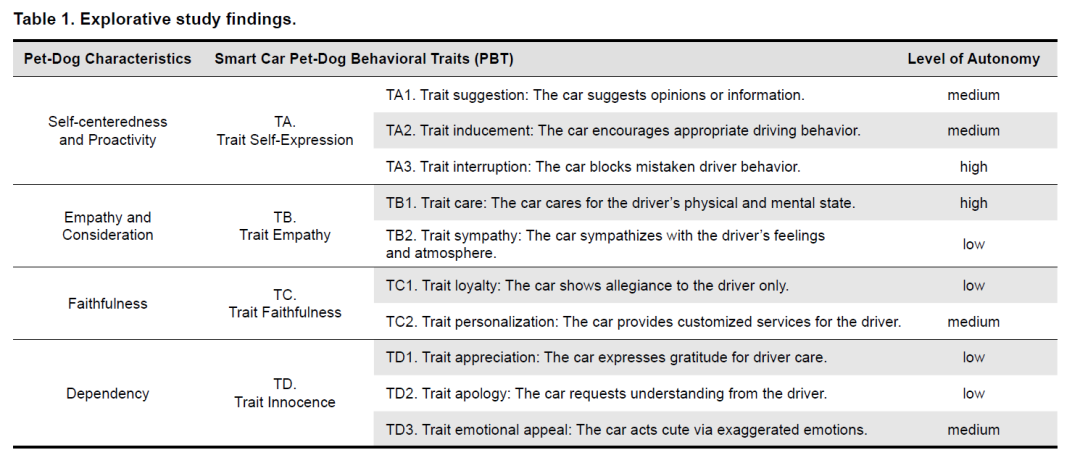
表1:探索性研究结果
07 在驾驶情况下应用PBT的在线调查
Online Survey Applying PBT in Driving Situation
目的和方法
Aim and Method
这项调查研究旨在了解宠物狗的行为特征(PBT)如何应用于智能汽车的用例互动中。我们想弄清楚每个PBT在智能汽车中最理想的使用场景,以及每个PBT如何应用于不同的使用场景,从而使使用场景受到用户欢迎。我们进行了一项在线调查,调查不同PBT在特定驾驶情况下的应用场景是否合适,如果合适,为什么这样的场景更受欢迎。
This survey study aimed to understand how pet-dog behavioral traits (PBT) could be applied to a smart car’s interactions in use cases. We wanted to clarify the most desirable use cases for each PBT in smart cars and how each PBT can be applied to different use cases so that the use scenario is welcomed by users. We conducted an online survey to investigate whether the application scenarios of different PBTs in particular driving situations were appropriate and, if so, why such scenarios were preferable.
调查设计
Survey Design
该调查旨在使用两个独立变量(有10个等级的驾驶情况和有10个等级的PBT)评估100个应用场景。我们在调查中使用 了想象的场景来让用户熟悉新的情况(Finch,1987)。对真实用户情景的选择性表述可以帮助分解真实世界情景中的复杂性和冲突(Hughes & Huby, 2002)。
我们使用智能租车构建了一个短途旅行的叙述,涵盖了汽车使用的各个方面,包括以任务为导向的情况(例如, 加油、听音乐)、由情况决定的情况(例如,第一次见面、返回),或者涵盖一段使用时间(例如,适应)。我们选择了租车的情境,将各种使用情况自然地整合到单日旅行的叙述中。这使我们能够用更现实的情况(如适应和处置)来代替一段时间内的情况(如适应和返回),从而使它们更容易被想象出来。
根据以前的研究(Dula & Geller, 2003; Neale et al., 2002),选择了10种有代表性的驾驶情 况。(S1)第一次坐车,(S2)适应汽车,(S3)跟随汽车指南,(S 4)听音乐,(S5)昏昏欲睡时开车,(S6)超速,(S7)汽车需要加油,(S8)停车,(S9)重新进入汽车和(S10)返回汽车。在选择情境时,我们考虑了现实的和常见的情境(例如,离开汽车)而不是很少经历的情况(例如,丢弃汽车)。我们对模 棱两可的情况(例如,适应汽车)进行了完善,使其得到更具体的描述(例如,学习如何使用汽车)。我们创造了100个应用场景,这些场景是具体的通过使用熟悉的表述方式解释和表达卡通式的插图使参与者可以很容易地理解并沉浸在情景中( 见图1)。我们交叉检查了每个应用场景,以确认它代表了相应的PBT或情况的核心概念。我们确保在提供的插图和描述中相同的特征或情况的表达是统一的。
我们进行了一组试点研究,以优化调查的时间。为了提高可访问性,调查网站允许通过响应式网站从任何设备上访问(Fink,2015)。受访者可以随时停止和继续调查。
受访者使用5点李克特量表表示他们对100个应用场景的偏好(图2)。受访者还被要求评估每个场景的情感质量和实用性。这些分数被用来了解为什么一个特定的场景更受欢迎或不受欢迎。这使我们能够确定一个场景受到欢迎是因为它是令人愉快的,还是因为它拥有一个满足需求的功能。在对某一特定用例的应用场景进行评估后,受访者可以进入下一个场景。用例是按照日常租车使用的顺序组织的,这样受访者就可以按顺序体验每个场景。在每个场景结束时, 参与者被要求选择他们最喜欢的场景,并解释为什么他们在选定的场景中更喜欢某个特定的应用。
我们通过大学和当地社区的公告栏和SNS分发调查链接。受访者可以自愿参与调查,在驾驶经验、年龄、性别或地区方面没有任何条件。我们在调查开始时收集了人口统计信息,并通知参与者,如果他们完成调查,将获得5美元的 奖励(Simsek & Veiga, 2001)。
The survey was designed to evaluate 100 application scenarios using two independent variables (driving situation with 10 levels and PBT with 10 levels). We used imaginary scenarios to familiarize users with novel situations in the survey (Finch, 1987). The selective representation of real user scenarios can help disentangle the complexities and conflicts present in real-world situations (Hughes & Huby, 2002).
We constructed a short-trip narrative using a smart rental car that covered various aspects of car use, including situations that were task oriented (e.g., refueling, listening to music), situationally determined (e.g., first meeting, returning), or covered a period of use (e.g., adaptation). We selected the rental car context to naturally integrate the various use cases into the narrative of a single-day trip. This allowed us to substitute situations over time (e.g., adaptation and disposal) with more realistic situations (e.g., adaptation and returning) so they could be more easily imagined.
The 10 representative driving situations were selected based on previous studies (Dula & Geller, 2003; Neale et al., 2002): (S1) first ride in car, (S2) adjusting to car, (S3) following car guides, (S4) listening to music, (S5) driving while drowsy, (S6) speeding, (S7) car requires fuel, (S8) parking, (S9) reentering car and (S10) returning car. When selecting situations, we considered realistic and commonplace situations (e.g., leaving a car) rather than rarely experienced situations (e.g., discarding a car). We refined ambiguous situations (e.g., adjusting to the car) to be more specifically described (e.g., learning how to use the car).
We created 100 applied scenarios that were concretely explained and expressed in familiar representations by using cartoon-style illustrations so participants could easily understand and immerse themselves in the scenarios (see Figure 1). We crosschecked each application scenario to confirm that it represented the core concept of the corresponding PBT or situation. We ensured that the same traits or situations were expressed uniformly in the provided illustrations and descriptions.
We ran a set of pilot studies to optimize the duration of the survey. For greater accessibility, the survey site allowed access from any device via the responsive website (Fink, 2015). Respondents could stop and resume the surveys whenever they wanted.
Respondents indicated their preferences in 100 application scenarios using 5-point Likert scales (Figure 2). Respondents were also asked to assess the emotional quality and usefulness of each scenario. These scores were used to understand why a particular scenario was more preferred or less preferred. This allowed us to determine whether a scenario was welcomed because it was likely to be enjoyable or because it fulfilled a utilitarian function. After evaluating the application scenarios for a particular use case, respondents could move on to the next situation. The use cases were organized in the order of routine rental car use so that respondents would experience each scenario in a progressive sequence. At the end of each situation, participants were asked to select their favorite scenarios and explain why they preferred a particular application in the selected situation.
We distributed the survey link through bulletin boards and the SNSs of universities and local communities. Respondents could voluntarily participate in the survey and there were no conditions in terms of driving experience, age, sex, or region. We collected demographic information at the start of the survey and notified participants that they would receive a $5 reward if they completed the survey (Simsek & Veiga, 2001).
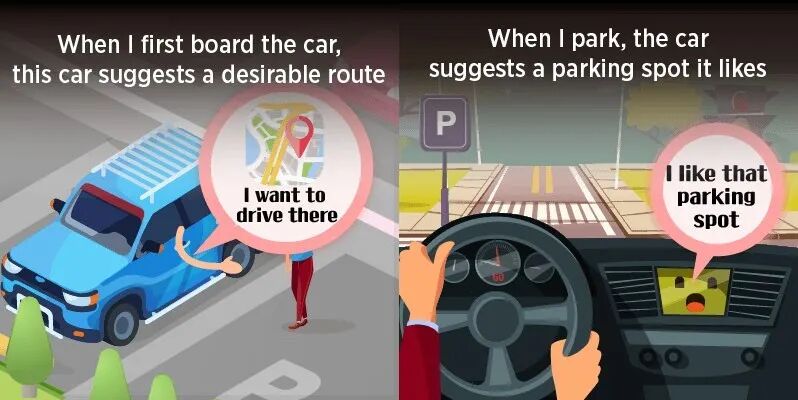
图1:调查的卡通式插图。
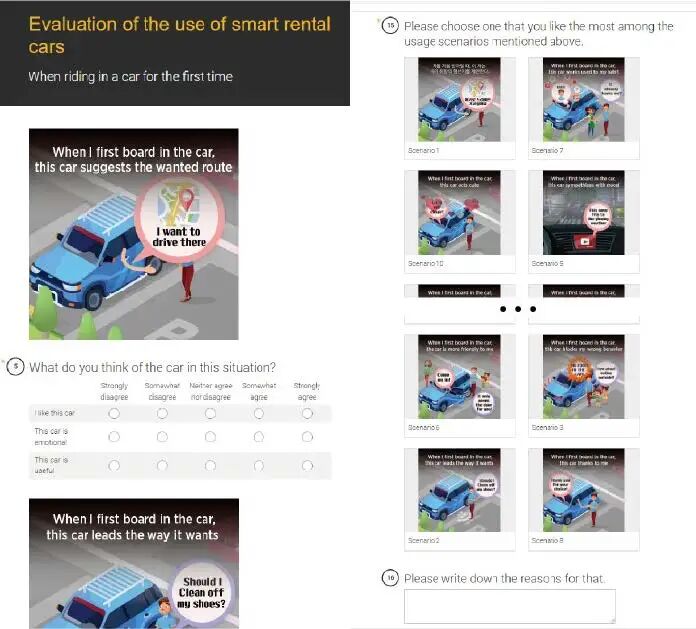
图2:基于网络的响应式调查界面,适用于手机、PC或平板电脑。
数据收集和分析
Data Collection and Analysis
参与者平均花了40分钟来完成在线调查。总共招募了155名受访者;110名参与者(女性=35.5%;男性=64.5%)提供了完整的答复,我们删除了重复的答复。参与者为18-65岁(65%为25-35岁)。参与者报告了不同程度的驾驶经验,从没有经验到超过10年(SD=11.2);47%报告的填写者拥有超过10年的驾驶经验。大多数参与者经常独自开车(82.6%),一半人有自己的车(53%)。
对100个场景中的每个场景的评分进行了收集和打分。这些分数被转换为平均评分,用于统计分析(Norman, 2010)。除了对偏好(最大=4.54,最小=1.68)、情感质量(最大=4.18,最小=2.14)和有用性(最大=4.62,最小=1.6 2)的平均评分外,还收集了关于受访者最喜欢哪些情景以及为什么喜欢这些情景的开放式回答。
使用偏好的平均分数,以特征(10级)和情况(10级)为主体内因素进行双向重复测量方差分析,以评估所有条件下的整体差异。每个应用场景的偏好得分被视为因变量。每个条件的用户反应的平均值(M)和标准差(σ)被计算出来。我们进行了对应分析的事后测试(Tukey),以确定哪种类型的宠物狗行为特征在各种情况下最受青睐。我们对特征和情况进行了分析,以了解作为主体内变量的评分偏好的影响。我们还进行了相关测试,以了解智能汽车互动中的情感质量和有用性与参与者的偏好有多大关联。
我们对最受欢迎的应用场景和相应的开放式回答进行了定性分析。我们研究了这些回答的基本含义,以发现与PBT的核心特征或各自的使用案例相关的参考资料。这使我们在解释统计结果时对基本动机有了更丰富的解释。
Participants took an average of 40 minutes to complete the online survey. A total of 155 respondents were recruited; 110 participants (female = 35.5%; male = 64.5%) provided complete responses and we removed duplicate responses. Participants were 18-65 years old (65% were 25-35). Participants reported varying levels of driving experience, from little experience to over 10 years (SD = 11.2); 47% reported over 10 years of driving experience. Most participants regularly drove alone (82.6%) and half had their own car (53%).
The ratings for each of the 100 scenarios were collected and scored. The scores were converted to average rating scores for statistical analysis (Norman, 2010). Aside from the average rating scores for preference (MAX = 4.54, MIN = 1.68), emotional quality (MAX = 4.18, MIN = 2.14) and usefulness (MAX = 4.62, MIN = 1.62), open-ended responses were also collected regarding which scenarios the respondents preferred the most and why such scenarios were preferred.
Using the average scores for preference, two-way repeated- measures ANOVA was performed with traits (10 levels) and situations (10 levels) as within-subject factors to assess global variance among all conditions. The preference scores for each application scenario were treated as dependent variables. The mean (M) and standard deviation (σ) values of the user responses were calculated for each condition. We conducted a post-hoc test of correspondence analysis (Tukey) to determine which types of pet-dog behavioral traits were most favored in various situations. Traits and situations were analyzed with regard to the influence of the rated preferences as within-subject variables. We also performed a correlation test to understand how much emotional quality and usefulness in smart car interactions correlated with participants’ preferences.
We performed qualitative analysis on the most preferred application scenarios and the corresponding open-ended responses. We examined the underlying meanings of the responses to find references associated with the core characteristics of PBTs or the respective use cases. This led us to richer interpretations of the underlying motivations when interpreting the statistical results.
结果
Results
图3显示了100个应用场景中每个实验条件的偏好因素的平均得分(p = 0.000, < 0.05) ,来自方差分析(表2)。图基事后检验显示,最受欢迎的特质是个性化和关心,而引导和打断是其次。之后是忠诚度、同情和建议。夸奖、道歉和情感诉求特征是最不受欢迎的。皮尔逊相关分析显示,情感质量和有用性都与偏好分数密切相关s [F(2,11385) = 21745.12, p < 0.05, 调整后R2 = .792 (使用Enter方法)]。按照传统的解释标准(Coolican,2017),有用性是一个非常强的预测因素(r=.876),情感质量是一个强的预测因素(r= .636),表明这些方面高度影响应用场景中的偏好。
分析表明,根据情况,哪些类型的宠物狗行为特征( PBT)是首选。它还揭示了为什么一个特定的应用场景通过参考报告的动机而受到青睐。图4提供了每种PBT(前30%的应用场景)的首选驾驶情况概览。下文将详细介绍特征和用例之间的偏好分数关系。
Figure 3 shows the average scores of the preference factors for each experimental condition in the 100 application scenarios (p = 0.000, < 0.05) from the ANOVA (Table 2). Tukey post-hoc tests revealed that the most preferred traits were personalization and care while trait inducement and interruption were the next most preferred. These were followed by loyalty, sympathy and suggestion. The appreciation, apology and emotional appeal traits were the least preferred. The Pearson correlation analysis showed that emotional quality and usefulness were both strongly correlated with preference scores [F(2,11385) = 21745.12, p < 0.05, adjusted R2 = .792, (using the Enter method)]. Following conventional interpretation standards (Coolican, 2017), usefulness was a very strong predictor (r = .876) and emotional quality was a strong predictor (r = .636), indicating that these aspects highly affected preferences in the application scenarios.
The analysis indicated which types of pet-dog behavioral traits (PBT) were preferred according to the situation. It also revealed why a particular application scenario was preferred by referring to the reported motivations. Figure 4 provides an overview of the preferred driving situations for each PBT (top 30% application scenarios). Details on the preference-score relationships between traits and use cases are provided below.
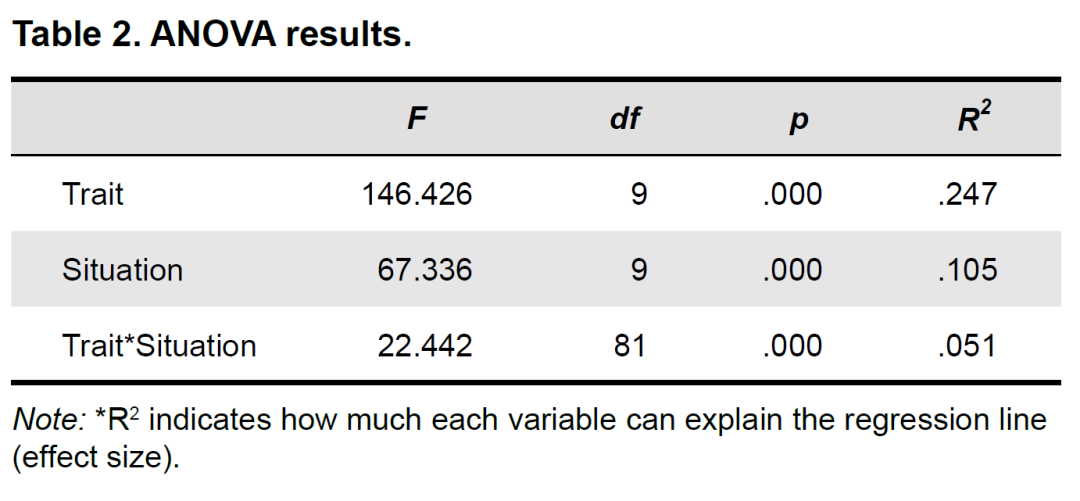
表2:方差分析结果。
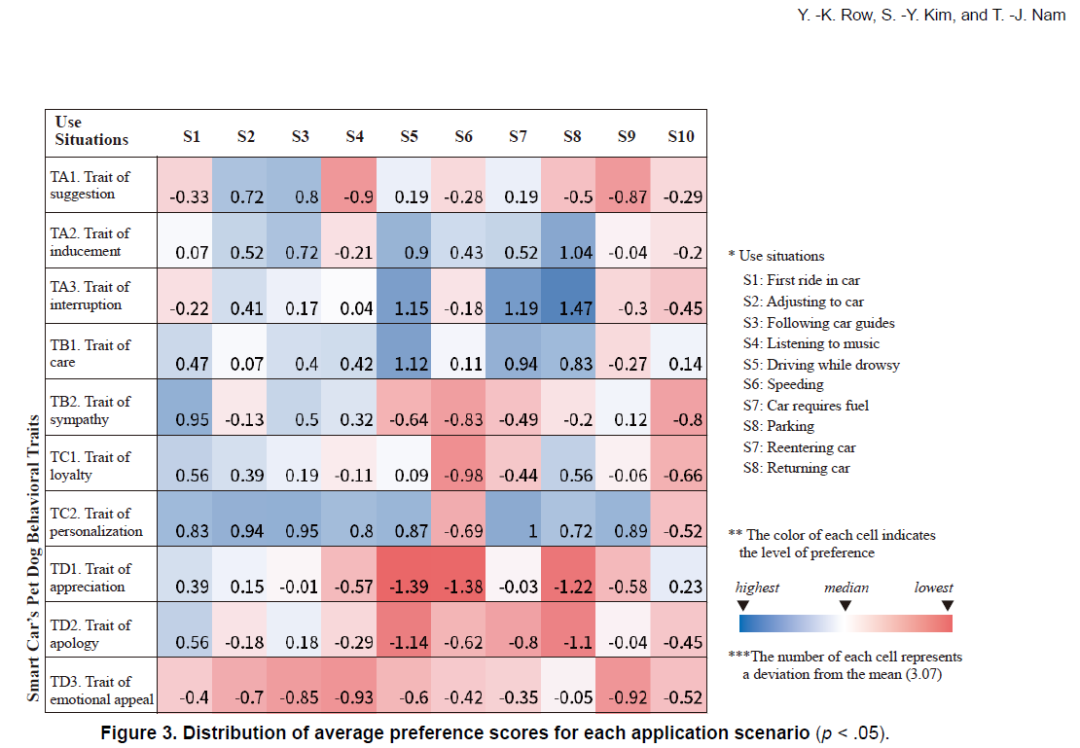
图3:每个应用场景
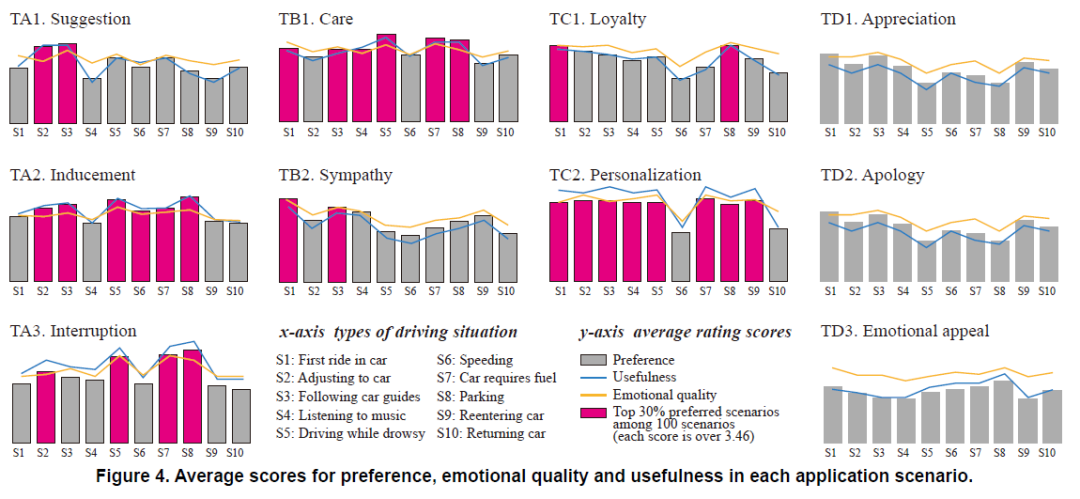
图4:每个应用场景中的偏好、情感质量和实用性的平均得分。
特质自我表达(TA)
当向司机提供新的指导信息时,以及在需要司机采取行动的情况下,特质的自我表达大多是首选。
建议(TA1)
当TA1被应用于驾驶者需要信息的指导情况时,TA1受到了欢迎,汽车及时地提供了有用的信息。最受欢迎的应用场景是当智能汽车呈现出有用的提示(S2,最高17%;得分:3.79)和建议附近的风景名胜(S3,最高15%;得分:3. 87)。一位喜欢这种应用场景的受访者说,这辆车会提供意想不到的乐趣。在需要进行小规模测量的情况下,这种特性也是首选,汽车会轻轻地提示司机。其他高分的应用场景通常涉及智能汽车在各种情况下向司机建议必要的行为,如当司机昏昏欲睡时(S5)或燃料不足时(S7)。
引导(TA2)
这一特点在应用于智能汽车需要司机采取更多基本行动的情况下受到欢迎,例如汽车以平稳和礼貌的方式催促司机采取行动。这方面的例子包括指出测速仪的存在以促使司机减速(S6,最高分26%,得分:3.5)或在可能存在风险的情况下唆使司机采取适当的防卫行动(S8,最高分4%,得分:4.11)。
打断 (TA3)
在危险或可避免的情况下,这种特性受到欢迎。智能汽车唤醒昏昏欲睡的司机的应用场景受到高度青睐(S5,前2%; 得分:4.22)。两个最受欢迎的应用场景涉及防止司机犯错,如放错油(S7,得分:4.54)或不关车门(S8,得分:4.2 6)。
同理心特质(TB)
就同理心而言,在司机情绪消极或环境不愉快的情况下, 关心(TB1)是首选。同情(TB2)在相对随意或与娱乐有关的情况下更受欢迎。结果表明,同理心可以通过提供愉悦的体验,以不同的方式提高驾驶体验的质量。
关心(TB1)
司机处于威胁驾驶安全的精神或身体脆弱状态,而智能汽车大大缓解了这种状况的情况下会受到欢迎。最受欢迎的应用场景包括降低音量,使司机可以集中精力驾驶(S4,最高分27%;得分:3.49),在发生瞌睡时为汽车通风(S5,最高分3%;得分:4.1),以及对司机超速时激动的心情表示关心(S6,得分:3.18)。当司机不舒服或处于不愉快的环境中,而汽车可以帮助解决这个问题时,这种特质也是首选。参与者更喜欢这种特性,以帮助避免加油站的油污臭味( S7,最高分8%;得分:4.01),并确保停车场的能见度(S 8,最高分13%;得分:3.9)。参与者报告说,智能汽车帮助缓解司机的不适的应用场景更有用,并评价它们更可取。这可能解释了为什么S9不受欢迎(最低的38%;得分:2.8),尽管它描绘了一个有问题的情况。这可能是因为在这个应用场景中,智能汽车只是关心司机的感受,而在其他场景中,智能汽车提供的建议可能是真正的解决方案。
同情 (TB2)
这在应用于第一次乘坐或重新进入的情况下,智能汽车向司机发出简单的问候,大多受到欢迎。最受欢迎的应用场景是,在最初的驾驶过程中,智能汽车能够理解司机的心情。(S1, 最高分6%; 得分: 4.02) 或当司机回到车上再次开车时(S9, 得分:3.19)。这一特征在应用于娱乐场合时也受到欢迎,如播放音乐和建议一些意料之外的新内容。例如,当智能汽车推荐听适合天气的音乐时(S3,得分:3.57;S4,得分:3.39),它受到高度欢迎。一位受访者回答说:"如果我的车能把握住气氛, 我会对它印象深刻"。结果表明,这种特质被普遍认为是非常感性的。当这一特质被智能汽车用来回应随意的、不那么个人化的信息(如天气),而不是司机的私人感受时,参与者感到更舒服。对于智能汽车来说,在每一个驾驶情况下表达同情心可能是相当不舒服的。
忠诚度特质(TC)
在忠诚度特质方面,个性化(TC2)是所有特质中最受欢迎的。忠诚度(TC1)没有那么受人喜欢,但仍然表现出相对较高的偏好。忠诚度被证明有利于促进智能汽车的情感和有用方面。这个结果可能是因为这种互动包含了个人因素。当驾驶者进入汽车时,忠诚度是首选,而在驾驶者需要各种信息来支持决策的情况下,个性化则更受青睐。
忠诚度 (TC1)
最受欢迎的应用场景与该特征的登机情况有关。在第一个乘坐场景(S1)中,智能汽车只为司机提供特殊功能(开门),这个应用场景的偏好得分是3.63--属于前20%。参与者认为采用这种特性的智能汽车是非常感性的。他们期待的感觉是受到欢迎,能够炫耀或有一种所有权的感觉。
个性化 (TC2)
这一特征在大多数情况下都受到欢迎。在10个应用场景中的8个中,这一特征被列入前30%。最受欢迎的应用场景是那些司机在做决定时需要考虑各种事情,而汽车提供了适当的指导。例如,参与者喜欢汽车引导司机到熟悉的道路(S3, 得分:4.02),选择司机可能喜欢的音乐(S4,得分:3.87)或根据司机的日程安排引导司机上路(S9,得分:3.96)。
参与者说,这些应用场景是有用的,因为智能汽车可以减少复杂的选择所产生的困难,并根据驾驶者的习惯和口味给他们真正需要的东西。参与者强调,这是该特征有用的最重要原因。回答表明,如果具有这种特征的智能汽车不提供任何适合用户的实用内容,司机可能会感到排斥,觉得他们的隐私受到了侵犯。
纯真特质 (TD)
正如图基检验结果所显示的,纯真在大多数情况下相对不受欢迎。然而,每个特质都有一些突出的首选应用场景。夸奖(TD1)在驾驶完成或司机完成一个动作时,大多受到欢迎。当智能汽车可能给驾驶员带来不适时,道歉(TD2)受到欢迎;当智能汽车需要驾驶员采取行动时,情感诉求(TD3)受到青睐。所有首选应用场景的情感质量都得到了高度评价。
夸奖(TD1)
在第一次进入和离开汽车时(S1和S10,分数排在前30%左右),以及司机给汽车加油时(S7),都喜欢这种特质。一位受访者回答说:"如果一辆智能汽车表现出花哨的问候, 那么它就值得油价!"
道歉(TD2)
当智能汽车可能造成不适,它要求原谅时,这是首选。受欢迎的情况包括:当智能汽车警告司机可能带来的不便时(S1,得分:3.63),当汽车因为恶劣天气传感器不稳定时(S3,得分:3.25),以及当汽车告诉司机座位太热而不能坐时(S9,得分:3.03)。参与者说,这些场景是情绪化的,因为汽车帮助他们采取更轻松的心情,并通过预测可能的不愉快而让他们舒服。特别是当汽车实质性地帮助司机提前处理某种情况以及不舒服的情况时,司机们就更喜欢了。对已经经历的不便的道歉则不太受欢迎。例如,在司机不可能提前做出反应的应用场景中,尽管智能汽车注意到了这种不便,但它也相对不受欢迎(S2,得分:2.89)。
情感诉求(TD3)
在智能汽车需要采取行动并告诉司机它需要什么的情况下, 这种特征受到欢迎。例子包括智能汽车做出惊恐的表情来让司机不要超速(S6),或者在停车时受到陌生人的威胁时表现出恐惧的表情(S8)。这些应用场景通过表达拟人化的情绪,如恐惧或惊吓,来引导司机采取行动。在不需要司机帮助的情况下,汽车不太表现出可爱或表现出亲密的反应。
Trait Self-Expression (TA)
Trait self-expression was mostly preferred when providing novel guiding information to the driver and in situations requiring action by the driver.
Suggestion (TA1)
TA1 was welcomed when it was applied to the guidance situation where drivers required information and the car presented useful information in a timely manner. The most welcomed application scenarios were when the smart car presented useful tips (S2, top 17%; score: 3.79) and suggested scenic spots nearby (S3, top 15%; score: 3.87). One respondent who liked this application scenario said this car would provide unanticipated pleasure. This trait was also preferred in situations where minor measurements were needed and the car would lightly prompt the driver. Other high-scoring application scenarios commonly involved the smart car suggesting necessary behaviors to the driver in various contexts such as when the driver is drowsy (S5) or when fuel is low (S7).
Inducement (TA2)
This trait was welcomed when applied to situations where a smart car required more essential actions from drivers, such that the car prompted driver action in a smooth and courteous way. Examples included pointing out the presence of a speed camera to induce the driver to slow down (S6, top 26%, score: 3.5) or instigating the driver to perform an appropriate defensive action where risk may be present (S8, top 4%, score: 4.11).
Interruption (TA3)
This trait was welcomed in hazardous or avoidable situations. The application scenario where the smart car wakes up a drowsy driver was highly preferred (S5, top 2%; score: 4.22). The two most preferred application scenarios involved keeping the driver from making mistakes such as putting in the wrong oil (S7, score: 4.54) or leaving the door open (S8, score: 4.26).
Trait Empathy (TB)
In terms of trait empathy, care (TB1) was preferred in situations where the driver was in a negative mood or unpleasant environment. Sympathy (TB2) was preferred in relatively casual or entertainment-related situations. The results indicated that empathy traits can be used to improve the quality of driving experience in different ways by providing pleasurable experiences.
Care (TB1)
This was welcomed in situations where the driver was in a mentally or physically vulnerable condition that threatened driving safety and the smart car substantially alleviated it. Highly preferred application scenarios included reducing volume so the driver could concentrate on driving (S4, top 27%; score: 3.49), ventilating the car when drowsiness occurred (S5, top 3%; score: 4.1) and showing concern for a driver’s agitated mood when speeding (S6, score: 3.18). This trait was also preferred when a driver was uncomfortable or in an unpleasant environment and the car could help solve the problem. Participants preferred this trait to help avoid oil stenches in gas stations (S7, top 8%; score: 4.01) and to ensure visibility in parking lots (S8, top 13%; score: 3.9). Participants reported that application scenarios where the smart car helped alleviate the driver’s discomfort were more useful and evaluated them as more preferable. This probably explains why S9 was not welcomed (lowest 38%; score: 2.8) despite the fact that it portrays a problematic situation. This was likely because in this application scenario, the smart car was simply concerned with the drivers’ feelings while in other scenarios the smart car provided suggestions that could be real solutions.
Sympathy (TB2)
This was mostly welcomed when applied to the first riding or reentering situations and the smart car extended a simple greeting to the driver. The most preferred application scenarios depicted a smart car that understood the driver’s mood during the initial drive (S1, top 6%; score: 4.02) or when the driver returned to the car to drive again (S9, score: 3.19). This trait was also welcomed when applied to entertainment situations such as playing music and unexpectedly suggesting new content. For example, when a smart car recommended listening to music appropriate to the weather (S3, score: 3.57; S4, score: 3.39), it was highly welcomed. One respondent answered, “If my car grasps the atmosphere, I will be impressed.” The results indicated this trait was commonly felt as very emotional. Participants felt more comfortable when this was trait was used by smart cars responding to casual and less personal information (e.g., weather) rather than the driver’s private feelings. For a smart car to express sympathy in every driving situation could be rather uncomfortable.
Trait Faithfulness (TC)
In terms of trait faithfulness, trait personalization (TC2) was the most preferred among all traits. Trait loyalty (TC1) was not liked as much but still showed relatively high preference. Trait faithfulness was shown to be conducive to promoting both emotional and useful aspects of smart cars. This result might be because such interactions comprised personal elements. Loyalty was preferred when a driver was entering the car while personalization was more preferred in situations where a driver required various information to support decision making.
Loyalty (TC1)
The most preferred application scenarios were related to boarding situations for this trait. In the first riding scenario (S1), where a smart car provides special features (opens the door) only for the driver, the preference score of this application scenario was 3.63–among the top 20%. Participants considered a smart car that employed this trait as very emotional. They expected feelings such as being welcomed, being able to show off or having a sense of ownership.
Personalization (TC2)
This trait was welcomed in most situations. In eight of the 10 application scenarios, this trait was included in the top 30%. The most welcomed application scenarios were those in which the driver had various things to consider in making a decision and the car provided suitable guidance. For example, participants liked it when the car guided the driver to a familiar road (S3, score: 4.02), selected music the driver might like (S4, score: 3.87) or guided the driver on the road in accordance with the driver’s schedule (S9, score: 3.96).
Participants said these application scenarios were useful because the smart car could reduce difficulties produced by complicated choices and give drivers what they truly needed based on their habits and tastes. Participants emphasized that this was the most important reason why the trait was useful. Reponses indicated that if a smart car with this trait did not offer any practical content that was appropriate for users, drivers might be repelled, feeling their privacy had been violated.
Trait Innocence (TD)
Trait innocence was relatively less welcomed in most situations, as indicated by the Tukey test results. However, there were some prominently preferred application scenarios for each trait. Appreciation (TD1) was mostly welcomed when driving was completed or a driver was completing an action. Apology (TD2) was welcomed where a smart car might cause discomfort to the driver and emotional appeal (TD3) was preferred where the smart car required the driver’s action. All preferred application scenarios were highly evaluated for their emotional quality.
Appreciation (TD1)
This trait was preferred when first entering and exiting the car (S1 and S10, scores ranked around the top 30%), as well as when the driver refueled the car (S7). A respondent answered, “If a smart car shows fancy greetings, it is worth the price of oil!”
Apology (TD2)
This was preferred when a smart car might have caused discomfort and it asked to be excused. Welcomed situations included when the smart car warned the driver about a potential inconvenience (S1, score: 3.63), when the car asked for understanding about the functioning of an unstable sensor caused by bad weather (S3, score: 3.25) and when the car told the driver the seat was too hot to sit in (S9, score: 3.03). Participants said these scenarios were emotional because the car helped them to take on a more relaxed mood and be generous by anticipating possible unpleasantness. In particular, it was more preferred when the car substantially helped the driver deal with a situation in advance as well as acknowledged an uncomfortable circumstance. Apologies for inconveniences already experienced were less welcomed. For example, in application scenarios when it was impossible for the driver to react in advance, it was also relatively less welcomed, despite the smart car noticing the inconvenience (S2, score: 2.89).
Emotional Appeal (TD3)
This trait was welcomed in situations where the smart car required action and told the driver what it needed. Examples included the smart car making frightened expressions to encourage the driver not to speed (S6) or showing fearful face when security might be threatened by a stranger while parking (S8). These application scenarios appealed to drivers to take action by expressing anthropomorphized emotions such as fear or fright. It was less preferred for cars to act cute or show intimate reactions when driver assistance was not required.
08 讨论
Discussion
PBT在智能汽车使用中的交互设计的应用
PBT's Application to Interaction Design in Smart Car Use
自我表达(TA) 根据用户的行为在干预程度上有所不同。T A可以根据情况的紧急程度来使用。建议(TA1)适合于在低紧急状况下推荐行为,如需要洗车或检查。引导(TA2)可以应用在必须采取行动但不紧急的情况下。TA2可以温和地引导司机采取他不愿意做的正确行动。一辆智能汽车可以通过强调缺点或惹恼司机来引导司机系上安全带或放慢速度。打断(TA3)适合于司机必须正确行动的紧急情况。例如,如果一个醉酒的司机试图启动汽车,启动按钮可以被隐藏起来。
同情心(TB) 可用于智能汽车主动或被动地根据司机的情绪状态提供反馈的情况。关心(TB1)适用于司机处于情绪不稳定状态或不舒服的环境的情况下。一辆智能汽车可能会鼓励一个紧张的司机,并更详细地引导道路。同情(TB2)可以在轻松和积极的情况下应用,以缓和气氛。例如,智能汽车可以播放与周围环境相匹配的背景音乐,丰富旅行的内容。
忠诚(TC) 可能适用于利用个性化服务的情况。忠诚度(TC1)将适用于休闲和轻松的情况,如令人满意的活动和专门为车主定制的行为。一辆智能汽车会记住经常上车的乘客,并播放他们在一起时听的歌曲。个性化(TC2)可以在提供反映个人信息的便利信息时加以利用。例如,当司机需要做出决定时,智能汽车可以提出合适的备选方案,或者它可以自动确定并执行最佳方案。它可以只缩小选择范围,让司机做出最后的选择。
纯真(TD) 可用于娱乐性的互动。夸奖(TD1)可以有效地利用来加强用户的努力。道歉(TD2)在由于环境变化或汽车功能受损而预计出现不便时是合适的,这样司机就可以做好准备。情感诉求(TD3)可以帮助在可能的困难情况下顺利地诱导司机的行为,需要司机采取行动,如需要支出或艰苦的行为时。它也可以帮助在司机的安全可能受到影响的情况下,快速和可靠地提供必要的行动。T D3可以吸引司机的注意力,并以更直观的方式传递信息。
当所有的PBT被应用于智能汽车时,当它们涉及到有用的、有趣的或好玩的互动时,它们特别受到参与者的欢迎。当个人信息没有被用于有用的互动时,参与者对智能汽车对私人信息的访问感到不舒服。过度使用没有实际意义的玩乐互动,会让司机觉得互动是负担,干扰驾驶。
Self-expression (TA) varied in the degree of intervention according to user behavior. TA can be used according to the urgency of the situation. Trait suggestion (TA1) would be appropriate for recommending behavior in low-urgency situations, such as the need for a car wash or an inspection. Trait inducement (TA2) can be applied in situations where it is imperative to take action but is not an emergency. TA2 can gently lead a driver toward correct action that the driver is reluctant to do. A smart car can induce a driver to fasten the seatbelt or slow down by emphasizing the disadvantages or annoying the driver. Trait interruption (TA3) is appropriate in emergency situations where the driver must act correctly. For example, if a drunk driver attempts to start the car, the start-up button can be concealed).
Empathy (TB) can be used in situations where smart cars actively or passively provide feedback according to the driver’s emotional state. Trait care (TB1) would be appropriate when applied to situations where the driver is in an emotionally unstable state or uncomfortable environment. A smart car might encourage a nervous driver and guide the way in more detail. Trait sympathy (TB2) can be applied in a light and positive situation to soften the atmosphere. For example, a smart car can play background music that matches the surroundings and enriches the trip.
Faithfulness (TC) may be applicable in situations where personalized services are utilized. Trait loyalty (TC1) would be appropriate in casual and light situations, such as events that are gratifying and behavior that is specifically tailored to the owner. A smart car would remember passengers who board frequently and play songs they listen to while together. Trait personalization (TC2) can be utilized when providing convenient information that reflects personal information. For example, the smart car could present suitable alternatives when a driver needs to make a decision or it could automatically determine and execute the optimal option. It could only narrow the options and let the driver make the final choice.
Innocence (TD) can be used for amusing interactions. Trait appreciation (TD1) can be effectively utilized to strengthen users’ efforts. Trait apology (TD2) would be appropriate when inconveniences are expected due to environmental changes or compromised car function so the driver can prepare. Trait emotional appeal (TD3) can help to smoothly induce driver behavior in possibly difficult situations that require action from the driver such as when expenditure or arduous behavior are needed. It can also help to quickly and reliably deliver necessary actions in situations where the driver’s safety may be compromised. TD3 can draw attention to the driver and deliver the message in a more intuitive way.
When all PBTs were applied to smart cars, they were particularly welcomed by participants when they involved useful, fun or playful interactions. Participants felt uncomfortable with smart cars’ access to private information when personal information was not utilized for useful interactions. Overusing playful interactions without practical merit can make drivers feel that the interactions are burdensome and interfere with driving.
PBT在驾驶情况下的应用与自主性的关系
PBT’s Application to Driving Situations as a Function of Autonomy
智能汽车根据使用情况需要不同程度的自主互动(Moite,1 992;Rödel等人,2014)。我们表明,PBT可以分为三个层次的自主性。图5阐述了PBT的自主性水平,其基础是积极性,即系统是独立于用户操作还是应用户要求操作(Parasuraman等人,20 00;Parasuraman和Riley,1997)和可控性,即系统是直接影响用户行为还是通过激励间接影响用户行为(Blumberg和Galyean,1995)。深化先前的发现,我们提出在智能汽车互动中根据三个层次的自主性来适当使用PBT。
图5显示了PBT的自主性水平与驾驶情况类型之间的理想关系,这取决于关键程度。高度自主的特征在关键情况下是合适的,以防止不正确的驾驶行为或保护驾驶员。方便的功能也可以自动提供,如自动座椅调整。涉及驾驶者行动的半自主特征可以包括在交通堵塞时建议替代路线,驾驶者可以忽略或接受。在智能汽车只是报告发生了什么的情况下, 依赖性特征是足够的。随后的判断和行动可以完全由司机决定。这些可以用来表达社会和情感反馈,以增加用户的乐趣。例如,汽车可以根据司机的情绪或天气提供问候。
图5意味着PBT的自主性水平与情况的紧迫性呈正相关。情况越紧急,需要的行动越多,高自主性的PBT就越有效。同时,低自主性的PBT适用于非紧急状况。为了确保与智能汽车的理想互动,司机应该接受偶尔的自主性的汽车,并及时放弃一部分驾驶控制权(Rödel等人,2014)。PBT可以通过创造反映不同程度的自主权的互动来支持这种过渡,以适应不同程度的情景紧迫性。
A smart car requires various levels of autonomous interaction depending on the use case (Moite, 1992; Rödel et al., 2014). We showed that PBT can be divided into three levels of autonomy Elaborated in Figure 5 are PBT’s autonomy levels based on activeness, whether a system operates independently of the user or operates at the user’s request (Parasuraman et al., 2000; Parasuraman & Riley, 1997) and controllability, whether it directly affects user behavior or indirectly affects it through motivation (Blumberg & Galyean, 1995). Deepening prior findings, we proposed appropriate PBT use according to three levels of autonomy in smart car interactions.
Figure 5 shows the desired relationship between the autonomy level of PBT and the types of driving situations depending on the degree of criticality. Highly autonomous traits would be appropriate in critical situations to prevent incorrect driver behavior or to protect the driver. Convenient functions can also be provided automatically, such as automatic seat adjustment. Semiautonomous traits that would involve driver action could include suggesting alternative routes in a traffic jam, which the driver could ignore or accept. Dependent traits are adequate in situations where the smart car simply reports what has happened. Subsequent judgments and action could be entirely up to the driver. These can be used to express social and emotional feedback to increase user enjoyment. For example, the car could provide greetings according to the driver’s mood or the weather.
Figure 5 implies that the autonomy level of PBT positively correlates with the urgency of the situation. The more urgent the situation and the required action, the more effective high- autonomy PBT will be. Meanwhile, low-autonomy PBT is appropriate in noncritical situations. To ensure ideal interaction with a smart car, drivers should accept the occasional autonomy of the car and relinquish a part of driving control timely (Rödel et al., 2014). PBT could support this transition by creating interactions that reflect various levels of autonomy in accordance with different degrees of situational urgency.
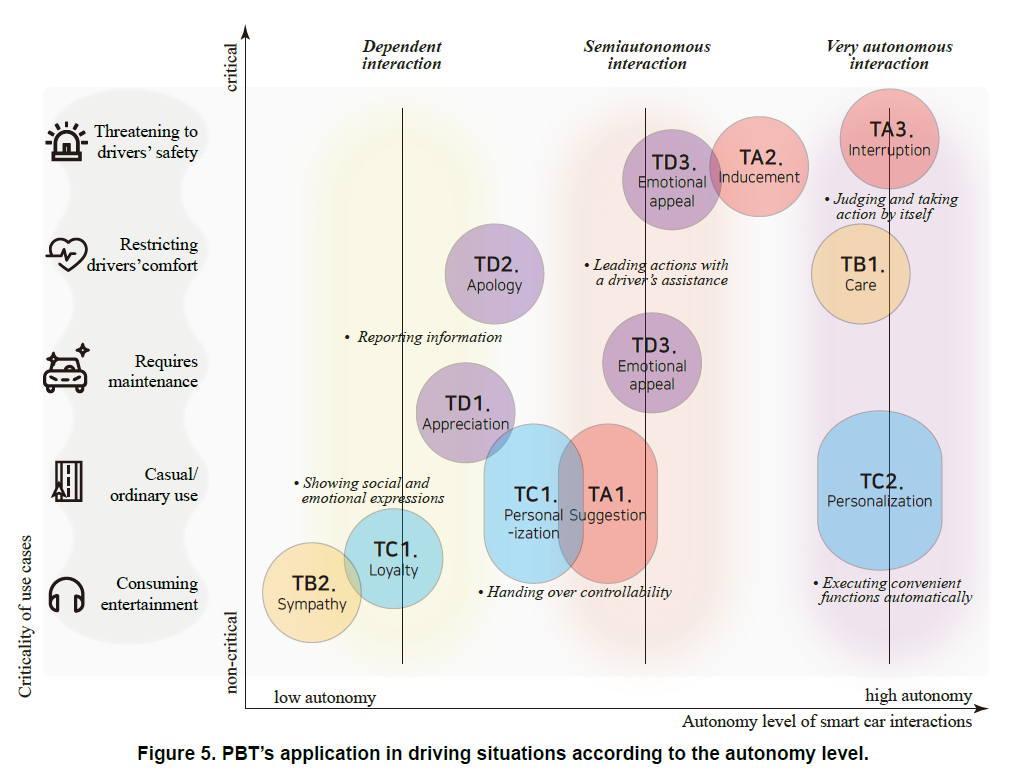
图5:根据自动驾驶水平,PBT在驾驶情况下的应用。
PBT如何增强情感化的智能汽车用户体验?
How PBT Can Enhance Emotional Smart Car User Experience?
研究2的结果表明,带有PBT的智能汽车可以支持与用户的亲密互动,在四个方面产生情感体验。首先,PBT可以通过与司机的间接沟通,使不情愿的互动变得可接受和有利。其次,PBT可以通过互利的互动加强与汽车的情感联系。狗主人在得到狗的协助的同时,也在狗身上花费了精力,这是建立情感默契的重要方式(Dotson & Hyatt, 2008; Sanders, 1993)。互惠互动的持续体验可以培养和发展与智能车的感情和亲密关系。第三,PBT可以在主动和生活化的互动方面提供令人愉快的体验。当汽车推荐新的内容或传达表现出自由意志或情感的信息时,用户可以从这种丰富、动态和意外的体验中获得快乐。最后,PBT可以通过诱导对智能汽车的低期望值和慷慨的态度来提高情感满意度。鉴于智能汽车的挑战来自于对智能汽车能力的不满意,用户期望的冲突和用户技能的退化(Casner等人,2016),需要车主照顾的PBT可以通过唤起责任感和仁慈,有助于使用智能汽车的情感满足。与作为情感代理人的智能汽车进行长时间的亲密互动可以提高用户的满意度。
The findings of Study 2 suggest that smart cars with PBT could support intimate interactions with users that produce emotional experiences in four ways. Firstly, PBT can make unwilling interactions acceptable and favorable by communicating with drivers in indirect ways. Secondly, PBT can enhance emotional bonding with a car through mutually beneficial interactions. Dog owners are assisted by their dogs while also expending effort on their dogs, which is an important way of building emotional rapport (Dotson & Hyatt, 2008; Sanders, 1993). The continuous experience of reciprocal interaction can foster and develop affection and intimacy with a smart car. Thirdly, PBT can provide delightful experiences in terms of proactive and lifelike interactions. When a car recommends new content or conveys information exhibiting free will or emotion, users can derive pleasure from this rich, dynamic and unexpected experience. Lastly, PBT can enhance emotional satisfaction by inducing low expectations and generous attitudes toward a smart car. Given that challenges for smart cars arise from dissatisfaction with smart car abilities conflicting user expectations and the deterioration of user skill (Casner et al., 2016), PBT requiring the owner’s care can contribute to the emotional satisfaction of using smart cars by arousing responsible and benevolent attitudes. Prolonged intimate interactions with smart cars that are emotional agents can enhance user satisfaction.
09 局限性和未来工作
Limitations and Future Work
关于访谈,考虑到招募方法和地点,结果可能反映了参与者对其宠物狗有更多的积极情感或高估狗的倾向。PBT可能不会在其他群体中产生相同程度的情感体验。喜欢动物或可爱事物的用户会更欣赏宠物形态的互动。同时基于养狗和未养狗的的调查结果在一定程度上支持了这种观点。特质性纯真一般不受欢迎,它的情感品质高于它的有用性。此外,最受欢迎的个性化,比情感化的有用性得分更高。据推测,由于参与者对狗的不同偏好,情感型PBT一般不会获得高分。因此,PBT的应用范围可能更多地取决于设计背景或目标用户。至于非养狗人,高实用性的特质可能更适用。此外,通过考虑我们对适当的应用相关性的建议,将有可能设计出能让养狗人和非养狗人都认同的互动。
就调查而言,驾驶情况仅限于短期租赁汽车的使用背景。尽管存在着各种使用情况,但这并没有涵盖智能汽车的所有潜在使用环境。为了涵盖这些情况,我们可能需要进一步研究,将PBT应用于私人智能汽车的使用。在私人使用环境中应用PBT时,也有可能考虑到用户的态度随时间变化或反映个人特征。此外,该调查是基于想象中的场景,而不是真实的情况。为了减轻这个缺点,我们选择了一个具体的环境(租车使用)。然而,除了每个场景的特殊情况外,还有可能影响参与者的评价。为了解决这个问题,我们提供了插图来帮助参与者清楚地理解应用场景。在分析结果时,我们考虑了这种情况可能存在的限制,并排除了一些参与者没有正确理解应用场景的情况。在未来的工作中,我们将对一些首选的应用场景进行进一步的实证研究或访谈。
由于样本量有限,我们没有考虑到参与者的人口统计学或驾驶经验的差异。因此,未来的研究还有空间来发现用户特征方面的有意义的差异,如性别或驾驶经验。
在这项研究中,我们展示了归因于宠物狗的宠物形态的行为特征。我们的研究结果之一显示,参与者预期宠物形态的代理人不能完全自己工作,需要主人的照顾。可以看出,宠物形态的汽车与智力方面的低预期有关。这种解释与类似宠物的智能产品所具有的智能而愚蠢的特点相一致(Row & Nam, 2014)。鉴于放大的产品可能会导致对功能的高估,甚至是对安全问题的高估(Bartneck, Kulic, &Croft, 2008),我们假设不同的动物模型会影响用户与智能产品互动的不同方面。了解这些变量与智能产品互动之间的关系, 包括用户的期望,将是一个有趣的未来研究课题。
在未来的工作中,PBT的设计意义及其在驾驶情况下的应用可以作为设计思维的辅助工具进一步发展。需要进行后续研究以了解这些辅助工具对于智能汽车交互设计的过程是否有效。未来的研究还可以将PBT应用到智能汽车设计中,以验证它对设计实践是否有用。将需要进行智能汽车交互原型设计,以了解应用PBT作为交互方式的困难。还需要进行系统的用户研究,以实质性地验证每个特质对情感体验的影响。
Regarding the interviews, given the recruiting methods and locality, the results might reflect participants’ tendency to have more positive feelings for their pet dogs or to overestimate the dogs. PBT might not generate an affective experience to the same degree in other groups. Users who love animals or cute things would appreciate petmorphic interactions more. The survey findings, performed regardless of whether raising a dog or not, support to some extent this understanding. Trait innocence was generally less welcomed and its emotional quality was higher than its usefulness. Otherwise, personalization, the most widely welcomed, showed a higher usefulness score than the emotional one. It was assumed that the emotional PBT generally did not gain high scores due to participants’ different preference for dogs. As such, the range of PBT applications might depend more on the design context or target user. As for non-dog owners, the trait of high usefulness can be more applicable. In addition, by considering our suggestions on the appropriate application correlation, it will be possible to design interactions that can be agreeable to both dog owners and non-owners.
In terms of the survey, the driving situations were confined to the context of short-term rental car use. Despite various aspects of use cases, this does not cover all potential use contexts of smart cars. To generalize the findings, further research might be needed that applies PBT to private smart car use. It is also possible to consider user attitudes changing over time or reflecting individual characteristics when applying PBT in private use contexts. Moreover, the survey was based on imagined scenarios and not real situations. To mitigate this weakness, we selected a concrete context (rental car use). There is, however, the possibility that factors aside from the particular circumstances of each scenario affected participants’ evaluations. To address this, we provided illustrations to help participants clearly understand the application scenarios. We considered this possible limitation when analyzing the results and excluded some cases where participants did not properly understand the application scenario. In future work, we will conduct further empirical studies or interviews on some of the preferred application scenarios.
Due to the limited sample size, we did not account for differences in participant demographics or driving experience. Thus, there is room for future research to discover meaningful differences in terms of user characteristics such as gender or driving experience.
In this study, we demonstrated petmorphic behavioral traits attributed to pet dogs. One of our findings showed that participants anticipated the petmorphic agent not working entirely by itself and requiring the owner’s care. It can be seen that petmorphic cars are associated with low expectations in terms of intelligence. This interpretation aligns with the smart-but-dumb feature that characterizes pet-like smart products (Row & Nam, 2014).
Given that zoomorphic products might lead to overestimation on functionalities and even safety-critical issues (Bartneck, Kulic, & Croft, 2008), we assume that different animal models will affect different aspects of the user interactions with smart products. Understanding the relationship between these variables and the smart product interactions, including users’ expectation, would be an interesting future research topic.
In future work, the design implications of PBT and its applications to driving situations can be further developed as assistive tools for design thinking. Follow-up studies are needed to see if these assistive tools are effective for the process of smart car interaction design. Future research could also apply PBT to smart car design to verify that it is useful for design practice. Smart car interaction prototyping will be required to understand the difficulties in applying PBT as an interaction. A systematic user study is also needed to substantively verify the effects of each trait on emotional experiences.
10 总结
Conclusion
这项研究调查了使用宠物形态方法来设计智能汽车中的亲密互动。这项研究有三个具体贡献。首先,我们确定了四种提高用户情感体验的宠物狗行为特征(PBT):自我表达、 同理心、忠诚和纯真。其次,我们展示了哪些智能汽车情况最适合哪种PBT的特定应用,其中个性化特质最受欢迎,这特别适合于提供反映个人信息的最佳服务。纯真的特质相对不受青睐,尽管它可以用于有趣的互动。第三,我们对PBT自主性水平和情境中的紧迫性水平之间的积极关系的讨论可以指导设计师如何在设计实践中利用PBT。我们还讨论了利用PBT增强和提高用户对智能汽车的情感体验的潜力。这项研究可以为未来的智能汽车和驾驶员之间的亲密关系提供一个新的视角,即这种互动如何发生。
PBT可以应用于许多其他采用人工智能或代理形式的智能产品和系统中的人机互动。我们希望我们对宠物形态设计的理解和它在智能汽车环境中的应用能够为设计未来的智能产品和系统提供一个有用的方法,使其在人与机器的互动中更具有情感敏感性、更加自然和更令人愉悦。
This study investigated using a petmorphic approach for designing intimate interactions in smart cars. This research makes three specific contributions. Firstly, we identified four types of pet-dog behavioral traits (PBT) that enhance users’ emotional experiences: self-expression, empathy, faithfulness and innocence. Secondly, we showed which smart car situations are most suited for the particular application of each PBT with the personalization trait being the most welcomed; this is particularly appropriate for providing optimal services reflecting personal information. Trait innocence was relatively less favored, though it can be used for amusing interactions. Thirdly, our discussion of the positive relationship between PBT autonomy levels and urgency levels in situations can guide designers on how to leverage PBT in design practice. We also discussed the potential of enhancing and increasing users’ emotional experiences with smart cars using PBT. This research can provide a new perspective on the intimate relationship between future smart cars and drivers in terms of how such interaction can take place.
PBT can be applied to human–machine interactions in numerous other smart products and systems that employ AI or a form of agency. We expect our understanding on petmorphic design and its adoption in smart car contexts can provide a useful approach for designing future smart products and systems to be more emotionally sensitive, natural and pleasurable in human– machine interactions.
ABOUT US
参考文章:
Using Pet-Dog Behavior Traits to Enhance the EmotionalExperience of In-Car Interaction
作者:
Yea-Kyung Row, Se-Young Kim, and Tek-Jin Nam
译者:糖醋排菇
为尊重版权和译者
转载请联系我们